


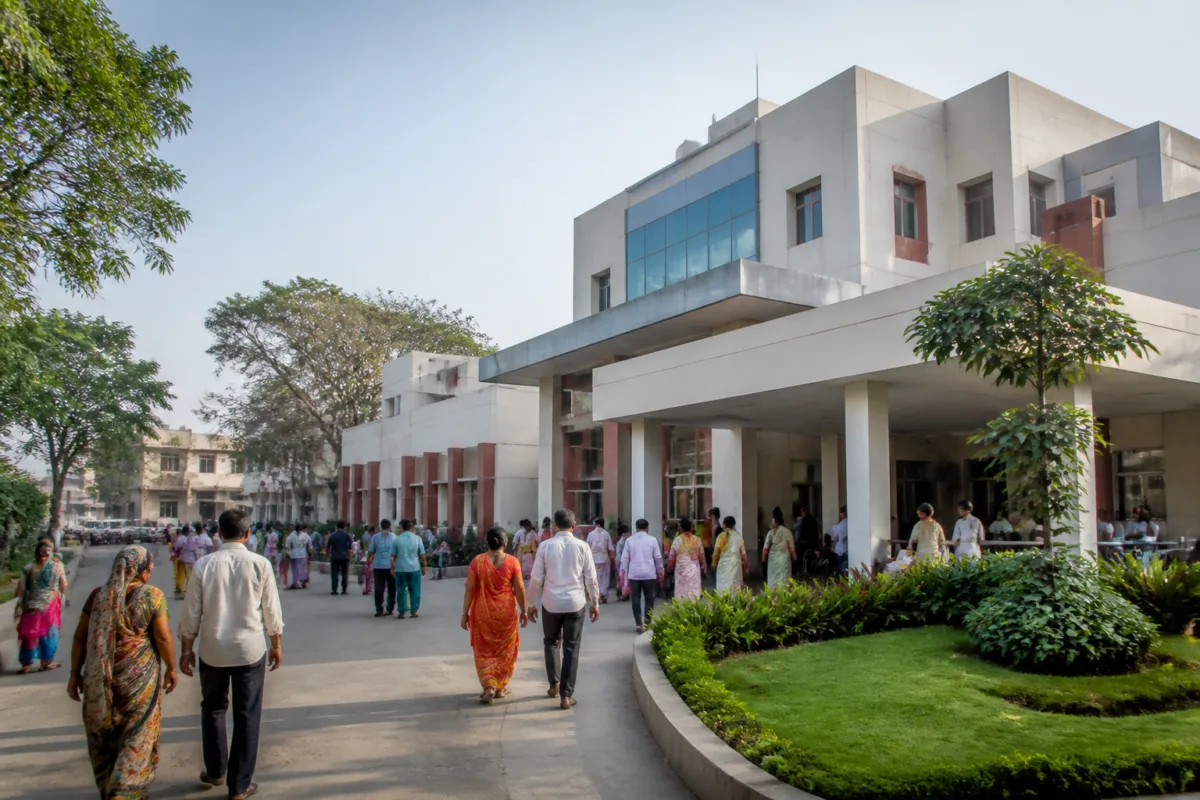
Tata Trusts’ plan to develop a network of 40 to 50 not-for-profit general hospitals marks a shift from philanthropy measured mainly by spending and reach towards philanthropy judged by the institutions it leaves behind. The proposal, disclosed by Chairman Noel Tata in the Trusts’ Annual Report for 2025-26, places healthcare infrastructure at the centre of a broader question: can private philanthropic capital create durable public assets that expand access without reproducing the inequalities of commercial healthcare?
The scale of the ambition is notable, but the available details also show what remains unresolved. The Trusts have not disclosed the hospitals’ locations, investment requirement or implementation timeline. The plan is therefore not yet a construction programme with clearly defined delivery milestones. It is, instead, an institutional direction linked to a wider health strategy for 2026-2031 and to the Trusts’ stated preference for building systems and organisations that continue to produce public value over time.
That distinction matters in healthcare. A hospital is not only a building with beds and equipment. It requires medical staff, referral networks, diagnostic capacity, recurring operating expenditure, governance systems and a financing model that can keep services accessible. Noel Tata said patients who can afford to pay would help fund care for those who cannot, indicating a cross-subsidy model in which paying patients support treatment for economically vulnerable patients. The report does not provide the proposed ratio of paying to subsidised patients, the services to be covered or the financial safeguards that would govern the model.
The proposed hospitals must therefore be read alongside the Trusts’ existing health work rather than as a standalone real estate expansion. In FY26, the Trusts disbursed Rs 1,556.31 crore. Institutional grants and direct project spending accounted for Rs 1,353.32 crore, while individual grants totalled Rs 202.99 crore. Rural upliftment received the largest allocation at Rs 457.62 crore, followed by education at Rs 270.26 crore, cancer care at Rs 178.46 crore, institutions at Rs 169.31 crore and healthcare at Rs 105.97 crore.
Water and sanitation received Rs 59.04 crore, while nutrition received Rs 57.64 crore. Individual grants were concentrated in medical assistance, at Rs 143.30 crore, and education, at Rs 59.38 crore. These figures show that the Trusts’ health-related role already spans several layers: direct help to individuals, programme spending, cancer treatment and institutional development. The proposed general hospitals would add a more permanent physical and organisational layer to that portfolio.
The Trusts’ health strategy for 2026-2031 provides the clearest evidence of how that layer is intended to work. It covers about 75 blocks in core states and proposes strengthening more than 100 public health facilities across 35 high-priority districts. The stated targets include reaching a population of 25 lakh, reducing under-five mortality in intervention areas from 32 to 25 per 1,000 live births, bringing primary care to 10 lakh elderly people and upskilling more than 20,000 frontline workers.
These targets suggest that the Trusts are not positioning hospitals as substitutes for the public health system. At least in the strategy described in the report, hospitals sit alongside public facilities, primary care and frontline workers. Strengthening more than 100 public facilities could allow philanthropic funding to address gaps in the existing network instead of creating isolated centres that attract patients away from local public services. However, the report as supplied does not specify the nature of the proposed strengthening, the facilities involved or how outcomes will be measured across districts.
The emphasis on blocks and high-priority districts also places the initiative outside a purely metropolitan healthcare model. Large hospitals are often associated with major cities, where specialist doctors, medical colleges, diagnostic firms and private capital are concentrated. The Trusts’ stated focus on rural upliftment and district-level public health facilities indicates an attempt to connect institutional investment with areas where access may depend on referral systems and workforce availability. The locations of the proposed 40 to 50 hospitals will be critical in determining whether the network fills geographic gaps or reinforces existing concentrations of care.
The Cancer Care Programme illustrates the Trusts’ existing capacity to operate at significant volume. In FY26, it recorded 1,06,626 outpatient consultations, 24,874 chemotherapy cycles and 2,879 surgeries. Radiotherapy was provided to 29,638 patients, while 13,031 new patients were served. These numbers describe a substantial treatment operation, but they also underline the difference between delivering a programme and building a general hospital network. Cancer care depends on specialised equipment and clinical teams; general hospitals require a broader mix of emergency, surgical, diagnostic, maternal, geriatric and primary-care functions. The report does not state how the existing cancer programme will connect to the proposed general hospitals.
The financing model will be equally important. Noel Tata’s description of patients who can pay supporting those who cannot points to internal redistribution within the hospital system. Such a model can widen access if the Trusts define eligibility, pricing, quality standards and subsidy commitments transparently. It can also create administrative complexity: hospitals must identify need, protect patients from excessive charges and maintain enough paying activity to support subsidised care. No financial projections or operating assumptions were included in the supplied report.
The Trusts’ annual disbursement figures also raise a question about the difference between capital and operating commitments. A hospital may require a large upfront investment, but its public value depends on years of recurring expenditure. Buildings, equipment and initial staffing are visible forms of philanthropy; maintenance, training, medicines and clinical governance are less visible but essential to continuity. The proposed network will be judged not only by how many hospitals are opened, but by whether they remain accessible, adequately staffed and financially resilient.
Noel Tata’s message explicitly rejects measuring philanthropy only by people reached or money spent. He wrote that institutions should be judged by what changes as a result of their work and described the Trusts’ aim as building institutions and models that become “enduring public assets”. That language shifts the evaluation framework from activity to institutional performance. It raises the importance of indicators such as treatment continuity, patient outcomes, workforce retention, affordability and the strength of linkages with public health facilities.
The Trusts’ institutional history is central to this approach. Tata cited the Indian Institute of Science, the Tata Institute of Fundamental Research and Tata Memorial Hospital as examples of institutions incubated by the founders. He also said the Trusts may seek partnerships with other philanthropies. For the proposed hospital network, partnerships could determine how quickly projects move, how capital is pooled and whether specialised expertise can be shared. The report, however, does not identify potential partners or establish a formal partnership structure.
There is also a governance question. Philanthropic hospitals can move faster than public agencies in raising funds, designing facilities or introducing new operating models. But their accountability depends on the standards they set for themselves and the public reporting they provide. The annual report’s emphasis on effectiveness and accountability is significant because a network of 40 to 50 hospitals would create a large institutional footprint. Publishing locations, timelines, capital commitments, patient eligibility rules and performance indicators would make the programme easier to assess as it develops.
The proposed network also sits within a changing philanthropic environment. Tata said a new generation of entrepreneurs is bringing greater ambition to social causes and that older institutions must respond by holding themselves to a higher standard of effectiveness and accountability. His warning that “trying to become the biggest before becoming the best rarely ends well” provides the clearest statement of the Trusts’ intended approach. Expansion, in this framing, is subordinate to institutional quality.
For India’s urban and regional systems, the larger issue is not simply how many hospitals philanthropy can build. It is whether new institutions can connect the fragmented parts of healthcare: primary care, district facilities, specialist treatment, public health workers and financial assistance. The Trusts’ stated targets span these levels, from elderly primary care and frontline-worker training to public-facility strengthening and specialised cancer services. The hospital plan will be meaningful if these elements function as a coordinated network rather than as separate projects.
The evidence currently confirms a substantial FY26 philanthropic commitment, a multi-year health strategy and an ambition to develop 40 to 50 nonprofit general hospitals. It does not yet establish where those hospitals will be located, how much they will cost, when they will be delivered or how the cross-subsidy model will operate. Those details will determine whether the proposal becomes a durable expansion of India’s health infrastructure or remains a broad institutional aspiration. The next developments to monitor are the publication of project locations, financing plans, implementation timelines and measurable standards for affordability and care quality.

