


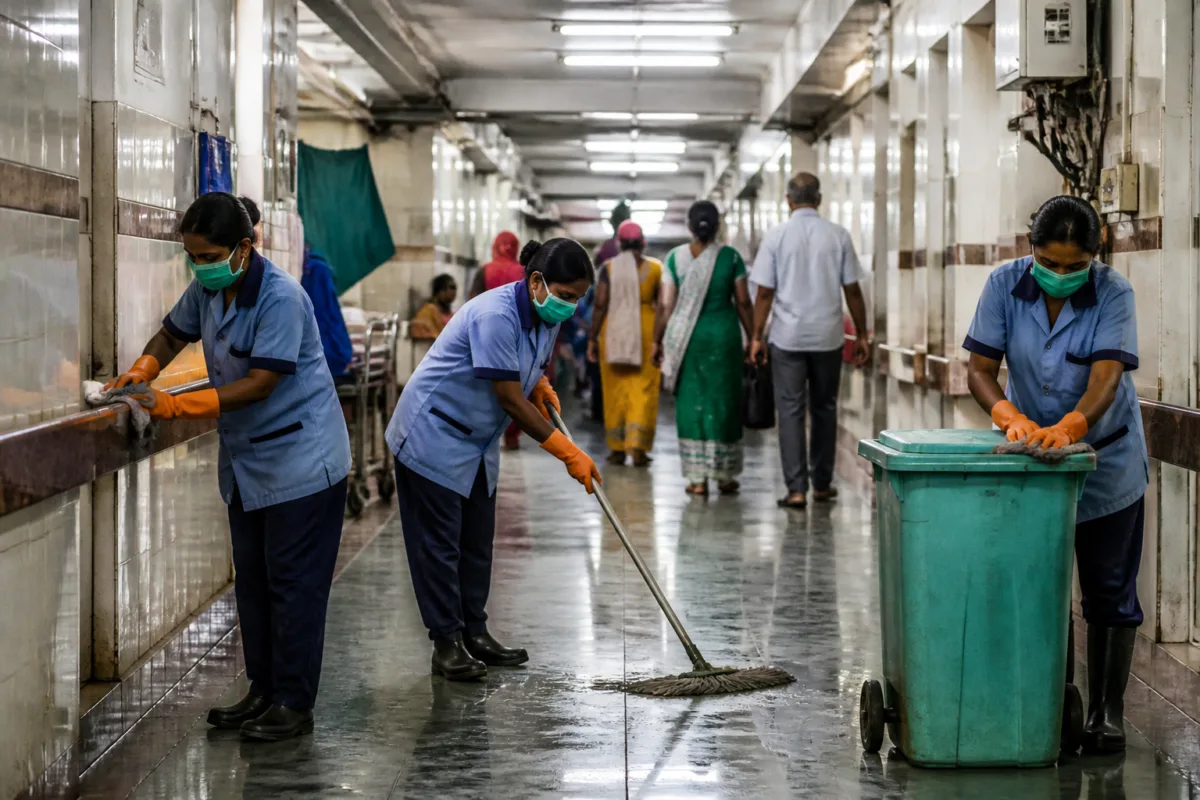
BJP MLA Mihir Kotecha’s demand that the Brihanmumbai Municipal Corporation replace large single-agency housekeeping contracts with an output-based empanelment system has brought an operational question inside Mumbai’s civic hospitals into public view: how should the city measure, distribute and monitor work that directly affects cleanliness, infection control and continuity of care?
Kotecha has written to BMC Commissioner Ashwini Bhide seeking a system under which multiple qualified agencies would be selected through a transparent process and work would be distributed among them. His proposal follows concerns over alleged irregularities in the civic body’s Rs 45 crore housekeeping tender for major hospitals. The allegations remain claims made by the MLA; the report does not record a finding by the BMC or another authority establishing tender manipulation.
That distinction matters because hospital housekeeping is not an ordinary support service. In a municipal hospital, cleaning, waste handling, staff accountability and infection-control practices form part of the operating environment in which doctors, nurses, patients and attendants interact. A procurement model that appears efficient on paper can still fail if the contractor is unable to maintain staffing, respond to disruptions or meet the standards expected across a large and diverse hospital network.
Kotecha’s central argument is that concentrating too many contracts with one agency can create operational and governance risks. He has suggested that no single agency should receive more than two or three hospital housekeeping contracts. Under his proposed model, several empanelled agencies would compete for work while the BMC retained the ability to distribute responsibilities across providers.
The proposal therefore shifts attention from the size of the tender to the design of accountability. A contract can specify how much the civic body will pay, but the quality of a hospital’s housekeeping service depends on what the BMC requires the agency to deliver and how it verifies that delivery. Kotecha has described the suggested system as output-based, with the emphasis placed on measurable service outcomes rather than simply awarding a large block of work to one provider.
The supplied report does not detail the proposed output indicators, payment deductions, inspection frequency or complaint-resolution process. Those omissions are important. Without a defined method for measuring performance, “output-based” contracting can remain a principle rather than an enforceable operating system. The BMC would need to establish what constitutes acceptable cleanliness, how quickly deficiencies must be corrected, who records non-compliance and how repeated failures affect payments or future eligibility. None of those mechanisms is specified in the material available for this analysis.
The immediate public-interest concern is continuity. Kotecha has urged the BMC to ensure that housekeeping services at civic hospitals are not disrupted while any new system is introduced. He has suggested that the existing tender arrangement should continue only until the proposed output-based empanelment system is adopted. This places the corporation between two administrative demands: reforming a contested procurement process and keeping essential hospital operations running without interruption.
That tension is common to public service contracting. A civic agency cannot treat a hospital tender as an isolated purchasing exercise because a transition affects daily operations. Staff deployment, cleaning schedules and supervision have to continue even while contracts are reviewed or redesigned. The report does not establish whether the BMC has accepted Kotecha’s proposal or begun a formal process to amend its contracting framework. It records the demand and the existing concern over the Rs 45 crore tender, but not a final administrative decision.
The proposal also raises the question of whether competition alone can improve services. Multiple agencies may reduce dependence on one provider and limit the consequences of a single contractor’s failure. It may also allow the BMC to compare performance across hospitals or zones. However, the number of agencies is not itself a guarantee of better housekeeping. The outcome would depend on the qualification process, the clarity of the contract, the capacity of hospital administrators to supervise vendors and the BMC’s willingness to enforce standards when performance falls short.
The institutional setting is significant. The BMC is responsible for major municipal hospitals and medical colleges where housekeeping is linked to the functioning of public healthcare facilities. The report says the corporation has already introduced Minimum Essential Standards for Mumbai’s civic hospitals. These standards are intended to create common administrative and operational guidelines covering staff uniforms, biometric attendance, housekeeping, procurement and inter-hospital reviews.
The directive, issued by the Office of the Director Medical Education and Major Hospitals, is described as applying across municipal medical colleges and hospitals. Its stated objectives include greater consistency in professional discipline, cleanliness, infection control, staff accountability and procurement. It also asks hospitals to ensure that eligible patients receive government-scheme benefits and that hospitals learn from one another.
This creates an important overlap between the housekeeping tender debate and the BMC’s standards initiative. If the corporation has established common expectations for cleanliness, attendance and accountability, the next institutional question is how those expectations will be embedded in contracts and verified at hospital level. A standard that exists only as a directive may not change daily conditions unless procurement documents, supervision systems and payment arrangements all refer to it.
The available material does not say whether the Minimum Essential Standards contain performance benchmarks for contractors or whether they are linked to the Rs 45 crore tender. It also does not specify how hospital-level reviews will feed into vendor evaluation. These are the administrative links that will determine whether the standards operate as a reform of service delivery or remain a parallel set of instructions.
Kotecha’s proposal highlights three possible governance concerns: concentration of contracts, transparency in awarding work and resilience when a service provider faces difficulty. His stated rationale is that multiple qualified agencies would promote transparency, healthy competition, better service quality and cost efficiency while preventing monopolistic practices. These are the intended benefits of the proposed structure, not outcomes established by the report.
The suggested limit of two or three hospital contracts per agency would distribute work more widely, but it would also create a more complex management environment for the BMC. More providers can mean more contracts, more points of contact and more performance records. The corporation would need to maintain consistent standards across agencies while avoiding a situation in which fragmented responsibility makes it difficult to identify who is accountable for a failure.
That is why the debate cannot be reduced to whether one agency or several agencies are preferable. The central administrative issue is whether the BMC has the information and enforcement capacity to manage the model it chooses. An output-based arrangement requires reliable monitoring. It also requires a clear chain of responsibility between the civic headquarters, the medical education and major hospitals department, hospital administrations and the contracted agencies.
The report provides one concrete financial marker: the housekeeping tender is valued at Rs 45 crore. It does not provide the contract duration, the number of hospitals covered, the existing agency or agencies, the staffing levels, the tender criteria or the performance record that prompted the allegations. Without those figures, it is not possible to determine the scale of concentration, compare the proposed model with the current one or assess whether the tender represents value for money.
That absence of information is itself relevant to the public discussion. Procurement transparency depends not only on an open tender process but also on the public availability of essential information about what is being purchased, how success is defined and how performance is reviewed. The supplied report does not establish whether such information is publicly available in the BMC’s tender documents or whether the corporation has released a response to the MLA’s allegations.
Kotecha had previously raised concerns in May and accused senior Health Department officials of being involved in alleged tender manipulation. The latest letter repeats his call for structural changes. The report does not record an official response from the accused officials or the BMC confirming or rejecting those allegations. They should therefore remain clearly identified as allegations rather than treated as established findings.
The timing of the letter alongside the Minimum Essential Standards gives the issue a wider significance. The BMC appears, according to the report, to be pursuing common operating guidelines for civic hospitals at the same time that a public demand is being made for changes in how housekeeping services are procured. The success of either effort will depend on whether the two systems are connected: standards must shape contracts, and contract performance must be visible in hospital reviews.
For patients and hospital workers, the practical question is less about the administrative label attached to the procurement model and more about whether services remain reliable. The source material does not provide patient complaints, inspection results or hospital-level performance data, so it cannot establish the current quality of housekeeping across Mumbai’s civic hospitals. It does, however, show that the service has become a subject of concern because it sits at the intersection of public spending, hospital management and infection-control expectations.
The next stage is therefore institutional rather than rhetorical. The BMC’s response to Kotecha’s letter, the status of the Rs 45 crore tender and the manner in which the Minimum Essential Standards are implemented will determine whether the issue produces a measurable procurement reform. The available evidence confirms a demand for multiple-agency, output-based housekeeping contracts and records existing BMC standards. It does not yet confirm that the proposed system has been accepted, that irregularities occurred or that service outcomes have improved. Those are the facts that remain to be established through the corporation’s formal response, tender documents and implementation records.

