


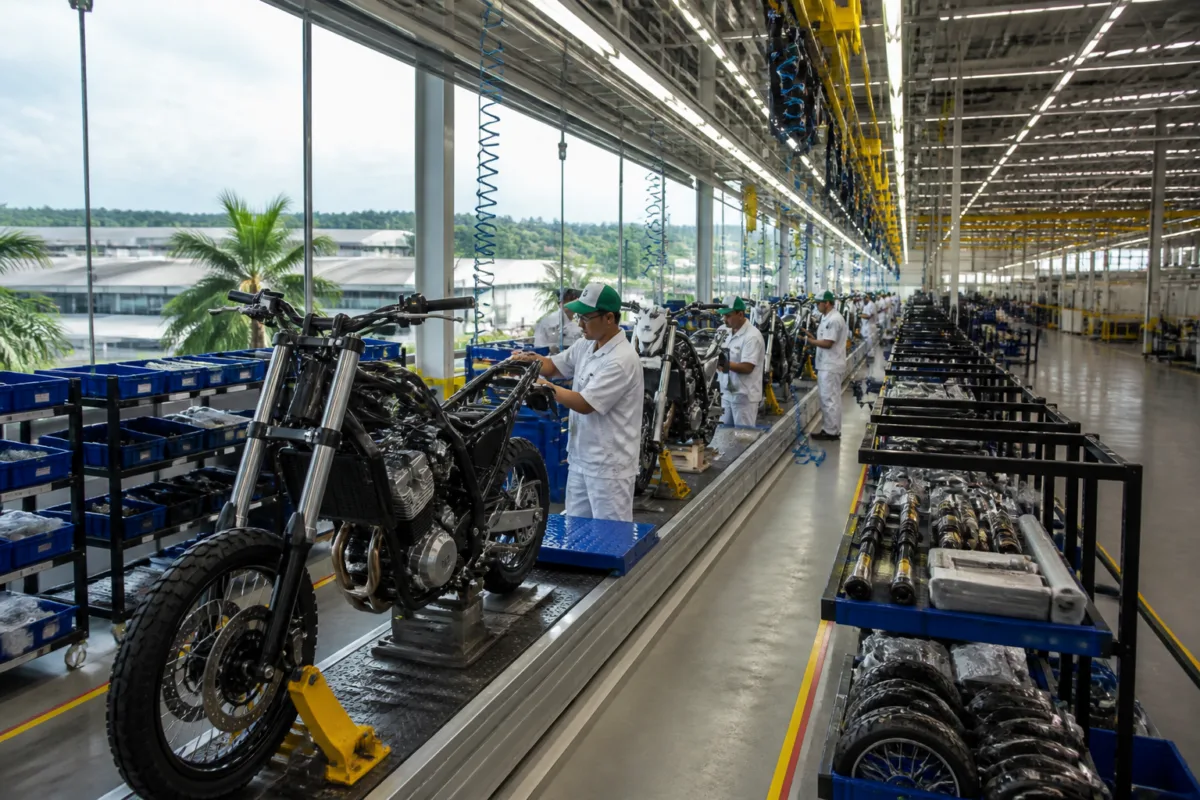
The KTM Brazil assembly plant in Manaus marks a deeper industrial commitment by Bajaj Auto and its Austrian motorcycle brand, moving beyond a partnership-based production arrangement towards an independent facility dedicated to KTM and Husqvarna motorcycles. The plant has an annual installed capacity of 20,000 units, but the company’s immediate plan is to assemble 3,500 motorcycles by the end of 2026 before scaling up next year.
That gap between installed capacity and initial production is central to understanding the facility. The opening is not simply a capacity announcement. It is a staged localisation strategy in which the company has created room for future growth while beginning with a measured production schedule, a defined product portfolio and a distribution network that is expected to expand from 12 locations to 30 outlets by 2027.
The facility is located in Manaus and operates on a completely knocked down, or CKD, basis. Under this arrangement, motorcycles arrive as disassembled components and are assembled at the local plant. KTM said the new unit received an investment of around 20 million Brazilian Reais in facilities and equipment. The plant will build ten models across the motocross, enduro and adventure segments under the KTM and Husqvarna brands.
The industrial move also reorganises an existing production relationship. KTM has been assembling motorcycles in Manaus since 2016 through a partnership with Dafra Motos. The new facility gives the Austrian manufacturer an independent industrial operation dedicated exclusively to its two brands, according to the company. It is co-located with Bajaj Auto’s facility in Manaus, linking the motorcycle brands’ Brazilian operations to a wider Bajaj industrial presence in the city.
This structure matters because manufacturing capacity is only one part of an automotive or motorcycle market. A local assembly unit must be connected to product planning, component movement, quality control, sales outlets and after-sales support. The information released by KTM shows the company addressing at least two of these layers together: assembly capacity through the new plant and market access through the planned expansion of its authorised network.
The models selected for production also indicate how the facility is being positioned. The motocross range will include the KTM 250 SX-F and KTM 450 SX-F. The enduro range will include the KTM 250 EXC-F, KTM 350 EXC-F 6DAYS, KTM 300 EXC and KTM 300 EXC 6DAYS. The plant will also assemble the KTM 390 Adventure R and KTM 390 Adventure X, along with Husqvarna’s FE 350 and TE 300 PRO.
This is a focused product mix rather than a broad, mass-market manufacturing programme. The models cover off-road competition, enduro and adventure touring. That focus allows the company to establish a dedicated industrial and sales platform around selected segments rather than immediately attempting to serve every part of the motorcycle market. The announced capacity of 20,000 units provides the physical headroom for expansion, while the initial 2026 target suggests that demand, production ramp-up and network development will be managed progressively.
The Manaus location adds an urban and institutional dimension to the announcement. The plant is not an isolated production site; it forms part of an industrial operation in a city that already hosts Bajaj’s facility and previously supported KTM assembly through Dafra Motos. The decision to co-locate the new KTM facility with the Bajaj Auto operation points to the importance of an established industrial base when companies reorganise manufacturing activities in a foreign market.
The supplied announcement does not provide details on employment, local supplier participation, component sourcing, logistics routes or the public incentives connected to the facility. Those omissions are important because they limit what can be concluded about the plant’s wider economic impact. The confirmed facts establish investment, capacity, product scope and distribution plans, but they do not quantify how the project will change local jobs, supplier activity or freight demand in Manaus.
The company’s description of the plant as an independent operation nevertheless shows a shift in institutional control. Since 2016, assembly had been conducted through a partnership with Dafra Motos. The new arrangement gives KTM a dedicated facility for KTM and Husqvarna products, while its location alongside Bajaj Auto’s plant preserves a physical connection with the Indian parent company’s Brazilian operations. Rakesh Sharma, joint managing director of Bajaj Auto, described Brazil as an important market in the global portfolio of Bajaj and KTM and said the inauguration was a further signal of the companies’ commitment to the country.
The statement also places the plant within Bajaj Auto’s broader relationship with KTM. Bajaj Auto owns the KTM brand, and the Manaus investment creates a local manufacturing platform for two marques rather than one. That distinction is reflected in the facility’s exclusive dedication to KTM and Husqvarna. It also means that the production site is being used to support a portfolio strategy, with different models serving distinct motorcycle categories while sharing a common industrial base.
The planned retail expansion is the second major indicator of the company’s approach. KTM currently has an authorised network across 12 locations in Brazil and plans to increase that number to 30 outlets by 2027. The network target is more than a sales figure. It is the operational link between production and consumers, particularly for specialised motorcycles that require brand-authorised service, parts availability and trained support. However, the announcement does not specify where the additional outlets will be located or how the company will phase their rollout.
The plant’s 20,000-unit annual capacity should therefore be read as potential rather than immediate output. KTM has said it plans to assemble 3,500 units by the end of 2026 and scale up further in the following year. The available figures show that the first-year plan represents a limited utilisation of the stated capacity. The announcement does not identify the production ramp-up milestones, the expected utilisation rate in 2027 or the factors that will determine the pace of expansion.
For Manaus, the confirmed development is an additional dedicated manufacturing facility and the continuation of motorcycle assembly activity that began in 2016. For Bajaj Auto and KTM, it is an effort to consolidate operations, localise assembly and build a larger authorised presence in Brazil. For urban and industrial observers, the case illustrates how a global two-wheeler brand can use a CKD model and a co-located industrial base to establish a more direct presence in a foreign market without immediately committing to the full scale of production.
The larger question is what happens between installed capacity and actual industrial depth. The new plant has a stated capacity, an investment commitment, a ten-model portfolio and a network expansion plan. The next evidence will come from production volumes, the progress of the 30-outlet target and any information on employment, suppliers and local component integration. Until those details emerge, the Manaus facility is best understood as the foundation of a planned expansion rather than proof of its full economic outcome.

