


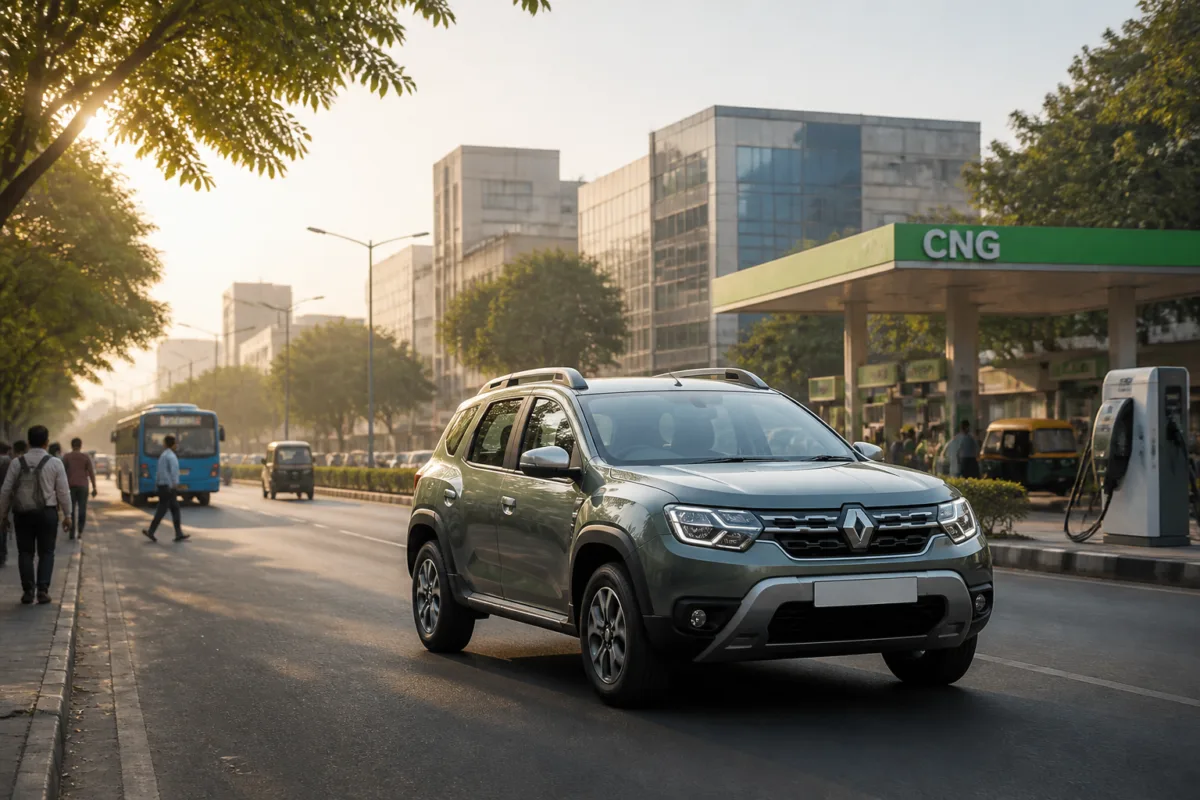
Renault India’s powertrain strategy is moving towards a wider mix of strong hybrids, CNG and electrification as the automaker tries to rebuild its position in a market where customer demand, emissions rules and infrastructure are changing at different speeds. The approach, outlined by Renault India CEO Venkatram Mamillapalle Deblaise in an interview with The Hindu BusinessLine, places product variety and local engineering at the centre of the company’s attempt to expand beyond a market share of below 1 per cent.
The strategy matters beyond Renault’s immediate commercial challenge. India’s urban mobility transition is not following a single path from petrol and diesel vehicles to electric cars. It is developing through several overlapping routes, including CNG for running-cost-sensitive customers, strong hybrids for fuel efficiency without charging dependence, and electric vehicles for buyers prepared to make a larger technology shift. Renault’s roadmap reflects the difficulty of designing vehicles for these different requirements while meeting rising regulatory and cost pressures.
The company has launched the Duster Strong Hybrid E-Tech 160 at a starting price of ₹16.99 lakh. Renault says the vehicle delivers a claimed fuel efficiency of 29 kilometres per litre, compared with around 21 kilometres per litre for comparable diesel vehicles. Those figures are company claims cited in the interview, but they show the commercial argument Renault is making: a strong hybrid can offer lower fuel consumption while retaining the operating convenience of an internal-combustion vehicle.
Deblaise described hybrid technology as “the new diesel”, arguing that it offers fuel economy and total cost-of-ownership benefits. At the same time, he said electrification remains Renault’s priority. The company’s position is that hybrid and electric vehicles address different customer requirements, particularly because hybrids can provide electric driving benefits without depending on charging infrastructure.
That distinction is important in a market where vehicle adoption is shaped not only by technology but also by the availability and convenience of supporting systems. The interview does not provide data on the size or distribution of India’s charging network, nor does it quantify the relative cost of owning a hybrid and an electric vehicle. It does, however, identify the practical issue Renault is trying to address: customers cannot all be expected to shift from internal-combustion vehicles to electric cars at the same time.
CNG is the second major element of the company’s expansion plan. Renault has not participated adequately in what Deblaise described as a market representing approximately 25 per cent of the relevant segment. The company plans to introduce CNG options for the Triber and Kiger, with the stated objective of reaching customers who are currently outside its product range.
The CNG plan also shows why powertrain choice is connected to market share. Renault is not relying only on completely new vehicle launches to increase volumes. By adding CNG versions to existing models, it hopes to broaden the customer base for vehicles already present in its portfolio. Deblaise said that if CNG accounts for about a quarter of the relevant market, Renault should aim for a similar proportion of sales in its models.
This is a narrower and more immediate strategy than waiting for a full technology transition. It allows the company to respond to an existing customer preference while continuing to develop hybrid and electric products. However, the interview does not establish whether Renault has set a specific sales target for CNG vehicles or how quickly the new variants will become available. The company’s stated opportunity is clear, but the scale and timing of the commercial impact remain to be demonstrated.
A product roadmap built around more than new launches
Renault’s response to its weak market position is being presented as a broad product and engineering programme rather than a single model intervention. The company has introduced a more powerful engine for the Triber after customer concerns about performance, particularly when the seven-seat vehicle is carrying a full passenger load. It is also planning improvements to the Kiger and further developments for the Duster.
The future roadmap includes a larger seven-seat model and the Bridger. Deblaise said Renault has never had so many product developments and upgrades planned for India. The company has not provided a concrete timeline for reaching a 5 per cent market share, and the CEO explicitly said that market share would be the result of its products, engineering and customer response rather than a target attached to a stated deadline.
That distinction is relevant for assessing the company’s plans. A product pipeline can expand the number of segments and customer requirements Renault addresses, but market share will still depend on how successfully those vehicles are priced, distributed and supported. The supplied interview does not provide projected volumes, dealership numbers, investment figures for the Indian product programme or a model-wise launch schedule beyond the stated timing for the Bridger.
The Bridger is scheduled for the end of 2027, with a development programme of approximately 88 weeks. Deblaise attributed the speed of the programme to closer coordination between engineering, manufacturing, product planning and marketing. In his account, Indian teams are operating through a shorter decision-making loop, allowing the company to respond more quickly to customer requirements.
This points to a shift in the role of India within Renault’s operating structure. India is not being described only as a market for imported or locally assembled products, but as an engineering and manufacturing base with responsibilities across development and exports. Indian engineers already support projects for markets including Brazil and France, according to Deblaise.
Local engineering as a competitiveness strategy
Renault’s localisation agenda has two connected parts. The first is to make products more suitable and affordable for Indian customers. The second is to use India’s manufacturing, component and engineering capabilities to support Renault’s global operations.
The company has set an ambition of €2 billion in annual exports from India by 2030. Deblaise said this would be supported through three channels: exporting vehicles manufactured in India, supplying components and subassemblies to Renault’s global manufacturing operations, and expanding engineering services. The interview does not specify the current value of exports or provide a year-by-year path to the 2030 ambition.
For the Indian urban mobility system, the significance lies in the connection between industrial capacity and the consumer product available in cities. Greater local engineering can help an automaker adapt vehicles to Indian passenger loads, road conditions, fuel preferences and regulatory requirements. It can also potentially shorten development cycles. But the interview provides no independent evidence yet on whether the 88-week Bridger programme or the broader localisation strategy will translate into lower prices, faster repairs or improved customer service.
The cost challenge is becoming more complex as regulatory requirements increase. Deblaise referred to CAFE III, E20 and proposed BS7 norms as factors that will increase compliance costs. Renault’s stated response is to rely on engineering to meet regulatory constraints and customer expectations while remaining competitive on cost.
These pressures affect the entire vehicle ecosystem. Stricter efficiency and emissions requirements can raise development and manufacturing costs, while customers continue to expect affordable vehicles with improved performance and fuel economy. A wider powertrain portfolio may help manufacturers serve different segments, but it also increases engineering, supply-chain and after-sales complexity. Renault’s plan therefore depends not only on launching more variants, but on managing that complexity without allowing prices to move beyond the reach of its intended customers.
The urban question is a choice between transitions
Renault’s roadmap captures a central feature of India’s vehicle transition: the change is not taking place through one universally preferred technology. CNG addresses a defined share of the relevant market. Strong hybrids are being positioned as an efficiency solution that reduces dependence on charging infrastructure. Electric vehicles remain the stated priority, but their adoption is being treated as a gradual process rather than an immediate replacement for internal-combustion vehicles.
For cities, this means the consequences of automotive transition will depend on the mix of technologies that reaches the road, not simply on the number of electric models announced. CNG, hybrid, petrol and electric vehicles have different implications for fuel use, infrastructure requirements, purchase costs and manufacturing systems. The supplied material does not provide emissions comparisons across these powertrains or evidence on how they are being adopted in particular cities, so it cannot establish which route will deliver the greatest urban benefit.
What it does show is that customer choice and infrastructure readiness remain closely linked. Renault’s argument for hybrids rests partly on the ability to deliver electric driving characteristics without requiring charging access. Its CNG strategy rests on an existing market opportunity that the company believes it has not addressed sufficiently. Its electric priority is being pursued alongside both options rather than instead of them.
The company’s next phase will therefore be judged on execution. Renault must bring CNG variants of the Triber and Kiger to market, improve the performance and appeal of existing models, develop the Duster further, deliver the Bridger programme scheduled for the end of 2027 and build the engineering and export capabilities associated with its 2030 ambition.
The evidence currently confirms a strategic reset centred on product breadth, localisation and faster development. It does not yet confirm whether the plan will lift Renault from below 1 per cent market share to a materially stronger position, or whether its mix of CNG, hybrid and electric vehicles will translate into measurable urban mobility gains. Those outcomes will depend on future launches, pricing, customer uptake, regulatory implementation and the company’s ability to deliver its stated timelines.

