


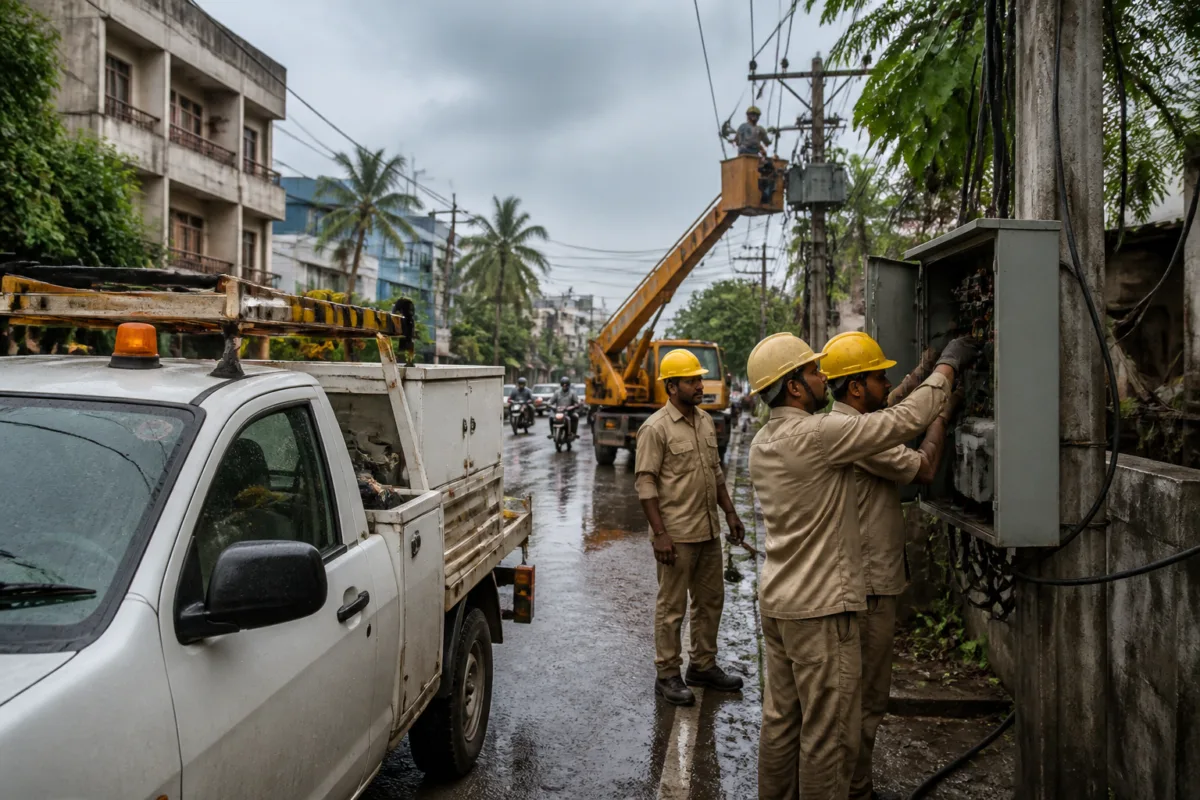
Tamil Nadu has expanded its monsoon power-fault response capacity with 82 additional fuse-of-call vehicles, taking the total fleet available for rapid repairs to 152 vehicles in Chennai and neighbouring districts, Electricity and Law Minister CTR Nirmal Kumar said on Monday.
The additional vehicles will be deployed across Chennai, Tiruvallur, Kancheepuram and Chengalpattu, with each vehicle staffed by four personnel. The minister said similar arrangements would be made in other districts as part of the state’s preparations for electricity faults during the monsoon.
The department has also deployed 12 crane-equipped vehicles to handle faults involving high-tension lines. The move is intended to support repair teams where damaged or disrupted overhead electricity infrastructure requires specialised equipment, according to the minister.
Fuse-of-call vehicles are typically used to respond to localised electricity complaints and faults. Their deployment is particularly relevant during periods of heavy rain, when waterlogging, fallen trees and damage to distribution infrastructure can interrupt supply in urban neighbourhoods. The minister did not provide a district-wise deployment plan or a target response time for the additional vehicles.
Nirmal Kumar also said the state was working to address constraints affecting the electricity grid as solar generation expands. Tamil Nadu is streamlining applications for solar power installations and working on net-metering arrangements, he said. Net metering allows eligible rooftop solar consumers to adjust electricity supplied to the grid against their consumption, subject to applicable rules and approvals.
The minister said around 28,000 applications had been received under a rooftop solar scheme that targets one lakh beneficiaries by March. The government would expedite application processing and net-metering arrangements, he said. The report did not specify how many of the applications had been approved, installed or connected to the grid.
The state is also preparing a battery storage policy to manage the gap between daytime solar generation and evening electricity demand, according to the minister. Solar generation is generally available during daylight hours, while household and commercial demand can remain high or rise during the evening. The minister did not provide a timeline for releasing the policy or details of its proposed capacity, financing model or implementing agency.
Nirmal Kumar said several states had faced power shortages and had been forced to purchase electricity at high rates. He cited Rajasthan as having reportedly paid as much as Rs 46 per unit, while attributing wider supply pressures to inadequate national-level forecasting and coordination. He also warned that higher temperatures and the possibility of an El Niño event could increase power demand next year.
The minister’s remarks came during a broader statement in which he defended the state government’s response to the disappearance of a girl in Gingee. He said police teams had been searching for her for several days, that the Director-General of Police was reviewing the investigation daily and that a statewide alert had been issued. He also criticised the previous DMK government over its handling of cases involving crimes against children and alleged irregularities in school safety certification.
The electricity department is expected to continue processing rooftop solar applications, finalise net-metering arrangements and obtain approval before announcing recruitment to vacant gangman posts, the minister said.

