


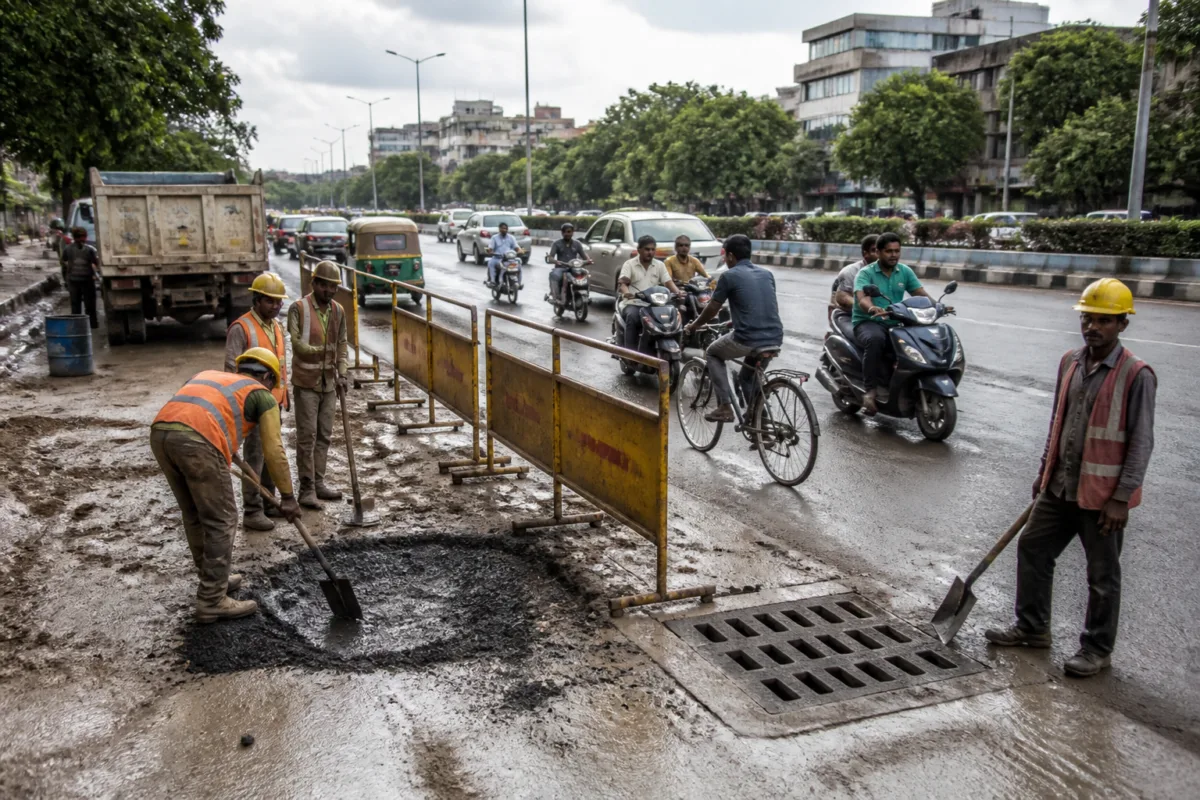
The Gujarat government has introduced a new road SOP requiring all municipal corporations, including the Ahmedabad Municipal Corporation (AMC), to survey roads before and after the monsoon and complete repairs to dangerous stretches within 48 hours. The policy also sets deadlines for pothole repairs, mandates quality checks and requires photographic proof of completed work.
Following the state government’s instructions, the AMC commissioner has directed the engineering department to implement the SOP. The stated priorities include improving road construction quality, ensuring timely repairs and protecting pedestrians, cyclists, persons with disabilities and other road users.
Under the new process, municipal authorities must inspect all roads before and after the monsoon. Repairs to damaged concrete road surfaces must be completed within 15 days, while minor patchwork must be completed within 30 days. Roads classified as seriously damaged and dangerous for residents must be repaired within 48 hours. Photographs of completed repairs must be uploaded to the municipal corporation’s application within 72 hours of the work being finished.
The SOP also makes barricading compulsory during repair work. Before a pothole is repaired, the road surface must be cleaned and an appropriate bitumen emulsion must be applied. The document also permits the use of technologies including cold emulsion injection and infrared recycling for road maintenance.
The requirements extend to road construction and resurfacing. Before hot-mix work begins, contractors and project management consultants must submit a quality-assurance plan. Work can start only after approval from the competent authority. Officials must verify the source, quality and available quantity of raw materials used for the road. A quality-control officer must be present both at the hot-mix plant and at the work site.
Records must be maintained for the weight of material leaving the plant, its dispatch time, arrival time at the site and temperature. Material that does not meet the prescribed quality standards cannot be transported to the site or reused. Before hot mix is laid, the surface must be cleaned and the material must be spread at the correct temperature and approved thickness, with appropriate road levels and slopes. Laboratory testing will also be required, while care must be taken to prevent damage to manholes, valve chambers and catch pits.
The SOP requires municipalities to maintain a road register and update it every October. For resurfacing, regrading or milling, the relevant officials and design consultant must jointly inspect the site. Road estimates must include details of water lines, drainage, storm-water lines and other underground services. Repeatedly failing drainage or storm-water lines and manholes must be rehabilitated or strengthened before new road construction begins.
The authorities must also record the thickness of the existing road surface and its underlying layers, along with levels near building entrances. Special design attention is required in areas with weak soil, black cotton soil, high groundwater levels or recurrent waterlogging. The SOP identifies industrial areas with heavy vehicle movement, BRTS corridors, roads with repeated potholes, accident-prone stretches and locations with high recurring repair costs as places where RCC roads may be considered.
The new procedure places responsibility not only on municipal repair teams but also on contractors, project management consultants, design consultants and quality-control officials. Its implementation in Ahmedabad will depend on how consistently road surveys, repair deadlines, material records and post-work inspections are carried out by the AMC engineering department.

