


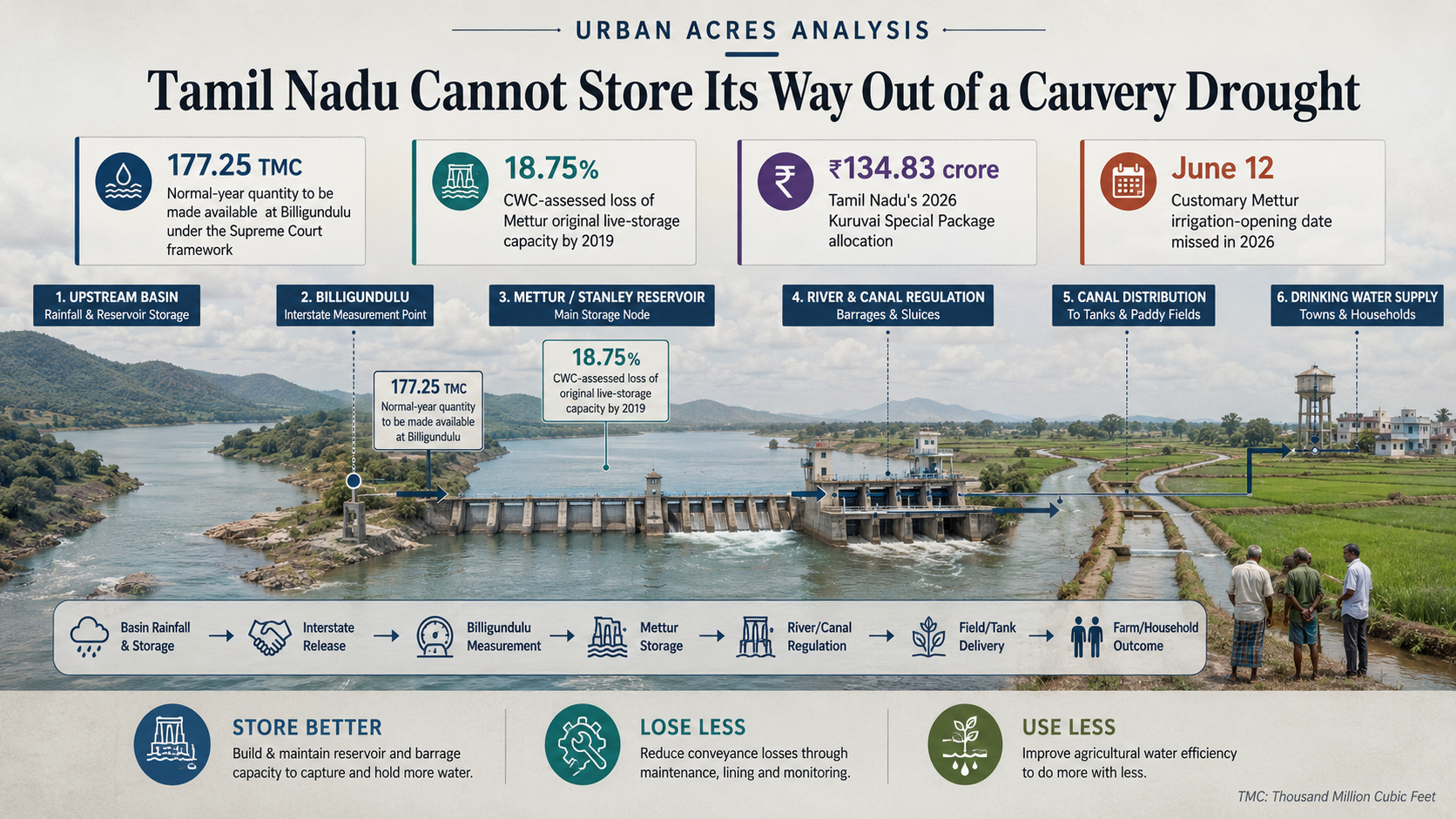
The 2026 water deficit has revived calls for barrages, reservoir desilting and water-saving paddy. All can contribute to resilience. None replaces the missing inflow. Tamil Nadu’s harder task is to manage the Cauvery as one measurable chain from interstate release to the water actually reaching a farm or household.
Tamil Nadu’s recurring difficulty in opening Mettur for Cauvery delta irrigation on June 12 has again produced a familiar policy menu: finish barrages, build more check dams, remove reservoir sediment and grow rice with less water.
Each deserves examination. Together, however, they can obscure the central hydrological fact.
A state can store water, convey it more efficiently and reduce how much it consumes. It cannot store water that never enters the system.
That distinction is especially important in 2026 because Tamil Nadu’s shortage is simultaneously an interstate allocation problem and an internal resilience problem.
The first is being argued through the institutional structure created to implement the Cauvery award. The second is principally Tamil Nadu’s responsibility.
On August 24, Tamil Nadu told the Supreme Court that water explicitly ordered by the Cauvery Water Management Authority had been received but that a deficit remained when releases were assessed against what the State considers its proportionate distress-year entitlement. The State has put the backlog at roughly 20 TMC; Karnataka disputes the allegation and points to basin distress. The Court has asked the parties to work through the CWMA process and listed the matter for August 31.
The legal baseline is more complicated than a fixed annual number
The Supreme Court’s 2018 judgment reduced the quantity Karnataka must make available at Billigundulu to 177.25 TMC in the normal-year framework and fixed Tamil Nadu’s overall share at 404.25 TMC.
But the same framework expressly contemplates years when Cauvery basin yield is below normal. In those circumstances, shares are to be proportionately reduced and reservoir storage, rainfall and releases become part of the authority’s operational calculation.
That matters editorially.
Tamil Nadu’s interstate claim must be reported vigorously and precisely, but resilience policy should assume that distress years will recur. Even perfect compliance with a distress-sharing formula does not guarantee the volume available in a normal monsoon year.
This is where Tamil Nadu’s own infrastructure and agricultural policy become decisive.
Mettur has lost storage — but the evidence does not support a 30%–40% loss
Sedimentation is real.
A Central Water Commission assessment calculated Stanley Reservoir’s original live storage at 2,646.74 million cubic metres and its 2019 live storage at 2,150.55 MCM. That is a reduction of 496.19 MCM, or 18.75% of original live capacity.
That is approximately 17.5 TMC of live storage lost since commissioning.
It is large enough to justify updated surveys and a serious reservoir-capacity strategy. But it is not the same as the 30%–40% loss cited in the triggering report.
More importantly, restoring storage has a specific function: it increases the ability to retain water when water is available.
It does not increase Cauvery basin rainfall. It does not guarantee Karnataka reservoir inflow. And it does not resolve an interstate release deficit.
Therefore the appropriate policy test for any large-scale Mettur sediment-removal proposal is not simply “How many cubic metres can be dredged?”
Government should establish:
recoverable capacity → cost per TMC recovered → sediment-removal method → disposal/use → environmental effects → construction period → operational disruption → expected life of recovered capacity.
A current bathymetric survey should precede any large capital claim.
More barrages may improve flexibility. Their yield must be demonstrated.
Additional barrages and check dams can have legitimate functions.
Depending on location and design, they can retain monsoon flows temporarily, improve regulation, support diversion systems and, in some settings, facilitate groundwater recharge.
But a barrage is not automatically additional water.
Tamil Nadu has discussed new Cauvery-system check dams and barrages for years. Earlier budget material included plans for a large multiyear programme, while subsequent government and parliamentary material continued to refer to Cauvery-system storage proposals.
The policy therefore needs to move from a structure-counting approach to a yield-and-service approach.
Every proposed structure should disclose:
- incremental dependable yield;
- flows it is intended to intercept;
- interaction with existing irrigation systems;
- effect on downstream users;
- flood-conveyance implications;
- land requirement;
- environmental approvals;
- construction cost;
- sedimentation expectation;
- O&M responsibility;
- and the final service area.
Without that, “another barrage” remains an engineering object rather than a demonstrated water-security intervention.
The Adhanur–Kumaramangalam project is instructive. Although commonly described as having been initiated years ago, official land-acquisition and environmental-public-hearing records were still progressing in 2024.
The lesson is not necessarily that the project is unjustified. It is that announcement, statutory clearance, land acquisition, construction and commissioning are different stages.
The distribution system matters as much as reservoir capacity
Cauvery water does not move directly from an interstate release into a paddy field.
The physical chain is:
Basin rainfall and reservoir storage → Karnataka releases → Billigundulu measurement → Mettur storage → Cauvery/Kollidam regulation → main canals → distributaries → field channels/tanks → farm.
Every interface can alter the eventual outcome.
A litre retained through improved canal operation or delivered to a tail-end command is functionally different from a litre released at a reservoir but lost before reaching its intended use.
This is why recurring desilting of canals and tanks can be useful — but kilometres desilted are an output, not the service outcome.
Tamil Nadu should measure whether maintenance changes:
head-to-tail delivery time, conveyance loss, actual irrigated acreage, canal reliability and groundwater substitution.
A successful desilting programme is one that delivers a measurable hydraulic improvement, not simply one that excavates sediment.
The demand side may produce some of the fastest resilience gains
Agriculture cannot be treated only as the recipient of whatever water infrastructure provides.
Paddy cultivation is itself part of the water system.
TNAU promotes techniques including alternate wetting and drying, under which irrigation is timed according to falling field-water levels rather than maintaining continuous inundation. TNAU material has reported significant water-saving potential under suitable field conditions.
Direct seeding and crop varieties with different duration and drought characteristics offer other ways to reduce exposure.
These measures deserve emphasis because their purpose is fundamentally different from a barrage.
A barrage manages supply. AWD manages demand. A shorter-duration crop manages exposure to timing risk.
A resilient Cauvery strategy needs all three categories.
But adoption numbers alone would again be insufficient. Tamil Nadu should measure water productivity — crop output per unit of water — along with yield, farmer income and groundwater extraction.
There is also an equity problem.
A farmer with a functioning borewell may be able to compensate temporarily for a late canal release. A farmer dependent entirely on surface irrigation, particularly near a tail end, has fewer options.
If the adaptation strategy simply encourages groundwater pumping during each Cauvery deficit, the State risks replacing a visible river-water shortage with a less visible aquifer problem.
₹134.83 crore is a drought response, not replacement water
Tamil Nadu’s Agriculture Department has announced a ₹134.83-crore Kuruvai Special Package for 2026.
That figure should be understood correctly.
It is a programme allocation intended to support agricultural adaptation and cultivation. It is not the financial value of the Cauvery deficit, it does not represent water created, and it should not be combined with barrage or reservoir project estimates as though they were one expenditure programme.
The meaningful evaluation will come later:
How much acreage was planted?
How much survived?
How much additional groundwater was used?
What happened to yield and farm income?
How much of the package was actually disbursed?
Which farmers could not access it?
Those are the outcomes against which the package should be judged.
Tamil Nadu needs a Cauvery resilience ledger
The institutional machinery already produces large quantities of upstream data.
Under the Cauvery management framework, reservoir storage, releases, rainfall and flows are monitored by the CWMA and Cauvery Water Regulation Committee.
Tamil Nadu should extend that logic all the way downstream.
A public dashboard should connect:
CWMA-directed release → actual Billigundulu flow → Mettur inflow → Mettur storage → sectoral release → canal head flow → canal tail flow → tank storage → irrigated area → groundwater level → crop outcome.
For drinking water, the same dashboard should show the abstractions feeding combined-water-supply systems and the actual household service outcome: continuity, tanker dependence and affected habitations.
That would allow the public to distinguish three very different failures:
not enough water entered Tamil Nadu;
available water could not be stored or conveyed efficiently;
or demand exceeded what could reliably be supplied.
Today those failures are too easily collapsed into a single phrase: “Cauvery shortage.”
The real resilience strategy is a portfolio
Tamil Nadu is justified in pursuing the interstate water to which it is entitled under the Cauvery legal framework.
But that cannot be the State’s only drought strategy.
Nor can the answer simply be to build more concrete structures.
A serious resilience programme combines:
legal enforcement + reservoir management + selective storage expansion + canal and tank performance + groundwater protection + crop adaptation + demand management + transparent measurement.
The crucial distinction is between creating resilience and claiming to create water.
Tamil Nadu cannot build its way out of basin hydrology.
It can, however, make every TMC that is available perform far better — and make the consequences of the next deficit less dependent on whether June 12 arrives with enough water behind Mettur’s gates.
