


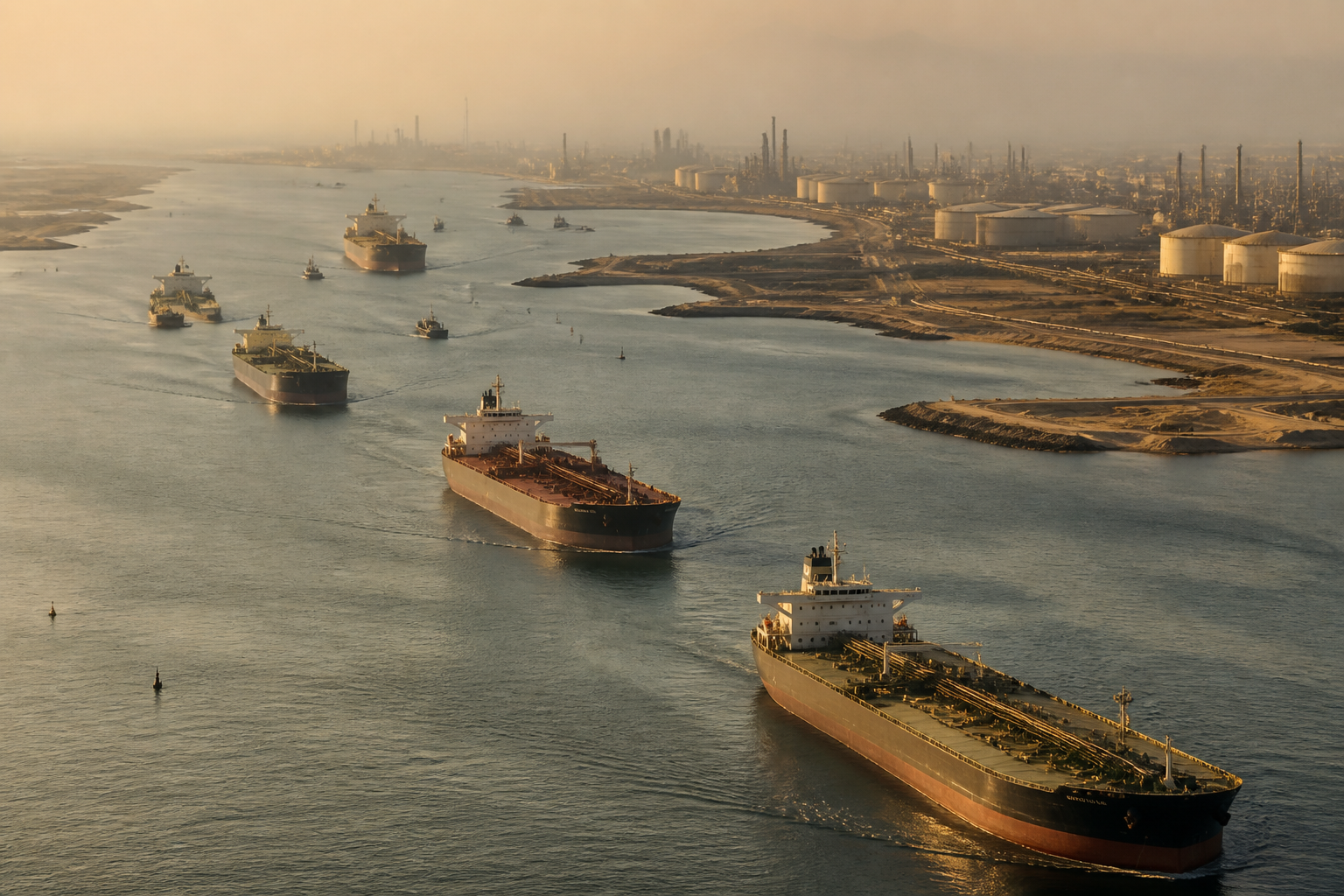
The 2026 Strait of Hormuz crisis did more than push up the risk of higher oil and gas prices. It exposed how dependent the global energy system remains on a small number of maritime routes, limited backup infrastructure and supply chains that can be disrupted faster than they can be redesigned. For India, one of the world’s major energy-importing economies, the crisis has turned diversification and strategic reserves from long-term policy goals into immediate questions of infrastructure resilience.
The Strait of Hormuz is a narrow maritime passage connecting the Persian Gulf with the Gulf of Oman and the Arabian Sea. According to the report by McKinsey Global Institute (MGI), around 21 million barrels of oil passed through the route every day in the fourth quarter of 2025. This included approximately 16 million barrels of crude oil and 5 million barrels of refined petroleum products. The route therefore carries not only crude destined for refineries, but also fuels that are already prepared for consumption or industrial use.
That concentration creates a structural risk. A disruption at Hormuz can affect crude supply, refined products, gas markets, shipping schedules and industrial costs at the same time. The report says that, at the height of the 2026 crisis, around 14% of the world’s oil and gas supply was affected. MGI estimated that the scale was more than twice that of the major oil shocks of the 1970s and roughly six times the disruption associated with the Russia-Ukraine conflict in 2022.
The important point is that the global market did not stop functioning. It adjusted, but the adjustment revealed the limits of its available buffers. MGI estimated that about 45% of the oil supply removed from the market during the crisis was absorbed through lower consumption, equivalent to around 6.8 million barrels per day. China reduced its oil imports, while the United States increased exports. These changes redirected available supplies and helped prevent a complete breakdown in market flows.
But demand reduction is not the same as new supply capacity. It can cushion a temporary shock, but it also implies lower industrial activity, postponed consumption or a shift to other fuels. The report says that inventories fell, prices rose and refinery systems came under pressure during the crisis. These effects matter for cities because energy costs are embedded in transport, electricity generation, construction materials, manufacturing, logistics and household expenditure.
The crisis also demonstrated why alternative infrastructure cannot be measured only by whether it exists on a map. Saudi Arabia’s East-West pipeline, one of the routes intended to bypass Hormuz, experienced a disruption during the period under review. Its problems showed that a bypass pipeline is not automatically a complete substitute for a maritime chokepoint. Capacity, operating reliability, geographic reach and connections to refineries, ports and distribution networks determine whether backup infrastructure can work when the primary route is under stress.
This is a wider infrastructure problem. MGI estimates that nearly two-thirds of global energy trade passes through maritime chokepoints. The Strait of Malacca carries approximately 23 million barrels of oil and refined products each day, while Hormuz carries around 21 million barrels. Other important routes include the Cape of Good Hope, the Suez Canal, the Turkish Straits, Bab al-Mandeb and the Panama Canal.
The report’s reference to recent tensions in the Red Sea and Yemen illustrates how a disruption can increase costs even when ships continue moving. Vessels may be forced to take longer routes, increasing journey times, fuel consumption and freight costs. For import-dependent countries, route length is not a minor logistical detail. It affects delivery schedules, inventory requirements, insurance exposure and the amount of working capital tied up in goods in transit.
The same vulnerability extends beyond crude oil. Asian spot liquefied natural gas prices, which were around $10 per million British thermal units before the war, rose to approximately $30, according to the report. When gas became more expensive, buyers including India shifted towards coal and oil where possible. This shows how tightly connected energy markets are: a disruption affecting one fuel can increase demand for another, raising pressure across the system rather than keeping the shock confined to a single commodity.
For India, this creates a layered energy-security challenge. The country needs access to crude, reliable shipping routes, adequate storage, refining capacity and the ability to substitute one fuel for another during a disruption. Each of these is a separate infrastructure requirement, but they work only when coordinated. More crude suppliers cannot fully protect the system if all major cargoes still depend on vulnerable maritime routes. Likewise, strategic reserves have limited value if they cannot be released and distributed quickly to the regions and sectors facing shortages.
The report identifies crude-supply diversification, strategic petroleum reserves, alternative shipping routes, domestic refining capacity and fuel-switching capability as important areas for India. These measures address different points in the supply chain. Diversification reduces dependence on a single source. Reserves provide time during a disruption. Refining capacity allows imported crude to be converted into usable products. Fuel substitution can reduce pressure on the most affected market, although it can also increase demand for coal or other fuels.
India and China may be able to absorb some oil and gas disruption through the availability of coal, the report says. However, this does not remove their exposure to global shipping. MGI estimates that around 84% of the energy trade of both countries passes through maritime chokepoints. The figure underlines a crucial distinction: domestic access to an alternative fuel is not the same as energy independence. Coal may provide substitution capacity, but the wider energy economy remains connected to seaborne trade, international prices and vulnerable routes.
The proposed response across major economies includes bypass pipelines, alternative oil and gas supplies, electrification and greater diversification of energy sources. MGI estimates that by 2030 these measures could cover between 35% and 70% of the oil flows passing through Hormuz before a new major disruption. This would represent approximately 7 million to 15 million barrels per day, or about 7% to 15% of global oil supply.
That range is significant because it also reveals uncertainty. The difference between 35% and 70% depends on whether projects are completed, whether they operate at sufficient capacity and whether they are connected to the right markets. A pipeline may offer a bypass for one producer but not for every importer. A storage facility may hold fuel but still depend on roads, railways, ports and pipelines for distribution. Electrification can reduce oil demand over time, but it cannot immediately replace every industrial, freight or aviation use.
The policy landscape is therefore not limited to petroleum procurement. It includes the planning and financing of storage, port capacity, refinery flexibility, pipelines, power systems, urban transport and industrial fuel use. It also involves coordination between energy ministries, oil companies, shipping operators, refiners and state-level distribution networks. A crisis that begins at sea can quickly become a problem of inland logistics and public administration.
For cities, the consequences are indirect but extensive. Higher fuel prices can raise the cost of bus operations, freight movement, construction equipment and essential goods. Expensive gas can alter the economics of electricity generation and industrial production. A switch towards coal or oil can increase pressure on air quality and emissions, even if it provides short-term supply relief. The report does not quantify these city-level effects, but its description of interconnected fuel markets shows why energy security is also an urban systems issue.
The Strait of Hormuz crisis has consequently exposed a weakness in the way energy resilience is often understood. The question is not only how much oil or gas a country can buy, or how many days of fuel it stores. It is also whether the entire chain—from overseas production and maritime passage to ports, refineries, pipelines, power plants and urban consumers—can continue operating when one link fails.
The evidence supplied in the report confirms that demand reduction, inventories and alternative routes can soften a major shock, but none is unlimited. It also shows that India’s exposure is shaped by both import dependence and maritime concentration. The developments that require monitoring are the expansion of strategic reserves, the reliability and connectivity of bypass infrastructure, progress on energy diversification and the ability of domestic systems to switch fuels without creating new environmental or logistical stresses.
