


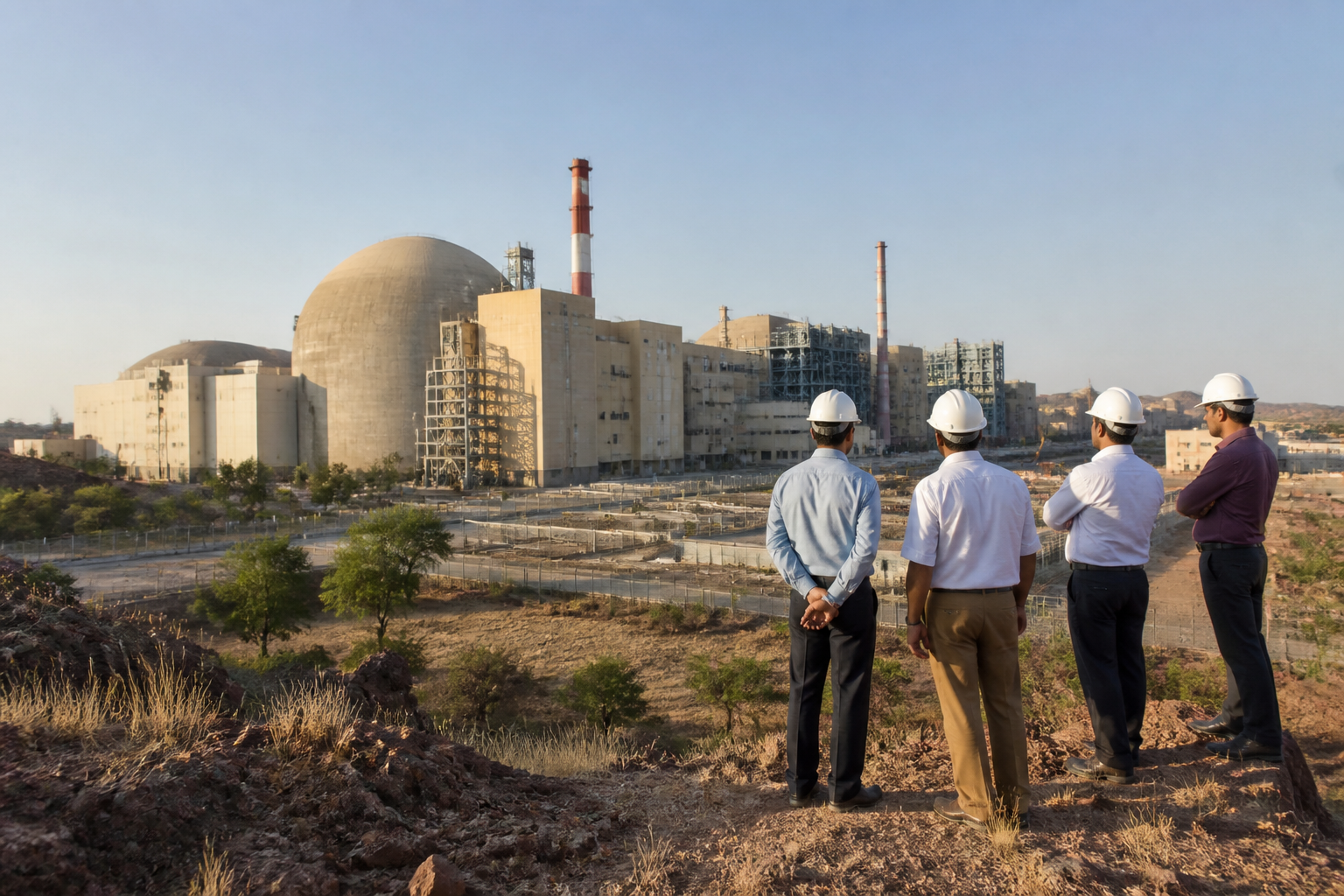
NPCIL’s commencement of fuel loading at Unit 8 of the Rajasthan Atomic Power Project marks a transition from construction and system preparation to the most consequential stage of reactor commissioning. The 700 megawatt reactor at Rawatbhata has not yet entered commercial operation, but the milestone shows that the unit has received regulatory permission and completed the prescribed prerequisites for moving towards controlled fission and power generation.
The event is important because nuclear projects are not brought online through a single inauguration or switch-on. They move through a sequence of technical, regulatory and operational gates. At RAPP-8, fuel loading began at 15:18 hours on September 19, according to a statement issued by Nuclear Power Corporation of India Ltd. The process took place in the presence of senior NPCIL officials, including the directors responsible for operations and projects, the Rawatbhata site director and station directors.
The next formal stage will be the First Approach to Criticality. This is the point at which a controlled nuclear fission chain reaction begins. It will be followed by the start of power generation and, later, the unit’s transition to commercial operation. NPCIL expects RAPP-8 to commence commercial operation during the current financial year, although the supplied report does not provide a more specific commissioning date.
That sequence makes RAPP-8 a useful case study in how large public infrastructure is commissioned. The visible milestone is fuel loading, but the decision to permit it rests on work that is largely invisible to the public: safety evaluations, system integrity audits and site-readiness reviews. NPCIL said the Atomic Energy Regulatory Board granted permission after these processes and after all prescribed prerequisites had been completed.
From construction to controlled operation
RAPP-8 is one of two indigenous 700 megawatt electrical Pressurised Heavy Water Reactors planned as part of the Rajasthan project’s current expansion. The project comprises Units 7 and 8, placing the two reactors within the broader development of the Rawatbhata site.
The fuel-loading milestone therefore represents more than progress on an individual reactor. It demonstrates the movement of an indigenous reactor design through the full project cycle: construction, system testing, regulatory review, fuel loading, first criticality, power generation and commercial operation. Each stage has a different institutional requirement, and completion of one does not automatically establish that the next will be achieved.
The supplied report places RAPP-8 within a national series of sixteen indigenous 700 MWe PHWRs. The first two reactors in this series, Units 3 and 4 of the Kakrapar Atomic Power Station in Gujarat, began commercial operation in financial year 2023-24. RAPP-7 followed in April 2025. RAPP-8 is described as the fourth reactor in the series to reach this stage of development.
The sequence matters for the country’s nuclear construction programme because later units can draw on experience from earlier projects, even though every site must still meet its own regulatory and engineering requirements. The information supplied does not establish the extent of any standardisation or cost benefit, but it does show a continuing pipeline rather than an isolated reactor project.
Why regulatory clearance is central
In infrastructure reporting, construction progress is often measured through physical indicators such as completed buildings, installed equipment or civil works. Nuclear commissioning requires a different reading of progress. A reactor can be visibly complete and still be unable to load fuel until the regulator is satisfied that the necessary systems, procedures and safeguards are ready.
For RAPP-8, NPCIL linked the permission to rigorous safety evaluations, system integrity audits and site-readiness reviews conducted as part of the regulatory process. These checks provide the institutional basis for moving from a non-operational facility to one that contains nuclear fuel and is prepared for controlled operation.
The distinction is significant for public accountability. Fuel loading is not itself proof that the reactor is generating electricity, nor does it mean that commercial operation has begun. It is an approved commissioning step. The subsequent approach to criticality, initial power generation and commercial declaration remain separate milestones.
This staged structure also creates a clear sequence for monitoring. The immediate milestone after fuel loading is the First Approach to Criticality. The later milestones are the start of power generation and the expected commercial operation of the unit within the current financial year. The source material does not provide details of the remaining tests, operating conditions or the criteria for commercial declaration, so those aspects cannot be assessed from the announcement alone.
The expansion beyond Units 7 and 8
The Rawatbhata site is also beginning the groundwork for its next phase. Geotechnical investigations for Units 9 and 10 commenced on September 19, the same day as the fuel-loading milestone for Unit 8. This places two different kinds of activity at the site at the same time: one reactor is approaching operation while the foundations for future units are being technically assessed.
Geotechnical work is an early but consequential part of infrastructure development. NPCIL said the investigations will establish the technical baseline for future civil and foundation engineering. The work will include borehole drilling, geophysical surveys and laboratory testing to evaluate soil and rock strata.
These investigations do not amount to construction commencement in the operational sense. They are intended to establish whether and how future civil and foundation works should be designed around site conditions. The distinction is important because the beginning of technical investigations is an early development phase, while reactor commissioning is a late-stage operational phase.
The simultaneous progress of RAPP-8 and the investigations for Units 9 and 10 illustrates the long time horizon of nuclear infrastructure. A nuclear site is developed through overlapping cycles. Existing units move through commissioning and operation while additional units undergo surveys, design preparation and foundation planning. The process requires continuity in regulation, engineering capacity and site management over many years.
What the numbers establish—and what they do not
The supplied facts establish a capacity of 700 MWe for RAPP-8 and identify the project as part of a sixteen-reactor series of indigenous 700 MWe PHWRs. They also establish the commercial-operation milestones already reached by Kakrapar Units 3 and 4 in FY24 and RAPP-7 in April 2025.
These figures show the scale and sequencing of the programme, but they do not by themselves establish the total additional electricity that will reach the grid, the final investment cost of the Rajasthan project, the construction schedule for Units 9 and 10, or the contribution of nuclear power to India’s overall electricity mix. None of those measures is provided in the source material.
The same caution applies to the expected commercial-operation timeline. NPCIL has said that RAPP-8 is expected to commence commercial operation later in the current financial year. Until the remaining commissioning stages are completed, this remains an expected milestone rather than an operational fact.
For citizens and electricity users, the practical relevance will eventually depend on when the unit begins supplying power commercially and how reliably it operates. The announcement provides evidence of progress towards that outcome, but not yet of actual electricity generation from RAPP-8.
The larger infrastructure question
RAPP-8 shows why major energy projects must be assessed through institutional milestones rather than announcements alone. Fuel loading is a meaningful advance because it follows regulatory approval and the completion of specified technical prerequisites. At the same time, it is only one stage in a chain that still includes criticality, power generation and commercial operation.
The project also raises a broader planning question about how India manages long-duration infrastructure programmes. The Rawatbhata site is advancing current-generation reactors while beginning the technical groundwork for the next pair. This requires the state-owned operator and regulator to manage several layers of activity without confusing early-stage planning with operational delivery.
The evidence currently confirms that RAPP-8 has entered the commissioning phase, that AERB permission was granted after the stated reviews, and that geotechnical investigations for Units 9 and 10 have begun. The developments to watch are the First Approach to Criticality, the start of power generation and the eventual commercial-operation declaration. Those milestones will determine whether the current progress translates into an operating addition to India’s nuclear generation capacity.
