


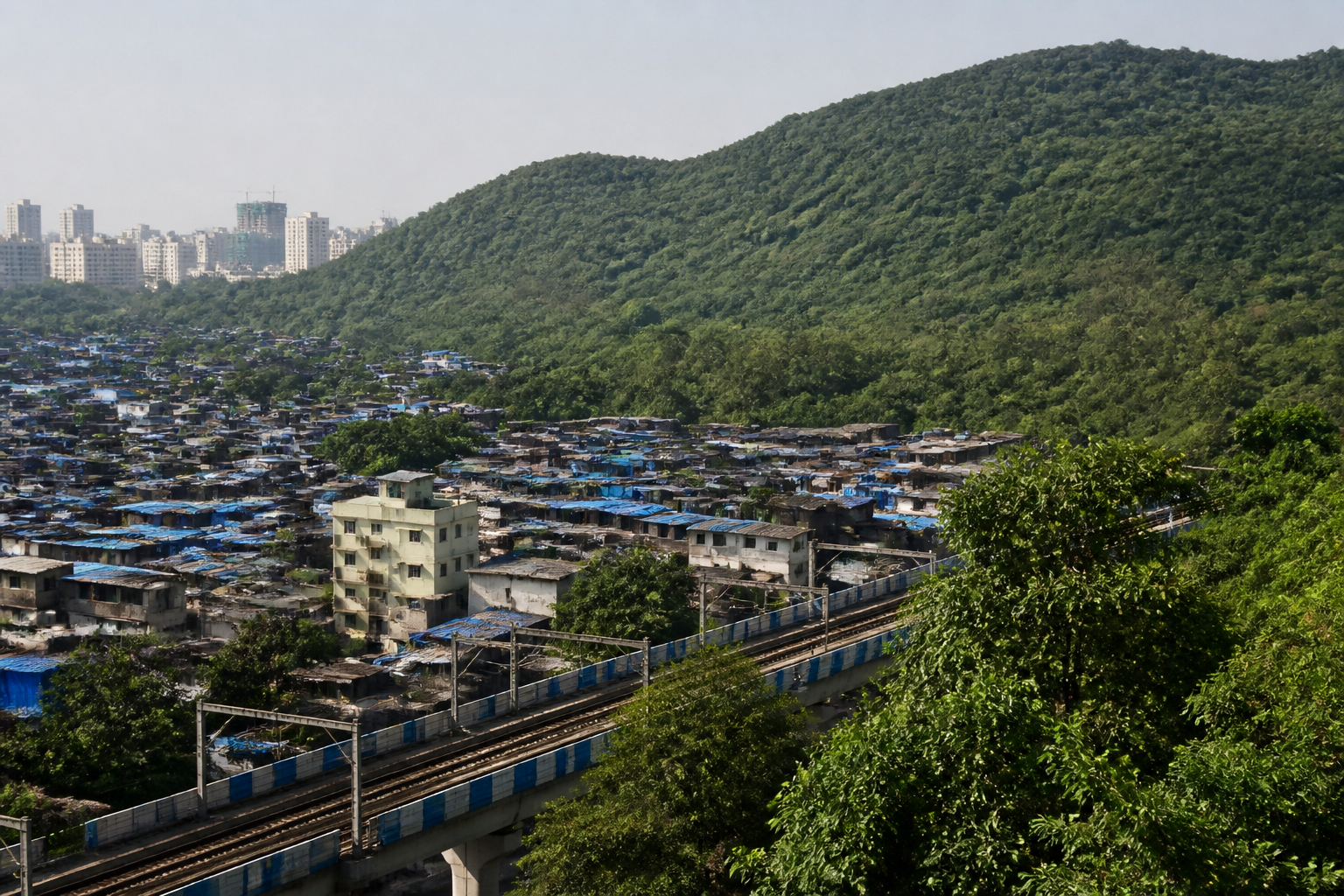
The Maharashtra government has accelerated work on a four-stage resettlement plan for residents living within and along the boundary of Sanjay Gandhi National Park in Mumbai. The plan covers approximately 25,000 people, but the government’s immediate focus is narrower: relocating about 4,000 residents whose settlements may obstruct construction of a protective wall around the park.
The decision followed a high-level meeting chaired by Deputy Chief Minister Eknath Shinde at Sahyadri Guest House, according to a report by Loksatta. The meeting reviewed the status of residents living inside the park and in adjoining areas, the availability of alternative housing, the need to establish the park’s precise boundary and the shortage of basic services in settlements awaiting a final resettlement arrangement.
The announcement is not simply a housing-allocation exercise. It brings together four questions that Mumbai has struggled to resolve in several contested urban areas: how a protected landscape is demarcated, how long-established residents are identified and relocated, how far people can be moved without undermining their livelihoods and social networks, and what public authorities owe residents while a rehabilitation process remains incomplete.
The government has directed the Revenue Department to determine the park’s boundary and begin the rehabilitation process for affected residents accordingly. This step is central to the entire plan. Without a clearly established boundary, it becomes difficult to determine which residents are affected by conservation-related restrictions, which structures are in the path of the proposed protective wall and which households should be considered for relocation.
The reported figures show the scale of the challenge. Around 25,000 residents are proposed to be resettled in four stages. The Maharashtra Housing and Area Development Authority, or MHADA, and the Slum Rehabilitation Authority have informed the Forest Department that completed homes are available for approximately 20,000 people at Khoni near Kalyan and Shirdhon near Panvel. However, these locations are far from Mumbai, and local residents have opposed relocation there. That resistance has contributed to the delay in the rehabilitation process.
The disagreement over relocation sites reveals the difference between housing availability and workable resettlement. A completed dwelling may satisfy one administrative measure of rehabilitation, but distance from the existing settlement can affect access to jobs, schools, healthcare, transport and community networks. The material supplied for the announcement does not establish the residents’ detailed livelihood patterns or the terms attached to the available homes. It does, however, record the central issue: homes have been identified, but the proposed locations have not been accepted by many residents because of their distance from Mumbai.
The government’s latest direction attempts to create a differentiated approach. Residents willing to move to the completed homes at Khoni and Shirdhon are to be rehabilitated there. For the remaining residents, MHADA and the Slum Rehabilitation Authority will examine their available housing stock and seek options as close as possible to the existing area. This approach acknowledges that a single relocation site may not be suitable for all households, although the report does not specify how eligibility, consent, allotment or transport-related concerns will be handled.
The plan also separates the case of approximately 2,000 local tribal residents living within the park. Rather than moving them into multi-storey buildings, the government has directed officials to consider homes compatible with their traditional way of life within the park area itself. The reported proposal is for one-plus-one-storey houses in the same area. This is a significant departure from a standard apartment-based rehabilitation model, but the supplied report does not provide details about the exact location, land tenure, design standards, environmental clearances, construction agency or timeline for these homes.
That distinction matters because the resettlement of tribal residents raises a different set of administrative and planning questions from the relocation of other households. The government’s stated approach recognises the importance of the existing way of life, but implementation will depend on how the proposed homes are reconciled with the park’s legal boundaries, conservation requirements and access to services. The available information confirms the policy direction, not the operational framework.
The protective wall provides the immediate physical trigger for the first phase. The Bombay High Court has directed that the park’s boundary be determined and that a protective wall be constructed around it. Against that background, the government has decided to prioritise residents who may obstruct the wall’s construction. This sequencing makes the first phase a combination of conservation infrastructure and rehabilitation rather than a complete solution to the wider settlement question.
The order of implementation could shape the credibility of the entire process. If the first phase is limited to clearing the alignment of the wall, residents may experience rehabilitation primarily as an enforcement exercise. If boundary demarcation, household identification, housing selection and basic services proceed together, the process could provide a clearer administrative basis for later phases. The supplied material does not establish which agency will publish the final household list or how disputes over inclusion and exclusion will be resolved.
The government has also ordered temporary measures while resettlement remains pending. Adani has been asked to provide electricity connections, the Brihanmumbai Municipal Corporation has been directed to arrange mobile toilets, and temporary repairs to settlement roads have been ordered in view of Ganeshotsav. These directions address immediate deficits in electricity, sanitation and access roads, which residents reportedly face because the park boundary has not yet been finalised.
The interim measures highlight a recurring problem in urban governance: uncertainty over land status can delay essential services even when people are already living in an established settlement. Electricity, toilets and roads are not only rehabilitation benefits; they are basic interfaces between residents and the city. Providing them temporarily does not resolve the legal or environmental dispute, but withholding them until relocation is completed can deepen the consequences of administrative delay.
The institutional structure described in the report is also complex. The Revenue Department is responsible for boundary-related action. The Forest Department is involved because the land falls within or around a national park. MHADA and the Slum Rehabilitation Authority are examining housing availability and relocation options. The municipal corporation is responsible for mobile sanitation facilities and road repairs, while Adani has been asked to facilitate electricity connections. The deputy chief minister’s office is coordinating the high-level review.
This distribution of responsibilities means that progress will depend on coordination rather than on a single housing decision. A boundary notification without verified household data would leave the rehabilitation list uncertain. Housing stock without resident acceptance would not resolve relocation. Relocation without interim services would leave the remaining settlements exposed to avoidable hardship. The report records the directions issued, but it does not state when each department must complete its assigned task or how progress will be publicly monitored.
The numbers further show why the process cannot be treated as a one-time clearance. The first phase involves about 4,000 residents, while the broader proposal covers approximately 25,000. Around 20,000 homes have reportedly been identified at two distant locations, and around 2,000 tribal residents are to be considered for in-park housing. These figures do not form a single uniform beneficiary group. They point to multiple categories of residents requiring different forms of assessment, housing and consultation.
The gap between the 25,000-person proposal and the first phase is therefore important. The immediate phase may respond to the protective-wall alignment, but most of the proposed resettlement remains unresolved. The government’s instruction to examine housing closer to the existing area suggests that available stock may not match the location preferences or practical needs of all residents. The report does not establish how many nearby homes could ultimately be offered, whether new construction will be required or how long the four-stage process is expected to take.
Sanjay Gandhi National Park occupies a distinctive position within Mumbai’s urban system: it is a protected landscape embedded in a dense metropolitan region, with settlements existing within or beside its boundary. That setting makes the issue larger than a conventional relocation project. The city must protect a legally significant ecological area while dealing with residents whose homes, services and livelihoods are connected to the surrounding metropolitan fabric.
The government’s latest review confirms three immediate directions: establish the park boundary, begin with residents affected by the proposed protective wall and develop more locally suitable options for those unwilling to move to Khoni or Shirdhon. It also confirms a separate in-park housing approach for approximately 2,000 tribal residents and temporary service measures for settlements awaiting rehabilitation.
What remains uncertain is equally important. The supplied report does not specify the final boundary, the household verification process, the consent and allotment mechanism, the schedule for each phase, the detailed design of the proposed tribal housing or the number of homes available closer to Mumbai. Those details will determine whether the announcement becomes an implementable rehabilitation programme or another stage in a long-running administrative process. The next milestones are the boundary determination, the housing inventory prepared by MHADA and the Slum Rehabilitation Authority, and the government’s follow-up on the first phase of relocation.

