


Goa’s rabies-control system is being tested beyond its own borders after about 40 cases were reported in Karnataka’s Karwar and Ankola over the past six months. The response shows that maintaining disease control in one state depends not only on local vaccination and sterilisation, but also on surveillance and coordination across adjoining districts.
According to a report by the Times of India, Goa has intensified monitoring along the Karnataka border after cases were reported in the two neighbouring areas. Ankola is about 70 km from Goa, while Karwar is also close to the state’s northern boundary. The proximity has led authorities to extend their attention beyond Goa rather than treat rabies control as an administrative issue confined within state lines.
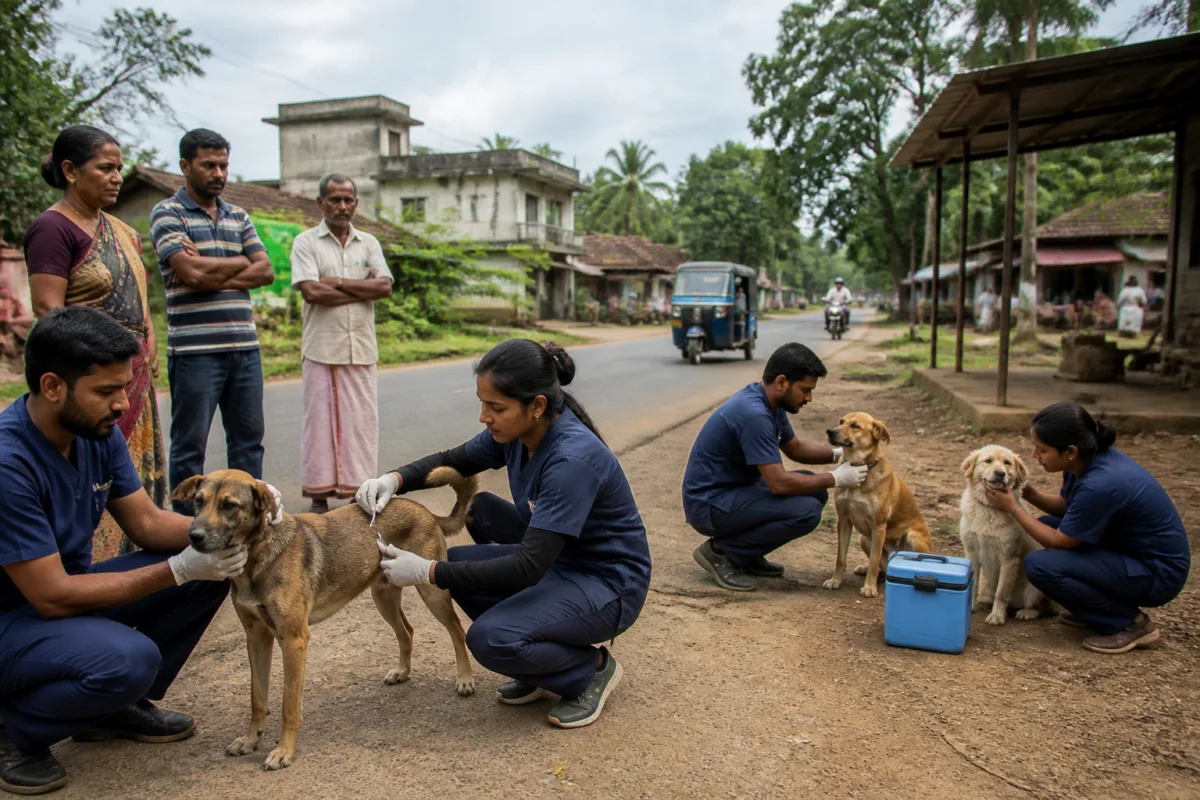
The immediate response includes sterilisation, vaccination, awareness campaigns and closer surveillance on both sides of the border. Mission Rabies director for education, Dr Murugan Appupillai, said around 40 cases had been recorded in Karwar and Ankola during the six-month period. The report does not specify whether these cases involved humans, dogs or other animals, making the precise epidemiological profile of the outbreak unclear. What it establishes is the scale of concern and the decision to respond through coordinated control measures.
That distinction is important. Rabies control is often discussed as a local campaign involving the capture, vaccination or sterilisation of stray dogs. The border response described in Goa indicates a more complex administrative reality. Animal movement, veterinary services, municipal boundaries and public awareness do not stop at a state line. A control programme can therefore be weakened by gaps in a neighbouring jurisdiction, even when local interventions show positive results.
Goa’s stated objective is to retain its status as India’s first 100% rabies-controlled state. The border vigilance is consequently not only a reaction to cases in Karnataka; it is also an effort to protect the results of a longer control programme. The source report says a recent Goa campaign sterilised about 900 dogs and recorded no rabies. Another campaign is expected in about a month.
The reported figures point to two different measures of performance. The sterilisation drive provides an operational number: about 900 dogs were covered in the recent campaign. The absence of detected rabies in that exercise provides a disease-control result. Neither figure, on its own, establishes that the wider risk has been eliminated. Sterilisation can support population management, while vaccination and surveillance are needed to address transmission and identify cases. The decision to combine all four measures—sterilisation, vaccination, awareness and surveillance—reflects that distinction.
The border setting also exposes the limits of judging public-health programmes by state-level labels. Goa may be classified as rabies-controlled, but the condition depends on continued monitoring and on the status of connected areas. Karwar and Ankola are not remote from Goa in administrative or geographical terms. The report’s reference to Ankola being about 70 km from the border makes proximity central to the response. The concern is not a theoretical national threat; it is a nearby regional issue requiring coordination between authorities with separate jurisdictions.
This creates an institutional question: who is responsible when a disease-control risk moves through a connected urban and rural region rather than remaining within one municipality or state? The reported response suggests that the answer cannot be limited to a single local body. Karnataka’s programme is expected to involve sterilisation, vaccination and awareness drives, while authorities on both sides are to strengthen coordination and surveillance. The arrangement places responsibility across state departments, local administrations, animal-health teams and organisations involved in rabies-control work.
The available information does not identify the precise agencies responsible for each activity, the funding arrangements, the number of animals to be vaccinated or the reporting mechanism between Goa and Karnataka. Those omissions matter because the effectiveness of a cross-border programme depends on execution. Surveillance requires regular reporting. Vaccination requires coverage and follow-up. Sterilisation requires sustained operations rather than a single campaign. Awareness programmes require residents to know how to respond to dog bites and where to seek help. The source confirms that these measures are planned or under way, but does not provide their targets or performance indicators.
The reported 900-dog sterilisation campaign illustrates why programme continuity is significant. A campaign can be counted by the number of animals treated, but that number does not explain whether coverage is evenly distributed, whether vaccinated animals can be identified later, or whether new animals enter the area after the operation. The supplied report does not provide those details, so it is not possible to assess the campaign’s coverage or compare it with the animal population in the affected areas.
The same limitation applies to the claim that no rabies was detected during the recent Goa drive. It is a relevant and encouraging finding attributed to the campaign, but it should not be read as proof that every part of the border region is free of risk. The authorities’ decision to maintain vigilance, extend interventions and prepare another drive indicates that control is being treated as an ongoing process rather than a one-time certification.
The story also shows how public safety is connected to the management of animals in cities and settlements. Rabies control involves more than emergency treatment after a bite. It requires systems that link animal birth control, vaccination, case reporting, public communication and monitoring of areas where animals and people interact. When those systems are managed separately, authorities may record activities without building a shared picture of risk. The emphasis on closer coordination suggests an attempt to address that administrative fragmentation.
For residents near the Goa-Karnataka border, the practical importance lies in whether the measures are visible and accessible. Awareness campaigns can help communities recognise risk and report suspected cases. Vaccination and sterilisation drives can reduce exposure when they are implemented consistently. Surveillance can help authorities identify where intervention is required. However, the report does not state how residents can access services, how suspected cases are reported, or whether emergency response arrangements are being expanded.
The Karnataka cases therefore function as a stress test for Goa’s control model. They raise questions about whether a state’s disease-free or controlled status can be sustained without a regional operating framework. Goa’s response is significant because it treats the border as part of the control environment. The approach moves beyond the idea that a successful state programme can be maintained independently of conditions in adjoining districts.
What the evidence confirms is limited but important. About 40 cases were reported in Karwar and Ankola over six months, Goa has intensified border surveillance, and authorities plan a combination of vaccination, sterilisation, awareness and coordination measures. Goa recently sterilised about 900 dogs and reported no rabies in that campaign, with another drive expected in about a month. What remains unclear is the nature of the reported cases, the scale and funding of the Karnataka programme, and the measurable targets for inter-state surveillance.
The next phase will show whether the response becomes a continuing cross-border system or remains a series of periodic campaigns. The planned drive in Goa and the promised coordination with Karnataka are the immediate milestones. Their outcomes will determine whether Goa’s rabies-control claim is supported by a durable regional framework or depends primarily on interventions within the state.

