


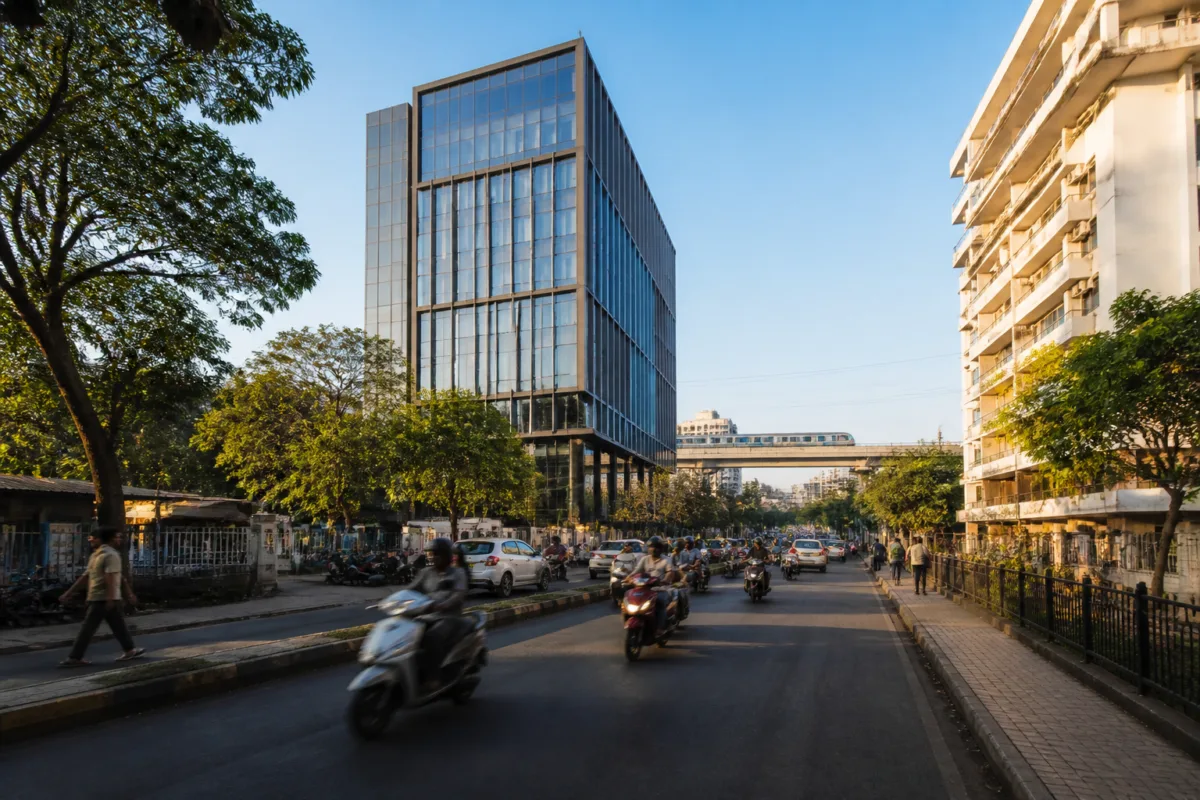
Pune’s office market is expanding, but its next challenge is not simply to add more workspace. It is to decide where that workspace should go. The city’s established employment districts—Hinjawadi, Kharadi, Baner and Balewadi—will remain important, yet new market evidence is drawing attention to western and central neighbourhoods where large residential populations, public transport and everyday services already exist.
The question is whether places such as Kothrud, Erandwane, Karve Nagar and Paud Road can support a larger share of institutional-quality offices without reproducing the congestion and access problems associated with peripheral commercial growth. The answer will depend on more than demand from companies. It will also be shaped by the availability of suitable properties, planning regulations, building standards and the capacity of roads and public transport.
This debate is emerging as Pune records strong office activity. Colliers reported 3.2 million square feet of Grade A office absorption in the city during the third quarter of 2026. Between January and September, absorption reached 6.9 million square feet, a 6% increase over the corresponding period last year. Cushman & Wakefield recorded gross office leasing of 1.99 million square feet in the third quarter.
The figures point to sustained demand, but they do not by themselves answer where future offices should be built. Office growth concentrated in a limited number of corridors can increase the distance between homes and workplaces for many employees. A broader distribution of employment locations could create more options, but only if the new hubs are connected, appropriately planned and capable of accommodating commercial activity without overwhelming existing neighbourhoods.
Commute infrastructure is already a major consideration in corporate location decisions. According to CBRE’s 2026 India Office Occupier Survey, 70% of occupiers prioritise commute infrastructure when selecting office locations. The survey finding places transport at the centre of the real estate decision rather than treating it as a secondary amenity.
For companies, long and unpredictable journeys can affect punctuality, attendance and employee experience. They can also influence an organisation’s ability to attract and retain talent. For employees, the location of an office determines not only travel time but also the daily cost and reliability of reaching work. In a city where residential growth and employment growth do not always occur in the same corridors, the office map becomes part of the mobility system.
Pune’s traditional employment hubs developed at different stages of the city’s expansion. Hinjawadi became associated with large technology campuses, while Kharadi emerged as a major eastern office district. Baner and Balewadi grew as mixed residential and commercial corridors. These locations continue to attract companies, but the market evidence cited in the report suggests that demand is also moving towards secondary or non-core micro-markets.
CBRE’s third-quarter 2026 India Office Figures noted a shift in transactions towards non-core corridors amid limited availability in core micro-markets and fresh supply in emerging locations. Around 51% of global capability centres establishing new offices during the quarter selected secondary micro-markets. Grade A+ buildings accounted for approximately 60% of GCC leasing.
These figures show two linked changes. First, companies are becoming more willing to consider locations beyond the city’s most established commercial districts. Second, moving away from a core corridor does not mean accepting lower-quality space. Building quality remains important, particularly for global capability centres and other occupiers that require modern services, reliable operations and formal workplace standards.
That distinction matters for neighbourhoods such as Kothrud. The area has traditionally been known for housing and educational institutions, but it also has healthcare facilities, retail, restaurants and other everyday services. Its established urban environment offers a different development model from a peripheral office campus, where commercial activity and supporting infrastructure may be delivered together but where employees can remain dependent on long-distance travel.
A workplace in or near an existing residential catchment could allow some employees to live closer to their offices. It could also give companies access to talent already living in western and central Pune. However, these potential benefits should not be treated as automatic. Kothrud’s suitability for additional office development would depend on whether appropriate sites are available, whether planning rules permit the required intensity and whether transport systems can absorb additional peak-hour demand.
The western Pune office submarket offers an important indication of both opportunity and constraint. Cushman & Wakefield includes Erandwane, Karve Nagar, Paud Road and Kothrud in its SBD West submarket, along with Aundh, Baner and Pashan. At the end of the third quarter of 2026, vacancy in this submarket stood at 3.9%, compared with a citywide vacancy rate of 13.88%.
A lower vacancy rate can indicate stronger demand for available space, but it can also mean that the market has less immediate flexibility. The same submarket had approximately 11.77 million square feet of planned and under-construction Grade A office supply through 2028. That pipeline creates room for expansion, while also raising questions about how new projects will connect with roads, buses, metro stations and surrounding residential areas.
The distribution of this supply will be significant. If large developments are placed in locations with weak public transport or inadequate last-mile connections, the city may gain office floor space without gaining more accessible employment. Conversely, development close to existing transit and services may reduce some travel distances, provided that the surrounding infrastructure is improved at the same time.
Metro connectivity strengthens the case for considering western Pune as part of a wider employment catchment. Stations including Vanaz, Anand Nagar, Ideal Colony and Nal Stop are located on the Vanaz–Ramwadi corridor, linking western Pune with central areas such as Deccan and the eastern corridor. These links can improve access for nearby residents and for workers travelling from other parts of the city.
The proposed Line 4A extension from Nal Stop towards Warje and Manik Baug could further strengthen connections across western and south-western Pune, subject to implementation. The qualification is important: a proposed connection cannot yet perform the function of an operating one. Office planning based on future transport capacity must therefore be aligned with actual project progress, station access and interchange arrangements.
Metro access alone will also not resolve the workplace-location problem. Employees must reach stations, transfer between modes and complete the final part of their journey. Bus services, pedestrian access, multimodal interchange facilities and reliable last-mile connectivity will determine whether a station is genuinely useful for office commuters. A commercial hub may be close to a metro line on a map but remain difficult to access if the route between the station and the workplace is unsafe, congested or poorly connected.
This makes the office-location question an institutional one. Real estate companies can develop buildings, but transport agencies, municipal authorities and planning institutions shape the conditions under which those buildings function. Decisions on floor-space intensity, access roads, parking, public transport, footpaths and building approvals can determine whether a new office cluster becomes a connected urban centre or another traffic-generating destination.
The data also points to the growing role of global capability centres in Pune’s market. GCCs accounted for approximately 65% of leasing activity recorded by Cushman & Wakefield in the third quarter of 2026. Banking, financial services and insurance was the largest contributing sector, followed by engineering and manufacturing, IT-BPM and flexible workspaces.
These sectors may have different workplace requirements, but they share a need for access to skilled workers and dependable office operations. Their location choices can therefore influence the city’s broader employment geography. If a significant portion of new demand moves towards secondary micro-markets, the shift could support a more distributed urban economy. If it remains concentrated in a few corridors, the city’s expansion may continue to reinforce long cross-city journeys.
The available evidence does not establish that Kothrud will become a major office hub, nor does it show that employment decentralisation will reduce Pune’s total congestion. It does, however, show why the possibility is being considered. Office absorption is rising, core micro-markets face constraints in some locations, companies are examining secondary corridors, and commute infrastructure is a stated priority for occupiers.
The larger urban question is whether Pune can coordinate housing, employment and transport before commercial growth hardens into a pattern that is expensive to change. Established neighbourhoods may offer a starting point because they already contain residents, institutions and services. Yet their capacity is not unlimited, and additional office development must be tested against local planning rules, road capacity, public transport quality and the needs of existing communities.
Pune’s next phase of office growth will therefore be measured not only in square feet leased or delivered. It will also be measured by how many people can reach work reliably, how well new buildings connect to public transport and whether employment opportunities become less concentrated in a handful of distant districts. Kothrud and western Pune may offer part of that opportunity, but the outcome will depend on how real estate decisions are matched with transport and urban infrastructure planning through 2028.

