


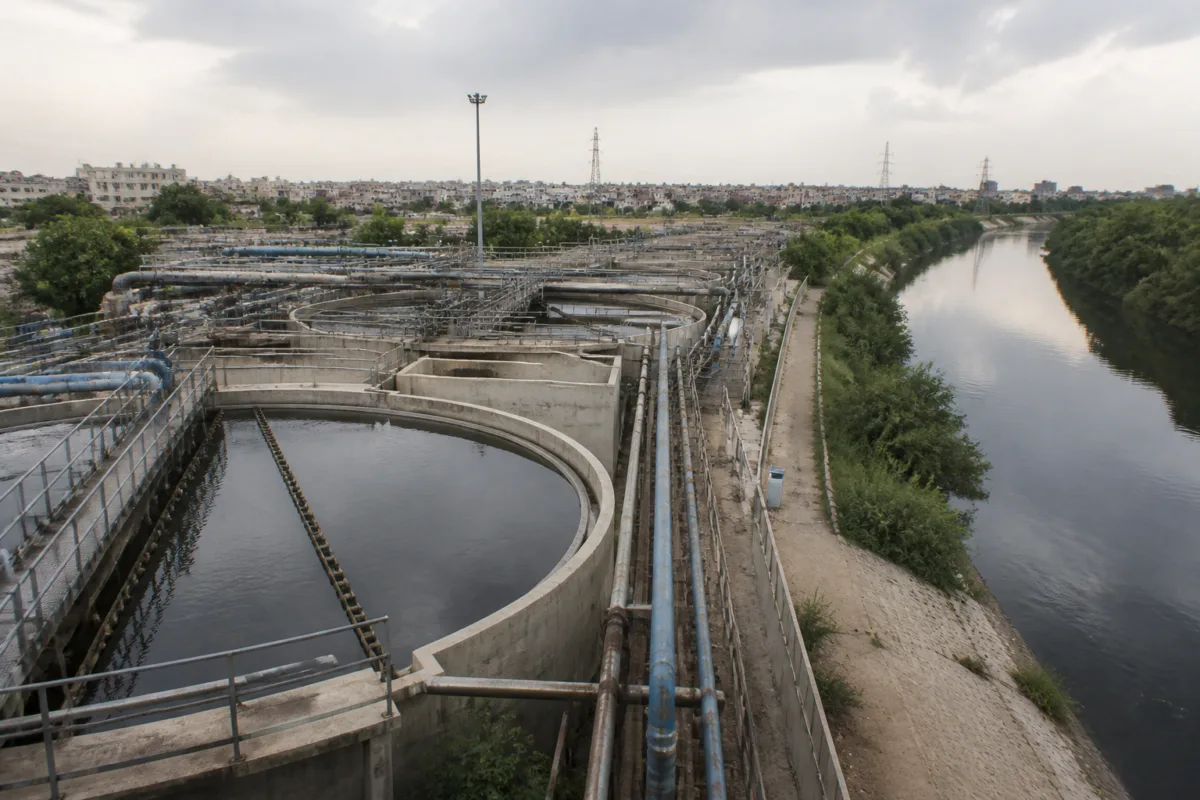
A Delhi Pollution Control Committee monitoring report has found that at least seven sewage treatment plants failed prescribed discharge standards in September, exposing a gap between the city’s wastewater-treatment infrastructure and the quality of water it is required to release. The failures involved total suspended solids, biochemical oxygen demand and faecal coliform levels—three indicators that show whether treated sewage is still carrying excessive organic matter, suspended material and harmful microbial contamination.
The findings matter because sewage treatment plants are not simply end-of-pipe facilities. They are a critical part of the urban water system, standing between household and commercial wastewater and the Yamuna or other receiving water bodies. When their outlet samples exceed prescribed limits, the problem is not limited to the performance of an individual plant. It raises questions about monitoring, operations, maintenance, treatment capacity and the institutional ability to ensure that public infrastructure performs after it has been built.
The DPCC report assessed samples from more than 30 sewage treatment plants in the national capital. Samples were collected from inlet and outlet points, allowing the regulator to compare the quality of sewage entering a facility with the quality of treated discharge leaving it. The report identified seven plants that did not meet the prescribed standards during the September monitoring cycle.
The most severe figures reported were recorded at the Yamuna Vihar Phase III plant. Its outlet sample showed faecal coliform at 64,000 MPN per 100 millilitres, against a permissible level of 230 MPN per 100 millilitres. That is not a marginal exceedance. The same outlet sample recorded total suspended solids of 109 milligrams per litre against a limit of 10 milligrams per litre, while biochemical oxygen demand stood at 42 milligrams per litre against a prescribed limit of 10 milligrams per litre.
These indicators describe different aspects of wastewater quality. Total suspended solids measure material remaining suspended in water, while biochemical oxygen demand indicates the amount of oxygen that microorganisms require to break down organic matter. Excessive levels can reduce water quality and increase the pollution burden on receiving water bodies. Faecal coliform is an indicator of contamination associated with human and animal waste. Its presence at the levels reported by the DPCC shows that treatment at the sampled outlet was not delivering the required microbial quality.
The Yamuna Vihar Phase III figures are particularly important because they show simultaneous failure across all three reported parameters. A plant may face a problem with one treatment stage or one operating condition, but the data supplied in the report points to a broader failure at the outlet on the day represented by the sample. The available report does not establish whether the problem was temporary, recurring or linked to a specific equipment or operational fault. That distinction will be important for determining whether the city is dealing with isolated breakdowns or a persistent performance problem.
The Mehrauli plant also recorded high faecal coliform, along with elevated total suspended solids and biochemical oxygen demand. The other plants identified as non-compliant were located at Yamuna Vihar Phase I, Okhla, Keshopur, Ghitorni and Vasant Kunj. At Ghitorni, faecal coliform reached 17,000 MPN per 100 millilitres. The Vasant Kunj plant recorded 8,100 MPN per 100 millilitres.
Taken together, the locations show that the issue is not confined to one part of Delhi. The plants named in the report are spread across different urban areas, from the north-east to south and south-east Delhi. That geographical spread does not by itself prove a common cause, but it does make the findings relevant to the city’s wider wastewater governance rather than to one local facility alone.
## Delhi sewage treatment plants and the performance gap
The central challenge highlighted by the report is the difference between infrastructure provision and infrastructure performance. The existence of more than 30 monitored sewage treatment plants indicates a substantial treatment network. Yet the DPCC’s outlet samples show that some facilities were not meeting the standards expected of them. For residents, the practical result is that a plant can remain part of the city’s formal sanitation system while still releasing discharge that fails regulatory limits.
This distinction is often lost when urban infrastructure is discussed through project counts, installed capacity or construction milestones. Sewage treatment is an operational service. Its effectiveness depends on the continuous functioning of biological, mechanical and disinfection processes, regular maintenance, skilled operation, reliable power and appropriate handling of sludge and incoming flows. The report supplied for this story does not provide plant-wise capacity, operating costs, downtime, staffing or maintenance records, so those factors cannot be assigned as causes. It does, however, demonstrate why those details matter.
The DPCC’s monitoring method also provides an important institutional signal. By collecting samples at inlet and outlet points, the committee is not merely recording pollution in a receiving water body. It is examining whether treatment facilities are reducing pollution before discharge. That places compliance at the level where responsibility can be more clearly traced: the plant outlet, its operator and the agencies responsible for oversight.
At the same time, one monitoring cycle cannot establish the full operating history of every plant. The report identifies failures in September, but the supplied material does not state how frequently each facility was tested, whether earlier samples showed similar results, or what corrective action followed. It also does not say whether the plants were operating under normal flow conditions when the samples were collected. These are not reasons to dismiss the findings; they define the questions that a functioning compliance system must answer.
## What the numbers reveal about urban water governance
The reported exceedances are significant because the standards are expressed as limits, not broad targets. At Yamuna Vihar Phase III, faecal coliform was 64,000 MPN per 100 millilitres against 230 MPN per 100 millilitres. At Ghitorni and Vasant Kunj, the reported levels were 17,000 and 8,100 respectively. The scale of these differences indicates that the concern is not simply a technical debate over small variations in laboratory results.
Similarly, the Yamuna Vihar Phase III outlet recorded total suspended solids at 109 milligrams per litre against a limit of 10, and biochemical oxygen demand at 42 milligrams per litre against a limit of 10. The figures show that treated discharge from the sampled outlet did not conform to the prescribed limits for the parameters reported. The available article does not provide the corresponding inlet values, so it is not possible to calculate the removal efficiency of the plant or determine how much pollution was reduced during treatment.
That missing comparison is important for public understanding. A plant may remove a substantial share of pollutants and still fail to meet the final discharge standard. Conversely, a poor outlet result may reflect a breakdown late in the treatment process even when earlier stages worked effectively. Publishing outlet results creates accountability, but diagnosing the cause requires the complete operating and sampling record.
The report’s findings also underline why environmental regulation cannot end with periodic measurement. Monitoring identifies non-compliance; governance must then establish what happens next. The supplied material confirms that the DPCC conducts periodic monitoring to assess treatment efficiency and ensure compliance with environmental norms aimed at reducing pollution in the Yamuna and other water bodies. It does not specify the notices, penalties, repair orders, retesting schedules or plant-level corrective plans associated with these September failures.
## The institutional question behind the discharge failures
Delhi’s sewage treatment system involves more than a plant and a regulator. Wastewater must be collected through a functioning sewer network, conveyed to the correct facility, treated through multiple processes and discharged in compliance with environmental requirements. A failure at any point can reduce the effectiveness of the wider system. However, the report provided here is a plant-monitoring report and does not establish whether the identified failures originated in collection, conveyance, treatment operations or discharge management.
That makes the next administrative response central to the story. For each non-compliant plant, the public-interest questions are straightforward: Was the plant retested? Was the cause identified? Was equipment repaired or replaced? Did the operator receive a direction to act? Did subsequent samples meet the standard? Without those answers, monitoring remains a record of failure rather than a mechanism for correcting it.
The geographic spread of the plants adds another layer. Delhi’s wastewater burden is distributed across multiple treatment facilities, meaning that the quality of the Yamuna cannot be improved through a single flagship intervention if several plants continue to underperform. The September findings do not quantify the volume of discharge from each facility, so they cannot be used to rank the plants by their contribution to total pollution. They do show, however, that compliance needs to be assessed plant by plant and connected to the condition of the receiving water bodies.
The bigger urban question is whether Delhi measures sanitation success by the presence of assets or by verified performance. A treatment plant is valuable only when it consistently converts incoming sewage into discharge that meets the required standards. The DPCC data makes that performance visible, at least for the parameters and locations reported.
The evidence currently confirms that seven plants failed prescribed limits in September and that several recorded extremely high faecal coliform levels. It does not yet establish the duration, causes or follow-up status of those failures. The next meaningful measure of governance will therefore be the response record: repeat sampling, plant-wise corrective action and transparent confirmation of whether discharge quality returned within prescribed limits.

