


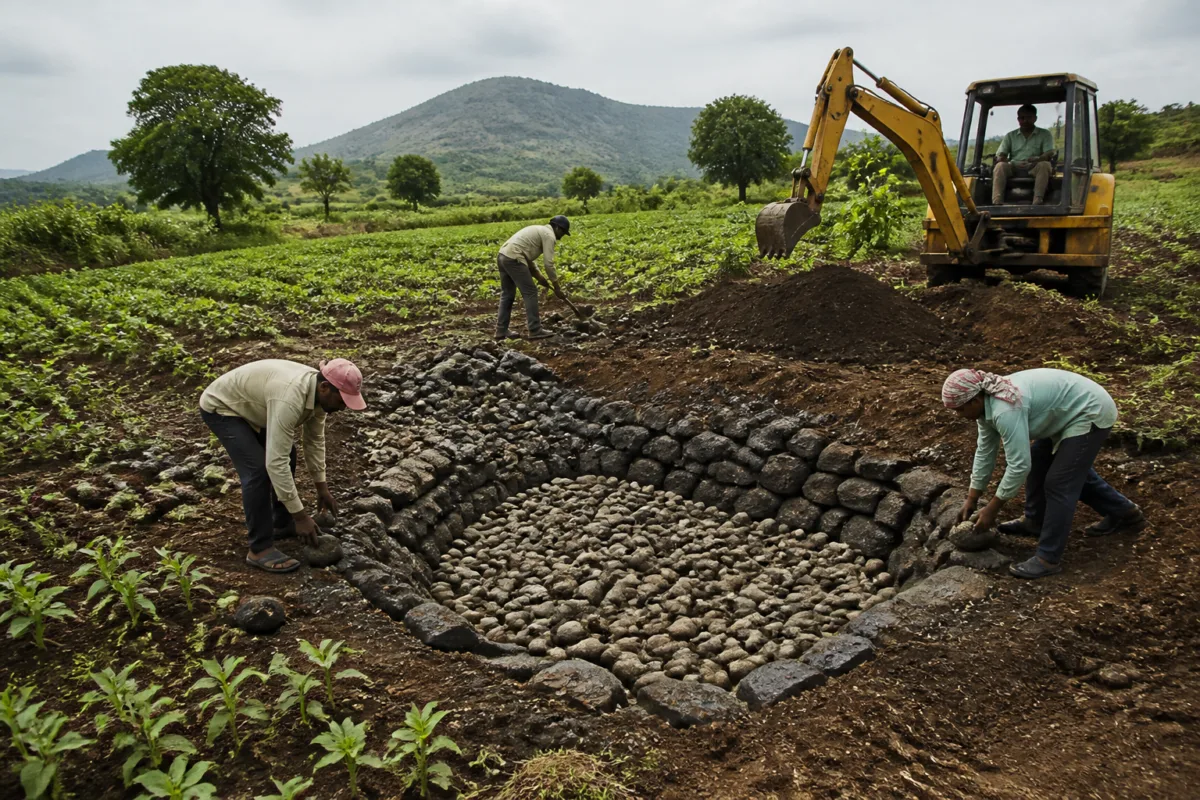
The Pune Zilla Parishad is considering a plan to create rainwater recharge pits in farms across the district to reduce waterlogging during heavy rain and improve groundwater availability for the rabi season. The proposal, known as ‘Jaltara’, would use stone-filled absorption pits placed at points where water collects along a farm’s natural slope.
The initiative is intended to address two connected problems: water accumulating in agricultural fields during intense rainfall and wells drying up after the monsoon. By slowing runoff and helping rainwater enter the ground, the district administration expects the intervention to support groundwater recharge and improve water availability for irrigation after the rainy season.
Under the proposed method, pits would be dug with the help of a JCB at locations where water naturally gathers. Each pit would generally measure about five feet in length, five feet in width and six feet in depth, and would be excavated until murum, or weathered rock soil, is reached. The pits would then be filled with black stone and rounded pebbles to allow rainwater to percolate into the ground.
Additional pits could be created in locations where water remains stagnant for longer periods. The arrangement is expected to help drain excess rainwater from fields while retaining part of the runoff within the soil profile. The district administration has not yet finalised the number of pits, the locations where the work would begin or the timeline for implementation.
The proposal is based partly on work carried out in villages in Mantha and Partur talukas of Jalna district. Those projects were implemented through public participation, non-governmental organisations and corporate social responsibility funding. Pune officials are examining whether a similar approach can be adapted for farms in the district.
Pune Zilla Parishad president Veerdhवल Jagdale and chief executive officer Gajanan Patil have expressed support for exploring the initiative. Jagdale said the district needs works such as Jaltara and that the programme could be effective if implemented across all talukas. He said the Zilla Parishad was considering whether funds from the Sixteenth Finance Commission could be allocated for the work.
The administration also plans to seek demands for such works from Zilla Parishad members before deciding on the scale and funding structure. That process will determine whether the proposal becomes a district-wide programme or is first tested in selected areas.
The proposed pits are designed to complement, rather than replace, conventional water-conservation works. Their immediate objectives are to improve the drainage of excess rainwater, increase the amount of rainfall entering the ground, reduce water stagnation in fields and potentially improve water availability for rabi irrigation. The next formal steps are the collection of local demands and examination of funding provisions under the Sixteenth Finance Commission.

