


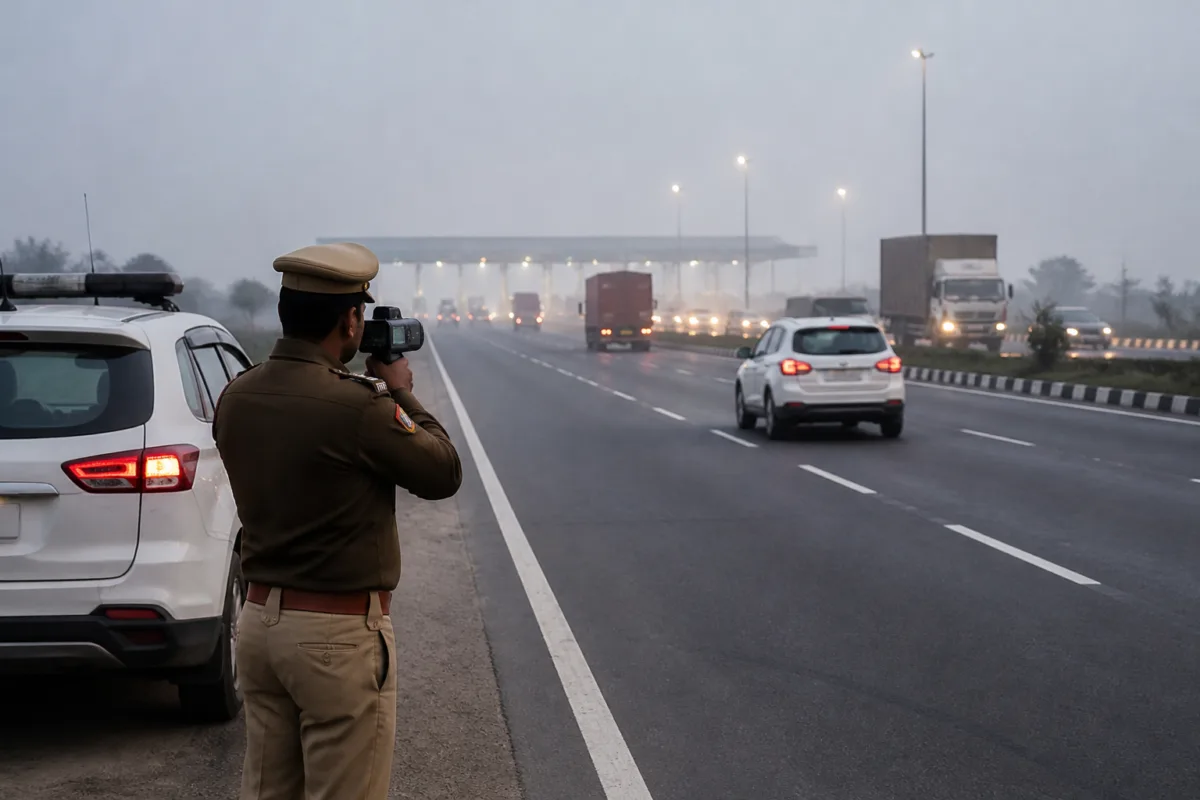
Uttar Pradesh’s expressway network recorded 29,785 speeding violations during a seven-phase enforcement drive, with authorities issuing fines totalling ₹6.06 crore over 21 hours of active checks. The figures, released by the state police, underline the scale of speeding on high-speed corridors as winter fog brings lower visibility and higher road-safety risks.
Conducted between October 26 and November 21 under Operation Safe Speed, the drive used speed interceptors on expressways across the state. Each phase involved three hours of enforcement on both carriageways, covering traffic in both directions. Police said the operation detected an average of 1,418 speeding motorists every hour.
The highest recorded speeds included 171 kmph, 167 kmph and 162 kmph, according to the police release. The Yamuna Expressway accounted for the largest share of violations, with 9,922 challans and penalties of ₹2.09 crore. The Ganga Expressway followed with 4,099 challans and ₹78.98 lakh in penalties.
The Purvanchal Expressway recorded 3,460 challans and ₹68.34 lakh in penalties, while the Agra-Lucknow Expressway recorded 3,446 challans and ₹69.58 lakh. Other figures released by the police included 3,067 challans on the Delhi-Dehradun Expressway, 1,892 on the Delhi-Meerut Expressway, 1,429 on the Gorakhpur Link Expressway, 1,166 on the Bundelkhand Expressway and 991 on the Eastern Peripheral Expressway. A further 313 challans were issued on other routes.
The enforcement figures have coincided with tighter winter speed restrictions. The Uttar Pradesh Expressways Industrial Development Authority revised speed limits from November 15 on the Agra-Lucknow, Purvanchal, Bundelkhand, Gorakhpur Link and Ganga expressways. The limits distinguish between daytime travel, from 8 am to 8 pm, and night-time travel, from 8 pm to 8 am.
For light motor vehicles, the maximum speed on these routes is 80 kmph during the day and 60 kmph at night. Medium and heavy passenger vehicles are restricted to 60 kmph and 50 kmph respectively. Goods vehicles, including trucks, dumpers and trailers, are limited to 50 kmph during the day and 40 kmph at night.
The Yamuna Expressway has separate limits issued by the Yamuna Expressway Industrial Development Authority. These set the maximum speed at 75 kmph for light vehicles and 60 kmph for heavy vehicles. The restrictions are scheduled to remain in force until February 15, 2027.
The traffic directorate has instructed district police units to enforce the limits formally notified by the competent authority for each expressway. This distinction is important for a network where different corridors are governed by separate operating authorities and may have different speed regimes. Enforcement based on the applicable notified limit is intended to avoid treating every expressway as subject to a single blanket standard.
The Director General of Police’s office also issued a November 19 directive asking traffic authorities to strengthen road-safety awareness on expressways and national highways. Toll plazas have been directed to use public-address systems and LED screens to advise motorists during fog conditions.
The guidance asks drivers to reduce speed, remain in designated lanes, avoid unnecessary overtaking, use low-beam headlights and fog lamps, and maintain a safe distance from vehicles ahead. Motorists have also been cautioned against using mobile phones or playing loud music while driving, and advised not to drive when fatigued or sleepy.
The directive extends beyond driver behaviour. It calls for coordination with relevant departments to ensure the availability of ambulances, medical teams and highway patrol units. It also asks authorities to remove accident-hit vehicles promptly, reducing the risk of secondary collisions on high-speed roads. Motorists can seek assistance through helplines 112 and 108.
The police said Operation Safe Speed would continue, with the stated focus on deterring dangerous driving and reducing fatalities rather than merely increasing the number of challans. The enforcement data therefore forms part of a wider road-safety response involving speed detection, seasonal regulation, public communication and emergency preparedness across the expressway system.

