


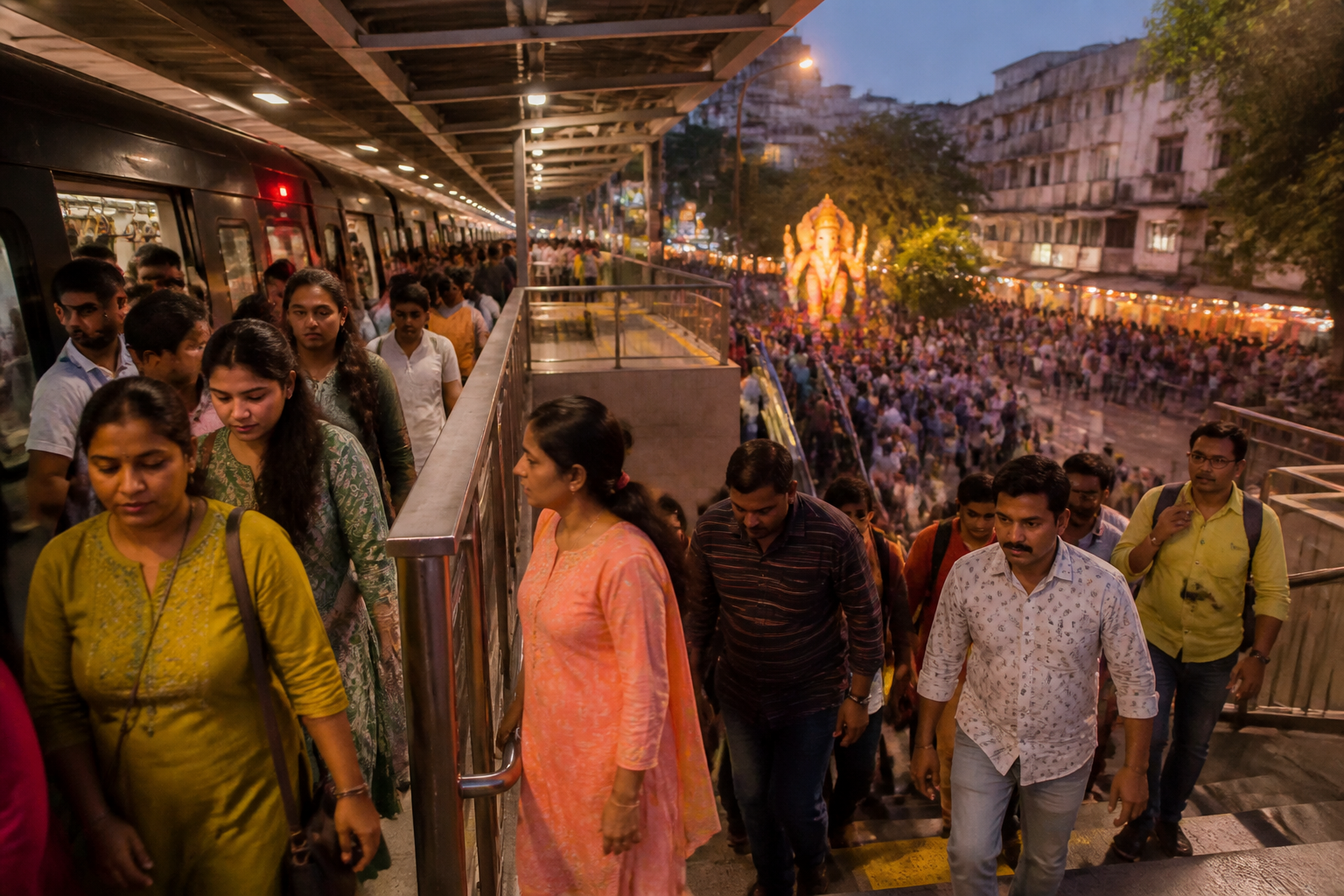
Pune Metro carried 25,06,702 passengers during the first seven days of this year’s Ganeshotsav, generating revenue of Rs 3.79 crore, according to figures reported by Loksatta. The surge shows how quickly a rail system can become the preferred way to reach Pune’s central neighbourhoods when roads are closed, traffic builds up and conventional travel becomes uncertain. It also exposes a harder operational question: whether the Metro’s crowd-management systems are prepared for the demand it is increasingly attracting.
The ridership figures are significant not only because they set a festival record, but because they reflect a change in the role of the Metro within Pune’s urban transport system. During the festival, major roads in the central peth areas are closed to traffic. Alternative routes face congestion, while stations such as Swargate, Mandai and Kasba provide relatively direct access to areas where visitors gather for darshan. The Metro therefore becomes more than a commuting option. It functions as a controlled access system for a dense, time-bound public event.
That distinction matters. Everyday ridership and festival ridership place different demands on a transport network. Regular travel is distributed across working hours and familiar origin-destination patterns. A major festival creates concentrated peaks: large numbers of people arrive at similar times, move towards a limited number of destinations and return after programmes or processions. Stations, ticketing areas, entry gates, platforms, escalators and exits must absorb these surges without creating unsafe crowd densities.
The figures reported for 14 to 20 September show how rapidly demand increased. Daily ridership rose from 2,62,671 passengers on 14 September to 2,87,091 on 15 September, 3,19,915 on 16 September and 3,72,832 on 17 September. It reached 3,86,816 on 18 September and peaked at 4,78,477 on 19 September before easing to 3,98,900 on 20 September. The pattern indicates that the festival’s transport pressure was not a single-day spike. It built through the week and intensified around the weekend.
Revenue followed the passenger trend, although the daily figures did not rise in exactly the same proportion. The reported revenue was Rs 43,19,707 on 14 September, Rs 46,93,037 on 15 September, Rs 52,18,175 on 16 September, Rs 61,61,123 on 17 September, Rs 63,60,118 on 18 September, Rs 60,25,271 on 19 September and Rs 51,49,237 on 20 September. Together, the seven-day total was Rs 3,79,26,669. These figures establish that the festival created both a substantial mobility demand and a measurable operating opportunity for MahaMetro.
The comparison with previous years makes the change clearer. Loksatta reported that Metro ridership during the complete Ganeshotsav stood at more than 20 lakh in 2024 and 37,17,578 in 2025. Ridership on the immersion day rose from 3,46,642 in 2024 to 5,90,957 in 2025. For 2026, MahaMetro expects total festival ridership to reach 44 lakh and immersion-day ridership to cross seven lakh.
These numbers should be read carefully. The 2026 figure of 44 lakh is an estimate, not a completed count. The seven-day figure of 25,06,702 is a recorded total for the period reported. The difference between those two numbers represents the expected demand for the remaining festival days, including the immersion procession, when travel patterns are likely to be especially concentrated. The available material does not establish whether the estimate will be met, but it does show that the system is planning for a substantial increase over 2025.
The most important trend is the speed of growth. Between the reported 2024 full-festival figure of more than 20 lakh and the 2025 figure of 37.17 lakh, festival ridership increased sharply. The reported 2026 estimate of 44 lakh suggests continued expansion, although comparisons are affected by the number of festival days, the timing of weekends, road closures and the level of activity in the central peth areas. This is why a single record-breaking day cannot by itself define system performance. The broader question is how consistently the network can manage changing demand across the entire festival period.
The weekend effect is central to that question. This year’s festival included only one Saturday-Sunday period, but the number of people visiting central Pune remained high. The report links the weekend to the highest ridership levels and notes that Metro services were extended until 2 am on Saturday night. Extended operating hours are an important response because festival travel does not follow the normal last-train timetable. Visitors may arrive late, remain in crowded areas for several hours and seek transport after processions or public celebrations end.
However, longer operating hours do not automatically solve the crowd-management problem. According to the report, passengers complained that the arrangements for handling crowds were inadequate even as ridership increased. A transport system can add trains or extend service and still experience congestion if access control, queue management, passenger information, interchange movement and station exits are not scaled at the same time. The source material does not provide operational details such as train frequency, platform occupancy, station-wise passenger loads or the number of staff deployed. Those gaps make it impossible to determine which part of the system faced the greatest pressure.
The reported criticism from transport experts raises a related planning issue. The detailed project report for Pune Metro had projected average daily ridership of up to six lakh passengers, according to the report’s quoted experts. Festival demand is not identical to average daily demand, and the available material does not establish whether that projection referred to the same network configuration or operating conditions. Even so, the comparison is useful because it highlights the difference between designing infrastructure for a projected average and preparing institutions for short periods of extreme concentration.
Urban transport capacity is not limited to the number of trains or the length of a corridor. It includes the full passenger journey: reaching the station, buying or validating a ticket, entering through security, waiting on a platform, boarding safely, exiting at the destination and dispersing into the surrounding street network. During a festival, the last stage is particularly important. A station may move passengers efficiently through its gates but still transfer pressure to a narrow road, a barricaded procession route or a congested market street.
Pune’s central peth areas make this challenge more complex. The Metro stations named in the report are close to destinations that attract large crowds, but proximity also means that passenger flows are concentrated. Road closures may make Metro access more attractive while simultaneously reducing the number of surface routes available for dispersal, emergency access and feeder movement. The source does not provide a detailed traffic-management plan, but the reported road closures and congestion establish the underlying coordination problem between MahaMetro, traffic authorities, police, municipal agencies and festival organisers.
This is where festival transport becomes a governance test. No single agency controls the complete journey. MahaMetro operates the rail service, while road closures and surface traffic involve other public authorities. Crowd safety also depends on policing, barricading, public announcements and emergency response. The report records the Metro’s ridership and revenue, but it does not identify the institutional arrangements used to coordinate these functions. That information would be necessary to assess whether the 2026 response was planned as an integrated mobility operation or assembled through temporary measures.
The available data nevertheless indicate that the Metro is becoming an important part of Pune’s event infrastructure. In 2024, about 3.46 lakh passengers reportedly used it on immersion day. In 2025, the number rose to nearly 5.91 lakh. The expected 2026 figure of seven lakh would represent another substantial increase if achieved. Such growth changes the operational baseline for future festivals. A crowd level that was once treated as exceptional can become a recurring planning assumption.
That shift has implications beyond Ganeshotsav. Large public events, religious gatherings, demonstrations, exhibitions and sporting occasions can all create concentrated travel demand. If Metro use rises whenever road access becomes restricted or surface congestion worsens, the network will increasingly be expected to absorb not just routine commuters but emergency and event-related demand. Planning for this role requires reliable data on station-level flows, peak-hour loads, train frequency, passenger waiting times and the performance of surrounding roads.
The revenue figures also show why high ridership is attractive to the operator. Seven days produced nearly Rs 3.8 crore in reported revenue. But revenue and service quality are not interchangeable measures. A crowded system may generate more fare income while providing a difficult or unsafe passenger experience. The complaints cited in the report underline the need to evaluate capacity through both financial and operational indicators. The available material does not provide enough evidence to judge whether the additional revenue was matched by adequate staffing, security, train deployment or passenger facilities.
The central urban question is therefore not simply whether Pune Metro broke a ridership record. It is whether Pune can convert exceptional festival demand into a more reliable and coordinated public-transport system. The record demonstrates public willingness to use the Metro when it offers a predictable alternative to congested or closed roads. The complaints demonstrate that demand can grow faster than the systems surrounding the trains.
MahaMetro’s expected total of 44 lakh festival passengers and more than seven lakh immersion-day passengers will need to be tested against final counts. Future assessment should also distinguish between total ridership and the passenger experience at the busiest stations. The next stage of the story is not only whether the record is reached, but what the final numbers reveal about station capacity, operating hours, crowd management and coordination with the city agencies responsible for the streets outside the Metro network.

