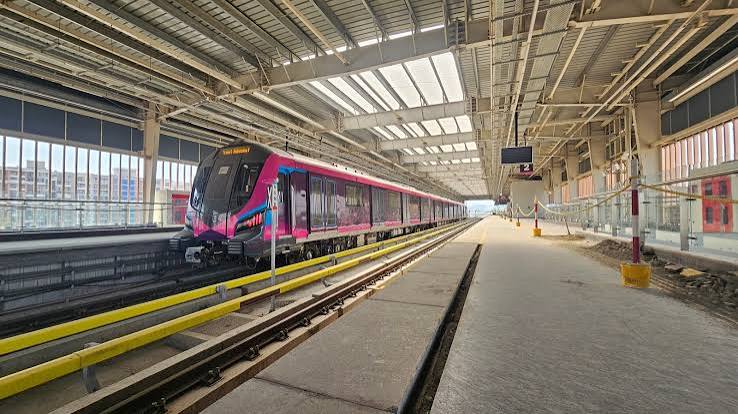
Pune’s Metro Line 3 is now expected to begin passenger services in September, with the first operational section linking Maan in Hinjewadi to Balewadi. The 13-km stretch has already received safety authorisation, bringing the long-awaited corridor closer to public use. For thousands travelling between Pune’s technology hub and the wider city, the opening could mark a significant shift away from increasingly congested roads.
The Pune Metro Line 3 project covers 23.2 km and is planned with 23 stations between Hinjewadi and Shivajinagar. The corridor is being developed under a public-private partnership and has an approved project cost of about ₹8,313 crore, according to the Pune Metropolitan Region Development Authority (PMRDA). The first section received provisional authorisation from the Commissioner of Metro Rail Safety on July 23, clearing the technical barrier to passenger operations. However, services did not begin immediately, as the formal inauguration schedule remained pending. Recent reports indicate that the launch is now being targeted for September. The significance extends beyond faster journeys. Hinjewadi is one of Pune’s largest employment centres, but its growth has placed substantial pressure on road infrastructure. Long commuting times, traffic congestion and dependence on private vehicles have become part of the daily cost of accessing jobs and commercial districts. A reliable mass-transit alternative could reduce some of that pressure while improving access for workers who cannot depend on private transport.
The project’s delivery history also highlights the difficulty of building major urban infrastructure alongside an expanding city. PMRDA’s own project information records extensions to the completion timeline, while progress updates show the corridor substantially advanced but not uniformly ready across all stations. For the Pune Metro Line 3, the immediate test will therefore be operational rather than ceremonial. Frequency, station access, last-mile connectivity, pedestrian safety and integration with buses will determine whether the corridor actually changes commuting patterns. Simply adding rail capacity will not deliver its full value if passengers still face difficult connections at either end.
The remaining sections towards Shivajinagar are expected to follow as construction and safety clearances are completed. The priority now is to convert a long-delayed infrastructure investment into dependable daily mobility, while ensuring that surrounding development remains accessible, safer for pedestrians and compatible with Pune’s longer-term need for lower-carbon urban transport.