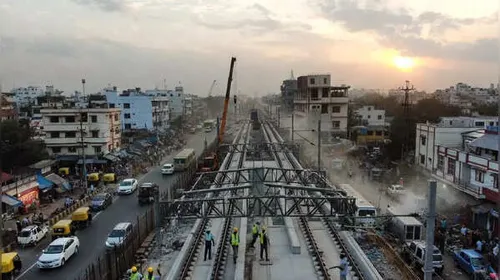
Pune’s southern transport network has entered a new construction phase with groundwork beginning on the underground Metro extension between Swargate and Katraj. Shaft excavation has started at Market Yard, creating the first visible construction activity on the corridor and setting the stage for tunnelling work on a route designed to connect densely populated southern neighbourhoods with the existing Metro network.
The Pune Metro expansion covers 5.46 km and was approved by the Union Cabinet in 2024 at an estimated cost of ₹2,954.53 crore. The sanctioned project comprises three underground stations and is targeted for completion by February 2029. Market Yard is the first station site where excavation has begun. Shafts are being prepared to facilitate the deployment of tunnel boring machines, or TBMs, which will excavate the underground route while limiting the need for large-scale surface disruption. Four TBMs are expected to be brought in phases as tunnelling progresses. The corridor has particular significance because it runs through a combination of residential, educational, commercial and transport-intensive areas. The alignment is intended to improve access to Market Yard, Bibwewadi, Padmavati, Balaji Nagar and Katraj, with the terminal station connecting into the wider road and bus network.
However, the project is evolving beyond the original three-station configuration. Recent project documents identify proposals for additional stations at Bibwewadi and Balaji Nagar. An environmental and social assessment also identifies a five-station configuration, including Market Yard, Bibwewadi, Padmavati, Balajinagar and Katraj. The final station arrangement will therefore be important for understanding the corridor’s eventual catchment and accessibility. The underground design offers an important urban advantage. Construction can reduce the permanent requirement for road space compared with an elevated corridor, although station shafts, construction compounds and traffic diversions can still affect surface movement during the building period. Current work has already required barricading and temporary changes around Satara Road and nearby bus rapid transit space.
For southern Pune, the larger question is whether the Pune Metro expansion can shift commuters from private vehicles to reliable mass transit. That outcome will depend not only on the railway itself, but also on pedestrian access, bus integration, safe crossings, cycling links and convenient interchange facilities. The project’s value will ultimately be measured by how effectively it connects people to jobs, education, markets and public services while reducing pressure on congested roads. Keeping construction on schedule, protecting pedestrian movement and integrating the new stations with existing transport systems will be critical as Pune extends its mass-transit network southwards.