


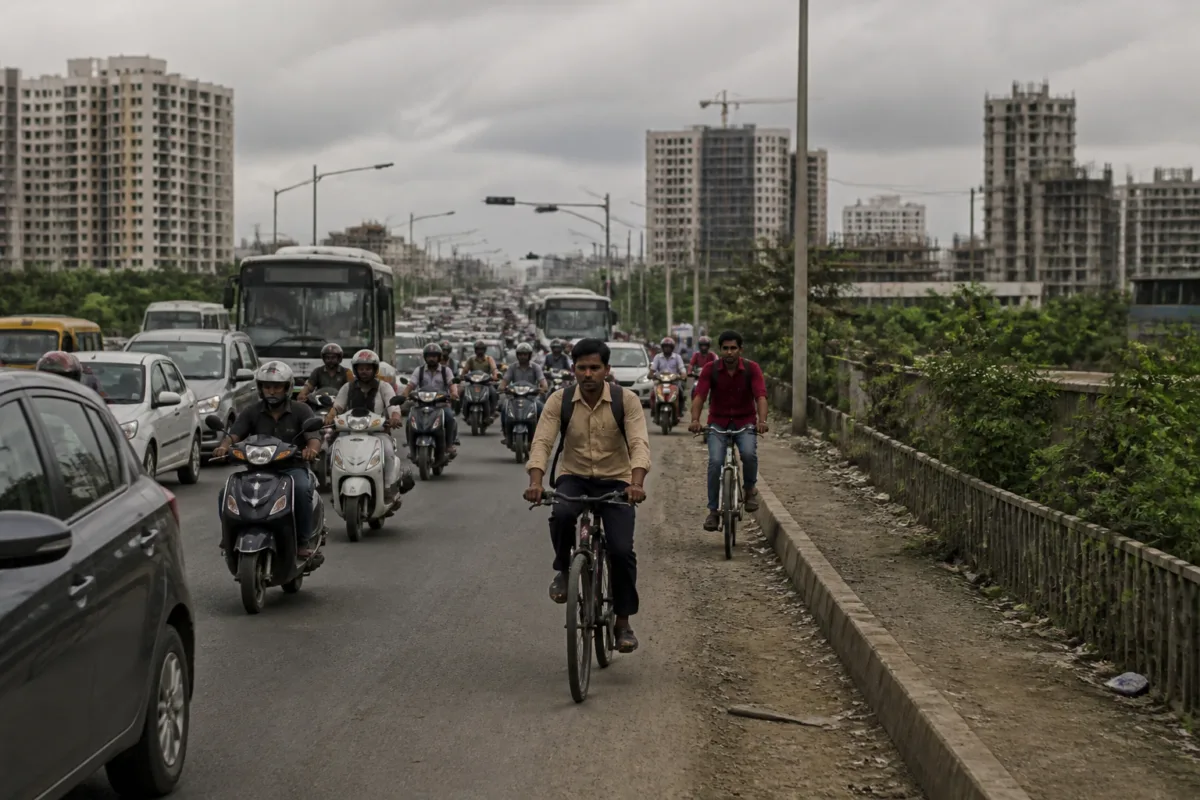
Pune’s cycling share has fallen from 45% of daily trips in the 1980s to just 3% in 2025-26, according to a study conducted by Additional Commissioner of Police Manoj Patil and his team. The decline is not simply a change in personal preference. It records how the city’s physical expansion, longer commutes, rising motorisation and worsening road safety have altered the way residents move.
The same figures show that Pune once had a substantially less motorised travel pattern. In the 1980s, cycling accounted for 45% of daily trips and walking for another 35%. Together, the two modes represented nearly 80% of all daily movement. By 2025-26, cycling had dropped to 3% and walking to 23.5%, while two-wheelers accounted for 37% of trips, cars for 10.25% and public transport for 11%.
The numbers point to a structural transition rather than a temporary fluctuation. Pune’s travel system has moved from one in which walking and cycling formed the bulk of daily mobility to one dominated by private motor vehicles. The change has taken place alongside the city’s geographical expansion, as residential areas have spread farther from the traditional urban core and commuting distances have increased.
Patil attributed the shift to these longer distances and the time required to cover them. As the city expanded towards its outskirts, commuters increasingly turned to two-wheelers because they offered faster travel, he said. The growth of motor traffic then made cycling less safe, creating a mobility cycle in which fewer people cycle, more people use motor vehicles and roads become still less comfortable for those travelling without one.
The historical sequence is clear. Cycling’s share fell from 45% in the 1980s to 37.2% by 1995. It declined further to 11% in the 2008 Comprehensive Mobility Plan survey before reaching 3% in the latest 2025-26 figures. The fall was therefore already well established before the latest estimate. The new figure indicates that cycling has become a marginal mode in a city once strongly associated with bicycles.
The corresponding rise in two-wheeler use is equally significant. Two-wheelers represented around 10% of daily trips in the 1980s and 38% in 2008. Their share stood at 37% in 2025-26. This makes them the dominant mode in the latest figures, even though their share is slightly below the 2008 level reported in the study.
Car use has also expanded, although from a much lower base. Cars accounted for less than 1% of daily trips in the 1980s and 10.25% in 2025-26. The increase adds to pressure on road space, but the data also shows that Pune’s motorisation story is not primarily a shift from bicycles to cars. It is predominantly a shift towards two-wheelers, with car use growing alongside them.
Walking has lost ground as well. Its share declined from 35% in the 1980s to 23.5% in 2025-26. Even after that fall, walking remains a much larger component of daily travel than cycling. This distinction matters because the safety and design conditions that affect cyclists often overlap with those affecting pedestrians: road crossings, vehicle speeds, junction design, footpath continuity and the allocation of street space.
Public transport, meanwhile, has not expanded at the same pace as the city’s travel needs. Its share increased from 8% in the 1980s to 11% in 2025-26. In the same period, the city’s built-up area and commuting distances grew, while private vehicle use became dominant. The figures supplied in the study do not establish the reasons for public transport’s relatively limited increase, but they show that it has not displaced the rise of two-wheelers.
This leaves Pune with a mobility pattern in which the most common trips are made by privately owned motor vehicles, while walking and cycling have lost substantial shares. The issue is not only how many residents choose bicycles. It is whether the city’s transport system allows cycling to remain a practical option for ordinary journeys.
Patil said that very few people now cycle to work compared with the 1980s and 1990s. He linked the change to the outward spread of residential areas, the need for faster travel and unsafe conditions caused by factors including rash and negligent driving. He also said that only a few roads offer safe cycling infrastructure.
That observation connects the travel data to the design and management of Pune’s streets. A bicycle trip is shaped by more than the distance between a home and a workplace. It also depends on whether the route is continuous, whether cyclists are exposed to fast-moving traffic, whether junctions can be crossed safely and whether road space gives non-motorised users a reliable place to travel. The supplied report does not provide an inventory of Pune’s cycle tracks or assess their quality, but it records the police official’s assessment that safe infrastructure is available only on a limited number of roads.
The figures also raise a planning question about the relationship between land use and transport. When housing spreads towards the periphery while jobs and services remain distributed elsewhere, daily trips become longer. A mode that was viable for shorter journeys may become less practical when distances increase. Two-wheelers then offer a relatively quick way to bridge the expanding city, particularly where public transport has not kept pace. The study’s account presents this as a major reason for Pune’s changing travel behaviour.
The timeline suggests that this process has been cumulative. The decline from 45% cycling in the 1980s to 37.2% in 1995 was followed by a sharper reduction to 11% in 2008 and 3% in 2025-26. Over roughly four decades, cycling’s share fell by 42 percentage points. During the same period, walking declined by 11.5 percentage points, while two-wheeler use rose by about 27 percentage points from its 1980s level. Car use increased by more than nine percentage points from a base of less than 1%.
These numbers should not be read as a complete account of Pune’s transport system. The supplied material does not specify the sample size, survey methodology, trip definitions, spatial coverage or whether the different historical estimates were produced using identical methods. It also does not provide figures for travel speeds, road fatalities, emissions, household vehicle ownership or the distribution of public transport use across neighbourhoods. Those limitations matter when comparing data collected across different decades.
What the figures do establish is the direction and scale of change reported by the study. Cycling, once the largest single mode in the city’s daily travel pattern, is now reported at 3%. Walking has also declined, while two-wheelers have become the leading mode. Public transport’s share has risen only modestly in the same comparison. The available evidence therefore describes a city where private motorised mobility has taken the place of a large part of everyday non-motorised travel.
The institutional challenge extends beyond building isolated cycle tracks. The reported causes include urban expansion, longer trips, motor traffic and unsafe driving. These involve multiple responsibilities: land-use planning affects the distances residents travel; road authorities determine street design and maintenance; traffic enforcement affects behaviour and safety; and public transport agencies influence the alternatives available to people who do not want to use private vehicles.
The study was conducted by a senior police official and his team, which places road safety within the account of Pune’s mobility transition. That is important because cycling decline is not only a question of transport preference. If residents abandon bicycles because they feel exposed to traffic, the city is losing a mode partly through the conditions created by its wider road system.
Pune’s experience also shows why a city can retain a reputation for cycling after cycling has ceased to be a major part of daily travel. Cultural memory and current mobility patterns are not the same thing. The latest figures suggest that the image of Pune as a cycle-friendly city is increasingly disconnected from the way most residents now travel.
The central evidence is clear: cycling’s share of Pune’s daily trips has collapsed from 45% in the 1980s to 3% in 2025-26, while two-wheelers account for 37%. The study links the change to urban expansion, longer commutes, faster motorised travel and unsafe road conditions. What remains to be established through fuller data is how these trends vary across neighbourhoods and whether improvements in street safety and public transport can change the pattern. For now, Pune’s four-decade travel record shows that the loss of cycling has been built into the city’s growth model.

