


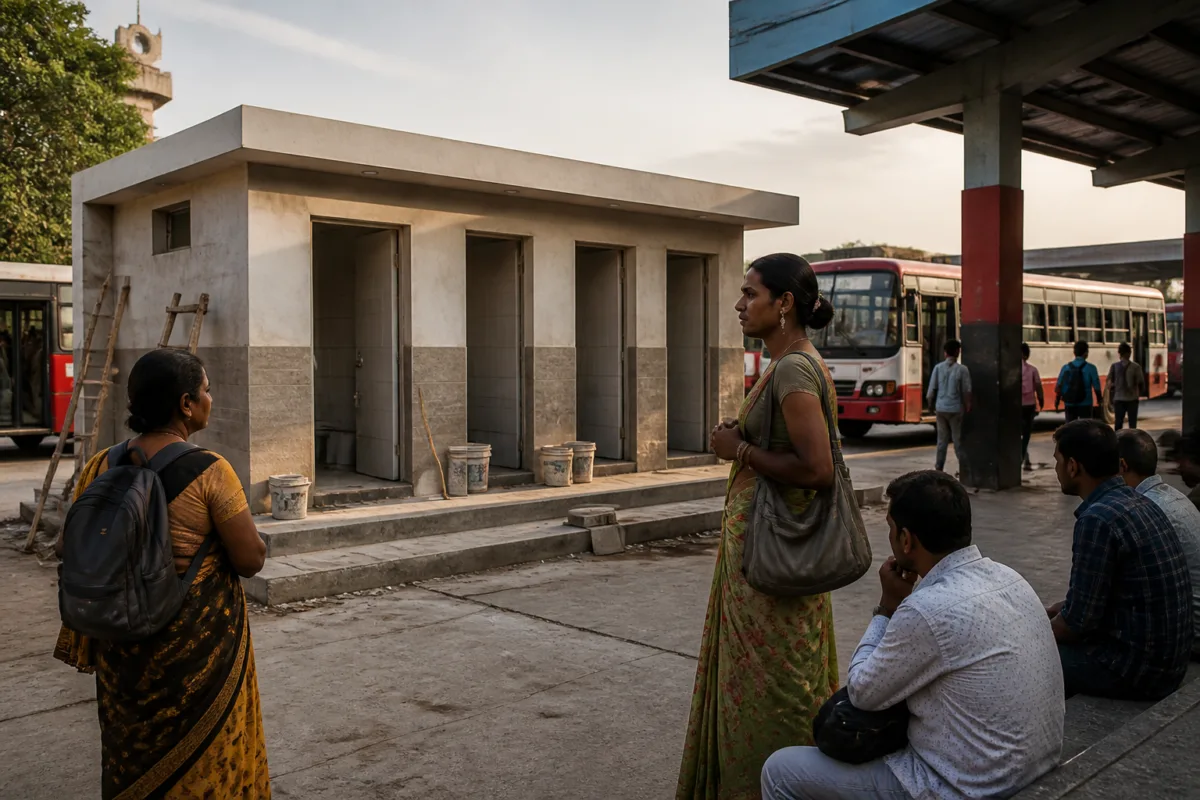
Maharashtra’s approval of Rs 9,76,63,195 for dedicated toilets for transgender passengers at state transport bus stations is more than a facilities announcement. It is an acknowledgement that a basic public amenity has not been serving all users equally, and that access to transport depends partly on whether people can safely use the infrastructure around it.
The proposal covers bus stations across six regional divisions: Mumbai, Pune, Nashik, Chhatrapati Sambhajinagar, Amravati and Nagpur. The state says the work will be funded through a scheme for the welfare of transgender people, with the Transport Department granting administrative approval after intervention by Minister of State Madhuri Misal. The Maharashtra State Road Transport Corporation prepared the proposal for facilities at various locations.
That sequence is important because it shows how an inclusion measure moves through the state’s administrative system. The need was identified in relation to the daily use of ST bus stations. The minister directed the Maharashtra State Road Transport Corporation, or MSRTC, to make arrangements. The corporation then submitted proposals to the state government, and the Transport Department approved the proposal in principle while placing technical and financial conditions on construction.
The decision follows proposals submitted by MSRTC’s vice-chairman and managing director on February 10 and September 22, 2026. Misal subsequently directed the authorities to grant administrative approval on priority and arrange funding through the Social Justice and Special Assistance Department. The Transport Department issued the government resolution on Wednesday, October 14, according to Pune Mirror.
The stated urban problem is straightforward but consequential. The absence of dedicated facilities has made travel difficult for transgender people, particularly at bus stations. Public transport is not limited to the vehicle or the route. It includes waiting areas, ticket counters, platforms, toilets, circulation spaces and the behaviour of the institutions managing them. When one part of that chain is inaccessible or unsafe, the practical value of the transport network is reduced for the affected passenger.
Toilets are often treated as secondary infrastructure in transport planning, even though they determine whether people can remain in a public place for extended periods. Bus stations are places where passengers may wait between services, change buses or travel across districts. For passengers who already face social barriers in public spaces, the lack of a facility that recognises their needs can turn an ordinary journey into a negotiation over safety, privacy and dignity.
The government’s stated rationale is therefore connected to both public infrastructure and public participation. Misal said transgender people must be able to move around public places with dignity and that the decision addresses the difficulties created by the absence of separate toilets at ST bus stations. The statement frames the facilities not as an optional addition but as a response to a barrier affecting access to public space.
At the same time, the approval is not the same as completed construction. The government has stipulated that plans must be approved, detailed cost estimates prepared and technical approval obtained from the respective executive engineers before work begins. These requirements create a formal implementation chain: administrative sanction, site-level planning, cost estimation, technical scrutiny and construction.
That chain also determines how quickly passengers will see a change on the ground. The input supplied for the decision does not specify the number of bus stations covered, the division-wise allocation of the approved amount, the design standards for the toilets or a construction completion deadline. It also does not identify whether each facility will be newly constructed, adapted from existing space or delivered through another site-specific arrangement. Those details will matter because administrative approval alone does not establish the operational reach of the programme.
The funding arrangement adds another institutional layer. The construction expenditure will be met from funds available under the department’s scheme for the welfare of transgender people, while the facilities are being delivered at MSRTC bus stations. This places the initiative at the intersection of social justice policy and transport administration. The Social Justice and Special Assistance Department is associated with the funding route, the Transport Department has granted approval, and MSRTC is the implementing transport corporation.
Such coordination can make inclusion visible in departmental budgets, but it can also make accountability more distributed. MSRTC controls the bus-station environment in which the facilities will be located. The Transport Department has approved the proposal and prescribed the technical process. The Social Justice and Special Assistance Department is identified as the source of scheme funding. The effectiveness of the programme will depend on these responsibilities being translated into site-level execution and maintenance.
The approved amount provides the clearest available measure of the state’s commitment: nearly Rs 9.77 crore across six regional divisions. But without the number of facilities, the amount cannot yet be used to calculate a reliable per-station cost or assess the geographic distribution of the investment. A future government release or implementation document would need to establish those numbers before the programme can be evaluated beyond its approval stage.
The absence of those details is not a minor reporting gap. Public toilets require more than civil construction. Their usefulness depends on location, opening hours, cleanliness, lighting, water availability, signage, maintenance and a clear system for addressing complaints. The supplied material confirms the approval and technical preconditions, but it does not set out the operational or maintenance framework. Those issues will determine whether the facilities function as dependable public infrastructure rather than one-time construction assets.
The decision also raises a wider question about how public agencies define universal access. A standard facility model may appear efficient, but it may not reflect the varied experiences of people using a bus station. The government’s stated focus on transgender passengers indicates that the existing arrangement was not considered adequate for this community. The next stage will show whether planning documents and site designs carry that recognition into practical features and management protocols.
This is particularly relevant for a transport system serving multiple regions and types of journeys. ST bus stations connect urban centres and smaller towns, and the approved geography spans Mumbai, Pune, Nashik, Chhatrapati Sambhajinagar, Amravati and Nagpur. The decision therefore treats the issue as a network-wide concern rather than an isolated problem at one terminal. However, the source material does not establish whether all stations in these divisions will receive facilities or whether the work will be prioritised at selected locations.
The programme’s importance ultimately lies in what it makes visible: transport access includes the right to use supporting public infrastructure without facing avoidable hardship. The approval identifies a specific exclusion in Maharashtra’s bus-station network and assigns a funding and approval pathway to address it. It does not yet establish how many passengers will be served, when construction will finish or how the facilities will be maintained.
The immediate milestones are the approval of plans, preparation of detailed cost estimates and technical clearance from the respective executive engineers. Those steps, followed by construction at the identified MSRTC locations, will determine whether the administrative approval becomes a functioning improvement in the everyday experience of transgender passengers.

