


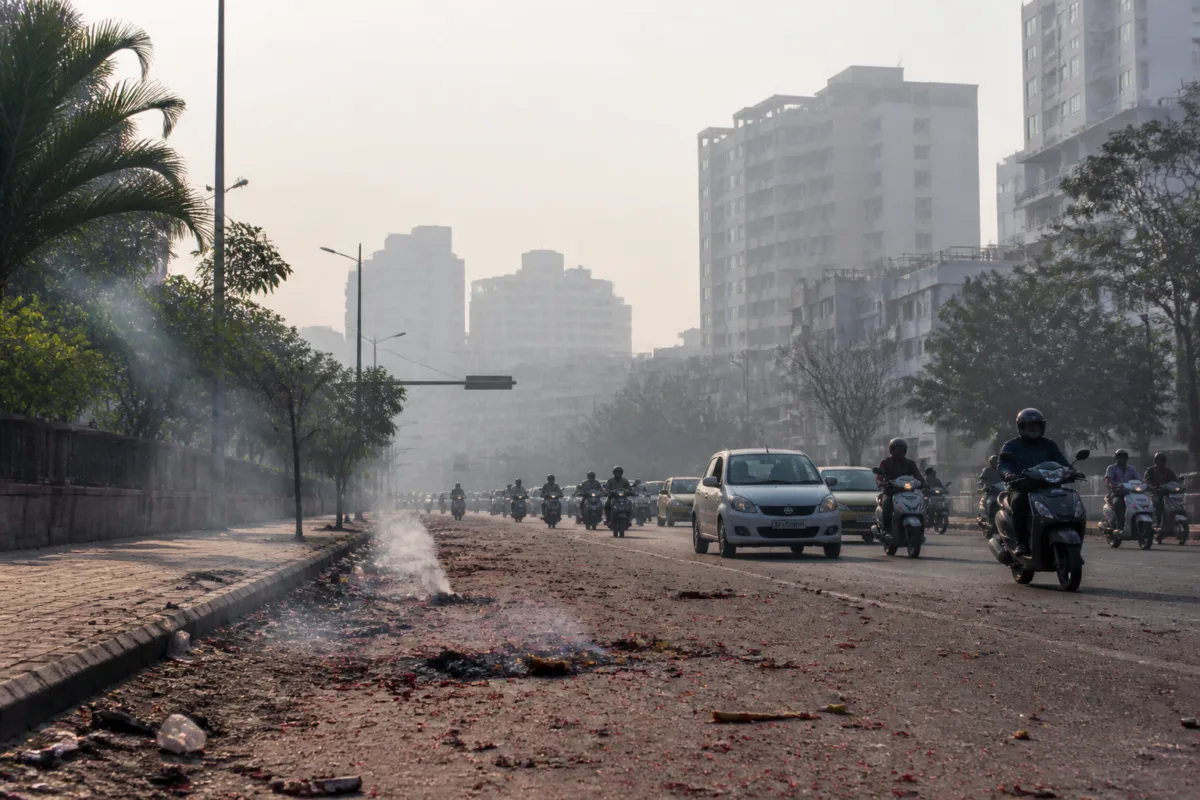
Pune’s air quality deteriorated sharply after Diwali fireworks, with the AQI crossing 500 in Wanowrie and reaching 417 in Kondhwa on Monday morning, while several locations across Pune and Pimpri-Chinchwad recorded very high pollution levels.
Readings displayed on an Air Quality Index application showed the city average crossing 200, placing overall air quality in the moderate-to-poor range under commonly used classifications. The deterioration was more severe in several suburban neighbourhoods, where readings crossed 400. Some locations reportedly recorded levels above 800 during the night, although the report did not identify those locations or specify the monitoring method used for those readings.
The spike followed extensive fireworks after Lakshmi Pujan on Sunday evening. Air quality had remained relatively normal between 8.30 pm and 9 pm, but changed as firecracker activity increased across central Pune and its outskirts. Loud crackers, long firecracker chains and decorative fireworks continued beyond midnight in several pockets, allowing smoke and fine particles to accumulate in the air.
Wanowrie recorded an AQI reading of 517 on Monday morning, according to the readings cited in the report. Kondhwa recorded 417, while Katraj registered 360. The figures indicate that the post-Diwali pollution was not confined to Pune’s central areas and extended across residential and commercial neighbourhoods in the wider urban region, including areas in Pimpri-Chinchwad.
Pune was ranked 34th among the world’s most polluted cities on the AQI application on Monday morning. The report said the city’s air quality had been relatively normal before the main Diwali celebrations, highlighting the sharp short-term change after overnight fireworks.
The pollution spike comes after the end of the monsoon, when rainfall no longer provides the same level of assistance in clearing suspended dust and particles from the atmosphere. Air quality generally improves during the rainy season, while dust levels tend to rise once the season ends. Firecracker emissions add a concentrated burst of smoke and fine particles over a short period.
Under commonly used AQI classifications, readings up to 50 are considered good, while 51 to 100 fall in the satisfactory range. Levels from 101 to 200 are classified as moderate, a range in which children and senior citizens may experience respiratory discomfort. Readings between 201 and 300 are considered poor, while levels above 300 fall into very poor or severe categories, depending on the classification system.
The reported readings show an uneven spread of pollution across Pune’s urban region, with some neighbourhoods recording substantially higher levels than the city average. The report did not provide details of any official advisory, enforcement action or additional monitoring response from civic authorities.

