


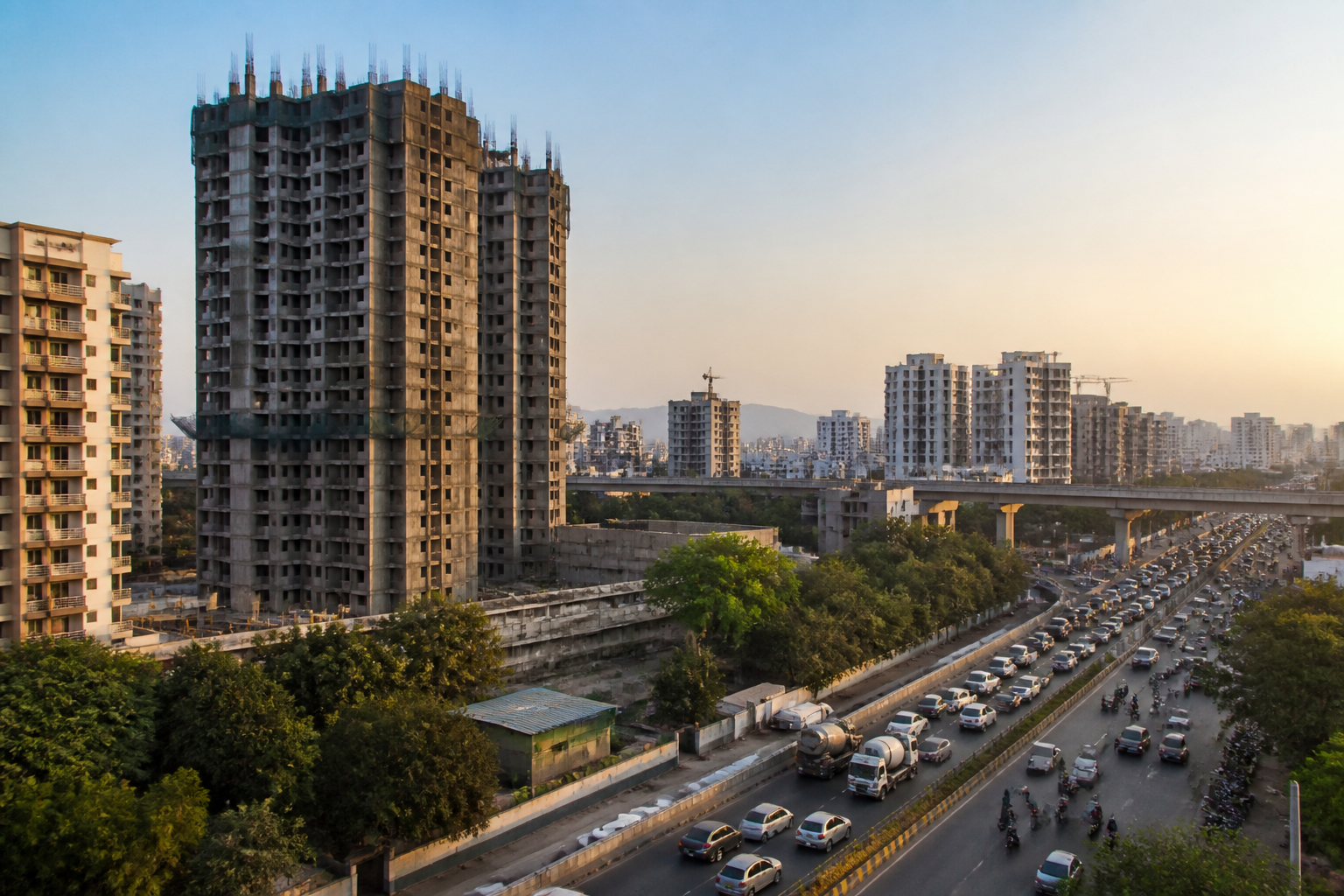
Pune’s debate over higher floor space index (FSI) is moving beyond the question of how much construction the city can permit. It is now raising a more fundamental issue: whether the municipal systems supporting that construction—roads, public transport, drainage, waste management, utilities, schools, healthcare and open spaces—can expand at the same pace.
The immediate trigger is a projection attributed to Pune Municipal Corporation Commissioner Naval Kishor Ram that 6.50 crore square feet of construction could take place within the municipal limits over the next four years. Former MP and Nationalist Congress Party (Sharad Pawar) leader Vandana Chavan has used that projection to ask the civic administration to assess infrastructure capacity before approving new construction.
The available report does not establish how much of the projected construction has already received permission, where it will be concentrated, or what additional population and travel demand it could generate. Those gaps are important because the urban consequences of FSI are determined not only by the total floor area permitted, but also by its location, intensity, land-use mix and relationship with existing infrastructure.
FSI, or floor space index, determines how much built-up floor area may be developed on a given plot. A higher FSI can support greater density and allow more homes or commercial space within areas that are already urbanised. But additional floor area also creates demands for access roads, water supply, sewage and storm-water drainage, electricity, public transport, waste collection, schools, healthcare and public open space. The central question for Pune is whether these obligations are being assessed together or handled separately through individual development permissions.
Chavan’s criticism is directed at the implementation of Maharashtra’s Unified Development Control and Promotion Regulations, or UDCPR. According to the report, she argued that the regulations are enabling large volumes of construction without adequate consideration of the city’s physical structure and the infrastructure required by residents. She called for construction and increased FSI to be halted temporarily in areas with inadequate facilities, along with audits of public transport, drainage, solid waste management, electricity, schools, healthcare facilities and open spaces.
Her statement also points to visible changes in Pune’s built form. She said that buildings ranging from five, seven and nine floors to structures of 15 to 20 floors are emerging in some areas under the regulatory framework. The report does not provide a citywide inventory of such buildings or identify the specific locations where this change is occurring. It therefore cannot establish whether the pattern is uniform across Pune or concentrated in particular corridors and neighbourhoods.
That distinction matters for infrastructure planning. A city can experience the same total amount of construction in very different ways depending on where it is located. Development near a major transport corridor may reduce some car trips if reliable public transport and walkable connections are available. The same additional floor area, however, can intensify congestion if surrounding roads, footpaths, junctions and public transport services have not been upgraded. Chavan specifically referred to increased FSI along metro routes and argued that supporting roads and other infrastructure had not yet been strengthened sufficiently.
The report does not include a capacity assessment from the PMC to confirm or reject that claim. Nor does it state how infrastructure requirements are calculated before permissions are issued. This is the key institutional question behind the political exchange: what department or agency is responsible for determining whether a neighbourhood can absorb additional built-up area, and what measurable threshold triggers improvements or restrictions?
The commissioner’s comments provide a second part of the picture. Ram reportedly said that Pune is expanding in all four directions and that population growth is contributing to an increase in the number of vehicles. As a result, existing roads are becoming insufficient, and projects such as a ring road and the High Capacity Mass Transit Route, or HCMTR, are considered necessary. The report says special efforts are being made for these projects, but it does not provide timelines, costs, alignments, funding arrangements or construction status.
This creates a sequencing problem. Development permissions can be issued at the level of individual plots or projects, while road, transit and drainage infrastructure often requires planning across entire corridors or catchment areas. If the two processes are not aligned, the cumulative impact of many individually permitted projects may become visible only after congestion, flooding, service shortages or waste-management problems have intensified.
Pune’s reported infrastructure pressures already span several systems. Chavan referred to traffic congestion, inadequate footpaths, blocked drains, poor road conditions, encroachments and uncollected waste. These concerns are not presented in the source report with performance data, service-level indicators or neighbourhood comparisons. Nevertheless, their presence in the debate shows why a construction-only assessment would be incomplete. The question is not simply whether a building can be structurally or legally permitted, but whether the surrounding urban network can continue to function as density rises.
An infrastructure audit, as proposed by Chavan, could potentially bring these separate systems into a common assessment. But the report does not define the proposed audit methodology. It is unclear whether the audit would measure present capacity, future demand, maintenance conditions, emergency access, service reliability or the infrastructure contribution required from new development. It is also unclear whether the exercise would apply across the entire municipal area or only to locations where large projects are proposed.
The same uncertainty applies to the proposed pause on large construction and higher FSI in under-served areas. The source material does not say whether Chavan’s request has been accepted, whether the PMC has issued any administrative order, or whether existing permissions would be affected. At this stage, the proposal remains a demand made to the municipal commissioner rather than a confirmed policy change.
The four-year construction projection, however, gives the debate a measurable reference point. At 6.50 crore square feet, the projected volume is large enough to make infrastructure planning a citywide concern rather than a project-by-project matter. Yet the figure alone does not reveal the likely impact. To assess that impact, the PMC would need to clarify the expected distribution of floor area, the mix of residential and non-residential development, the infrastructure already available in each area and the additional demand expected from the new construction.
The report also leaves unanswered whether the projected construction is a forecast based on planning permissions, market activity, available development potential or another measure. That distinction is significant. A projection of possible built-up area is not the same as a confirmed pipeline of construction, and neither necessarily translates directly into occupied buildings or a specific population increase. Without that explanation, the number should be treated as a planning signal rather than a precise forecast of future urban conditions.
Pune’s infrastructure debate therefore turns on the relationship between regulatory permission and municipal capacity. UDCPR may establish the development rules, but implementation requires coordination among the municipal corporation, transport agencies, utility providers, planning authorities and project proponents. The supplied report does not detail how that coordination currently works. It does show, however, that the consequences of FSI decisions extend beyond the building plot and into systems managed by multiple institutions.
The metro corridor issue illustrates the challenge. Higher FSI around transit infrastructure is generally linked in the report to the expectation that additional development can be supported by access to mass transport. But the source also records the criticism that roads and other supporting facilities have not yet become sufficiently capable. This places attention on the complete transport environment: stations alone do not resolve the need for footpaths, feeder connections, road management and safe access to public transport.
The broader evidence available in the report is therefore directional rather than complete. It confirms a projected increase in construction, a municipal concern about population and vehicle growth, and a political demand for capacity audits and restrictions in poorly served areas. It does not establish the current infrastructure deficit in numerical terms, quantify the effect of higher FSI on traffic or services, or demonstrate that a particular approval directly caused a particular failure.
That distinction is essential for public accountability. Claims about infrastructure collapse require evidence from service records, traffic data, drainage assessments, waste-collection performance, utility capacity and development approvals. Claims about the benefits of higher FSI likewise require evidence showing where density has been accompanied by adequate transport and public services. The present report identifies the questions but does not answer them.
For Pune, the next meaningful step would be greater disclosure around the 6.50-crore-square-foot projection and the infrastructure tests applied to new construction. The municipal administration would need to clarify the basis of the projection, identify areas facing capacity constraints and explain how the proposed ring road, HCMTR and metro-linked development are being coordinated with local roads and civic services. Until that information is available, the city’s FSI debate remains less about a single regulation than about whether urban growth is being measured against the systems that must sustain it.
