


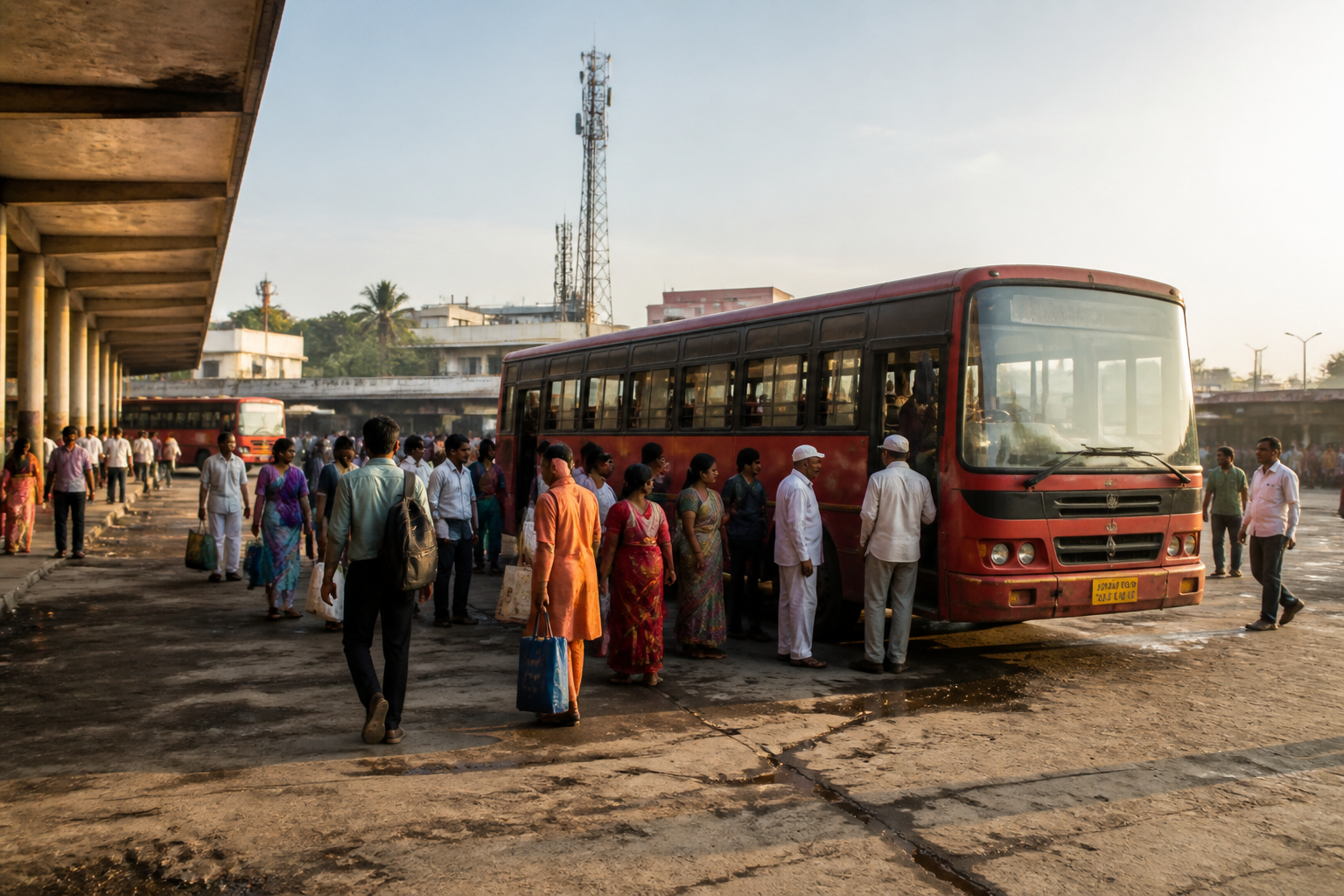
MSRTC revenue rose by Rs 66 crore in August after the Maharashtra State Road Transport Corporation began adjusting bus schedules and services to passenger demand, according to figures reported by Mid-Day. The increase was accompanied by the corporation’s highest-ever daily revenue of Rs 45 crore on August 31 and monthly revenue above Rs 1,000 crore for the first time. Together, the numbers point to a shift in how a large public bus system is attempting to manage routes, operating losses and passenger needs.
The reported change is not simply a story about higher collections. It is about the relationship between the services a public transport agency operates and the journeys that people actually make. MSRTC said depots were asked to examine passenger numbers and travel patterns before revising schedules. The approach places route-level demand at the centre of operational decisions, rather than treating the number of services operated as the main measure of performance.
That distinction matters because MSRTC serves a transport market that is dispersed across cities, towns and rural areas. According to the corporation, more than 85 per cent of its passengers travel less than 100 kilometres. This makes local and regional connectivity central to the organisation’s role, even though the corporation had increasingly focused on long-distance routes in recent years. MSRTC said some of those routes did not attract sufficient passenger traffic, producing higher operating costs without a matching increase in revenue.
The August figures emerged after review meetings and directions from Transport Minister and MSRTC Chairman Pratap Sarnaik. Following the review, depots began revising services to reflect local travel patterns. The changes included services for daily commuters, farmers, women, students and senior citizens, especially in rural and semi-urban areas. Depots were also directed to add buses on routes that experienced higher passenger movement during weekly market days, fairs and other events.
This is a different operating logic from a fixed timetable designed without regular feedback from the market it serves. In the model described by MSRTC, demand is not uniform across the day, week or year. A route may have limited use on an ordinary day but become important during a market day, a fair or a seasonal travel period. A bus system that can identify and respond to those variations may be able to improve collections without adding the same level of service everywhere.
The reported performance on August 31 illustrates the effect of a temporary demand surge. MSRTC recorded ticket sales of Rs 45 crore that day, compared with an average daily revenue of approximately Rs 34 crore to Rs 35 crore. The collection was therefore around Rs 10 crore higher than the usual daily level. The corporation attributed part of the increase to the deployment of buses on routes where passenger demand was stronger during the Raksha Bandhan period.
The daily figure is important, but it should not be read as a complete measure of structural improvement. A single high-revenue day can reflect a festival or other unusual travel pattern. The more consequential figure is the Rs 66 crore increase in August revenue compared with July and the crossing of the Rs 1,000 crore monthly threshold. Even these numbers, however, show collections rather than profit. The source report does not provide a complete August cost statement, route-level profitability figures or details of how much of the increase came from higher fares, greater ridership, additional services or seasonal demand.
That limitation is central to understanding the claim that MSRTC could cover its current operating losses within two to three months. The corporation said continued revenue growth could help it reach that position, but also indicated that the result would depend on whether the improvement could be sustained. The available figures establish a strong month of collections. They do not, by themselves, establish that the corporation has achieved a durable turnaround.
Public bus operations cannot be assessed only through revenue per route. MSRTC is also responsible for providing mobility where passenger volumes may be lower but the service remains important to residents. The report specifically identifies rural and semi-urban passengers, students, senior citizens, women, farmers and daily commuters as groups targeted by the revised schedules. For such passengers, the value of a bus route may include access to schools, markets, workplaces, health services and administrative centres, even when the route does not generate the highest return.
This creates a persistent planning tension. A transport agency seeking to reduce operating losses has an incentive to concentrate buses on routes with stronger demand. A public service operator, however, may be expected to maintain connections that are socially necessary but financially weaker. The source material does not indicate that MSRTC is abandoning low-demand routes, nor does it provide a framework for deciding which services should be reduced, retained or supported for social reasons. It does show that the corporation is placing greater emphasis on matching service levels with observed passenger movement.
The policy shift also makes depots more important. Each depot is responsible for serving the population in its area, and the revised model gives local units a larger role in adjusting routes and frequencies. This may allow decisions to reflect local conditions more closely than a uniform statewide timetable. Weekly markets, fairs and seasonal periods differ from one place to another, so local operational knowledge can be relevant to both service design and revenue collection.
At the same time, decentralised demand-based planning depends on the quality and consistency of the information available to depots. The report says schedules were revised after considering passenger numbers and travel patterns, but it does not specify the systems used to collect that information or the time period over which routes were evaluated. It also does not state whether the corporation has introduced common performance measures for passenger demand, cost per kilometre, occupancy or service reliability. Those details would be necessary to determine whether the August approach can become a repeatable planning method rather than a short-term operational correction.
The numbers reported by MSRTC suggest that the corporation’s average daily revenue is currently about Rs 34 crore to Rs 35 crore. Against that baseline, the Rs 45 crore collection on August 31 was a substantial increase. Monthly revenue crossing Rs 1,000 crore is also a first for the corporation, according to the report. But the comparison with July is not accompanied by a detailed month-by-month series, so the available evidence cannot establish whether August represents a continuing trend or a particularly strong period shaped by seasonal travel.
The same issue applies to the reported Rs 66 crore increase. Revenue growth can improve the position of a transport corporation, but operating sustainability depends on the relationship between revenue and expenditure. Fuel, staff, maintenance, vehicle availability, depot operations and route length all affect the cost of providing a service. The source report identifies higher operating costs on some long-distance routes but does not provide a cost breakdown. It therefore supports the conclusion that MSRTC has improved collections, while leaving the scale and durability of any financial improvement unresolved.
The larger urban and regional question is how public bus systems should plan services across places with very different levels of demand. A city bus route, a semi-urban connection and a rural market-day service may have different passenger patterns and different public purposes. Demand-based scheduling can help avoid running buses with very few passengers, but it must be balanced against the risk that reducing frequency will itself suppress demand or isolate passengers who have few alternatives.
For MSRTC, the August results provide an early test of whether a more responsive operating model can support both financial recovery and public-service obligations. The reported figures confirm that aligning buses with passenger demand coincided with higher collections. They do not yet show whether the method will improve route-level productivity across a full year, protect essential low-demand connections or reduce operating losses on a sustained basis. The developments to monitor are the corporation’s revenue and cost performance in subsequent months, the treatment of lower-demand routes and whether the revised depot-level planning system becomes a formal part of MSRTC’s operations.
