


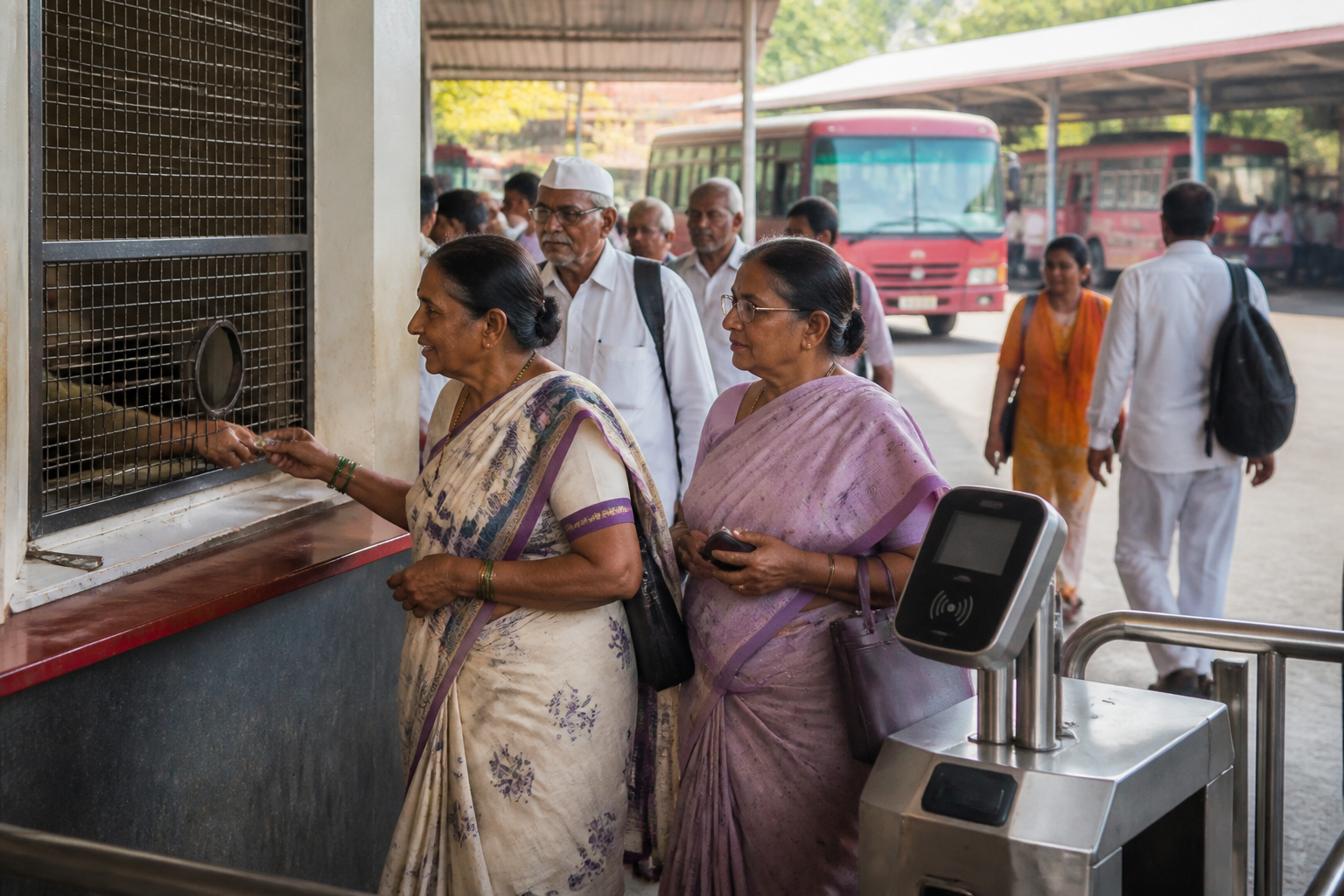
The rollout of National Common Mobility Cards (NCMC) for concessionary passengers in Palghar district has created a gap between registration and actual access. According to figures reported by Loksatta – Vasai-Virar, 45,406 cards have been registered after the Maharashtra State Road Transport Corporation made the card mandatory for some concession holders, but only 26,304 were active and in use at the time of the report.
That means roughly 58 per cent of registered cards had been activated, while about 42 per cent remained unusable or inactive. The difference is not a minor administrative detail. For passengers who depend on concessions to make bus travel affordable, registration alone does not provide the benefit. The card must also be activated and available for use when the passenger boards an MSRTC bus.
The NCMC system was introduced to make daily travel more convenient and modern through a common mobility payment and identification mechanism. In Palghar, the first phase has focused on women and senior citizens. The corporation appointed E-Bix Technologies Ltd to handle card registration and distribution. The district-level figures show that the system has attracted substantial demand, but that the process of converting registrations into active cards has moved more slowly.
The largest group among those registered is covered by the Women’s Honour scheme, with 35,176 cards. A further 5,972 registrations were made for senior citizens aged between 65 and 75, while 3,629 were recorded under the Amrit Senior Citizen scheme. Another 629 passengers were listed in the other category. Together, these figures account for the district’s total of 45,406 registrations.
The active-card figures show a similar pattern, but at a lower level. Of the cards registered under the Women’s Honour scheme, 19,091 had been activated. The active count was 4,250 among senior citizen passengers aged 65 to 75, 2,251 under the Amrit Senior Citizen scheme and 412 in the other category. The total of these active cards is 26,304.
The category-wise numbers show that the largest operational gap is among women passengers. There were 35,176 registrations under the scheme, but 19,091 active cards, leaving 16,085 registered cards yet to be activated. Among passengers aged 65 to 75, the difference was 1,722 cards. The Amrit Senior Citizen category had a gap of 1,378 cards, while the other category had 217 registrations that were not reflected in the active count.
The report attributes the delay to two factors identified by the Palghar MSRTC division. Agents appointed for registration and activation reportedly take between 15 and 30 days to activate a card. The department also said that passengers began the registration process late, contributing to the slower pace of distribution and activation.
This explanation points to an important distinction in the design of public-service technology: the point at which a person is recorded in the system is not necessarily the point at which the service becomes available. Registration is an administrative milestone. Activation is the operational milestone that determines whether a passenger can use the concession. In Palghar, the difference between the two stages is visible in the district’s figures.
The mandatory nature of the card has made this distinction more consequential. Women and senior citizens aged 65 to 75 have been required to carry an NCMC card to access MSRTC concessions from September 1, according to the report. The increase in registrations over the preceding two months followed that requirement. When a digital or card-based process becomes a condition for receiving an existing public benefit, delays in activation can affect access even when an applicant has completed registration.
The Palghar figures therefore describe more than a technology rollout. They show how a transport concession is being connected to a new administrative process involving registration, card distribution, activation and verification at the point of travel. Each step has to work for the intended benefit to reach the passenger. A delay at the activation stage can leave the passenger formally registered but practically unable to use the card.
The institutional structure also involves more than one actor. MSRTC has introduced the requirement and is responsible for the concessionary travel system. E-Bix Technologies has been appointed for registration and distribution. Agents are involved in activation. Passengers must complete the registration process and then receive an active card. The reported delay is thus located within a chain of responsibilities rather than at a single point.
The concentration of registrations at Vasai, Boisar and Palghar bus depots provides another indication of where demand has been strongest. The supplied report does not provide depot-wise totals or explain whether activation rates differ between these locations. It therefore establishes the overall district gap but does not establish whether the problem is concentrated in particular depots, agent networks or passenger categories.
The report also indicates that the rollout has not yet applied equally to all concession holders. The initial registration process focused on women and senior citizens aged 65 to 75. Registration for people above 75, students and passengers with disabilities began later, and the card had not yet been made mandatory for them. This phased approach means the 45,406 registrations do not represent every group eligible for an MSRTC concession.
That distinction matters when the district’s progress is assessed. The current numbers measure the first phase of implementation, not the final reach of the NCMC system across all concessionary passengers. They show strong uptake among the groups covered by the initial requirement, but they do not show how the system will perform when additional categories are brought into the process.
The figures also suggest that public adoption can be rapid while administrative completion remains slower. In roughly two months, tens of thousands of passengers registered. Yet the activation process, which the department says can take 15 to 30 days, has not kept pace with the number of applications. The result is a system in which demand is visible before operational readiness is complete.
No information in the supplied report establishes how passengers with inactive cards are treated when they travel, whether temporary alternatives are available, how activation status is communicated, or what procedure exists for correcting a delayed or failed activation. These are central operational questions, but they remain unanswered in the available material. The report also does not provide a target date by which all registered cards are expected to become active.
The same limits apply to the assessment of performance. The available figures allow the active share to be calculated, but they do not show the daily number of applications, the average activation time, the number of cards awaiting dispatch, or the rate of failed or rejected activations. Without those measures, it is not possible to determine whether the gap is narrowing, stable or widening.
What the evidence does establish is a clear implementation mismatch. Palghar has recorded 45,406 registrations, while 26,304 cards were active. The difference affects a transport benefit used by women and senior citizens, groups for whom the card requirement has already taken effect. The district’s experience illustrates that a mobility card programme is not completed when cards are enrolled; its success depends on whether passengers can reliably use the activated card within the transport system.
The next stage of the rollout will include other concession holders, according to the Palghar MSRTC division. The immediate milestones to monitor are the time required to activate the remaining registered cards, the treatment of passengers waiting for activation, and the eventual expansion of mandatory NCMC use to senior citizens above 75, students and passengers with disabilities.

