


Subheadline: The municipal commissioner expects 6.5 crore square feet of new construction in four years, but road acquisition and service capacity remain unresolved.
Standfirst: Pune’s next phase of construction is being defined not only by the volume of new buildings, but by the infrastructure needed to support them. Municipal commissioner Naval Kishor Ram has estimated that around 6.5 crore square feet of construction could take place within the Pune Municipal Corporation’s limits over the next four years. The forecast includes housing societies, information technology centres and data centres, as well as redevelopment in older parts of the city and new construction in recently merged villages. This analysis examines the gap between the pace of building approvals and the slower expansion of roads, pedestrian infrastructure, drainage and other public systems. It also looks at why the PMC’s proposed response depends on projects such as the High Capacity Mass Transit Route, the ring road and development-plan roads, many of which face implementation or land-acquisition challenges.
Pune’s construction forecast has placed a basic municipal question at the centre of the city’s growth debate: can infrastructure expansion match the speed at which new floor space is being created? Naval Kishor Ram, the Pune municipal commissioner, has estimated that about 6.5 crore square feet of construction could be completed within the PMC’s jurisdiction over the next four years. The estimate was presented as a future picture of the city and its suburbs, rather than as a single project announcement.
The scale of the estimate matters because the proposed construction is spread across several types of urban development. According to the commissioner’s comments reported by Loksatta, housing societies, information technology centres and data centres are expected to contribute to the increase. Construction is also continuing in areas that have recently been incorporated into the municipal limits, while older buildings and wadas in the peth areas are being replaced by new structures. These locations do not begin with the same road widths, drainage capacity or public-service networks.
That uneven starting point is central to the infrastructure challenge. The commissioner said the city would need a corresponding expansion of roads, water supply and other infrastructure. Without that expansion, he warned, Pune could face greater traffic congestion and become less attractive for industry. The statement connects construction growth to the capacity of the urban systems around it: buildings may be approved and occupied faster than the public networks required to serve them can be expanded.
The report does not establish that every proposed building has received approval or that all 6.5 crore square feet will necessarily be completed within the stated period. It records the commissioner’s estimate based on the volume of proposals being considered. Ram said that a High-Rise Building Committee meeting could decide proposals covering between 50 lakh and 60 lakh square feet in a single sitting. The estimate therefore reflects the potential pipeline of development as seen by the municipal administration.
This distinction between potential construction and delivered construction is important for understanding Pune’s planning problem. A proposal may move through an approval process while the road network serving its location remains incomplete. Water, sewage, pedestrian routes and connecting roads may then have to be upgraded after the urban form has already been established. The commissioner’s comments suggest that the PMC is attempting to address this sequencing problem by prioritising infrastructure works alongside the expected increase in construction.
Pune’s development framework is also contributing to the changing scale of buildings. Ram pointed to the Unified Development Control and Promotion Regulations, or UDCPR, as a factor allowing additional floor space index or increased transferable development rights to be used. These planning provisions can support taller buildings and greater redevelopment capacity. In the city’s older peth areas, redevelopment is replacing older wadas with new buildings. In the merged villages, open land is being used for high-rise construction.
The result is not simply a larger number of buildings. It is a change in the intensity and distribution of urban activity. Taller or denser development can concentrate more residents, workers, vehicles and service demand within places where the existing network was designed for a different scale. The commissioner said that roads, footpaths and sewage systems in several areas could become inadequate as the population grows. The municipal administration is carrying out works to increase system capacity, but he acknowledged that the pace of this work is slow.
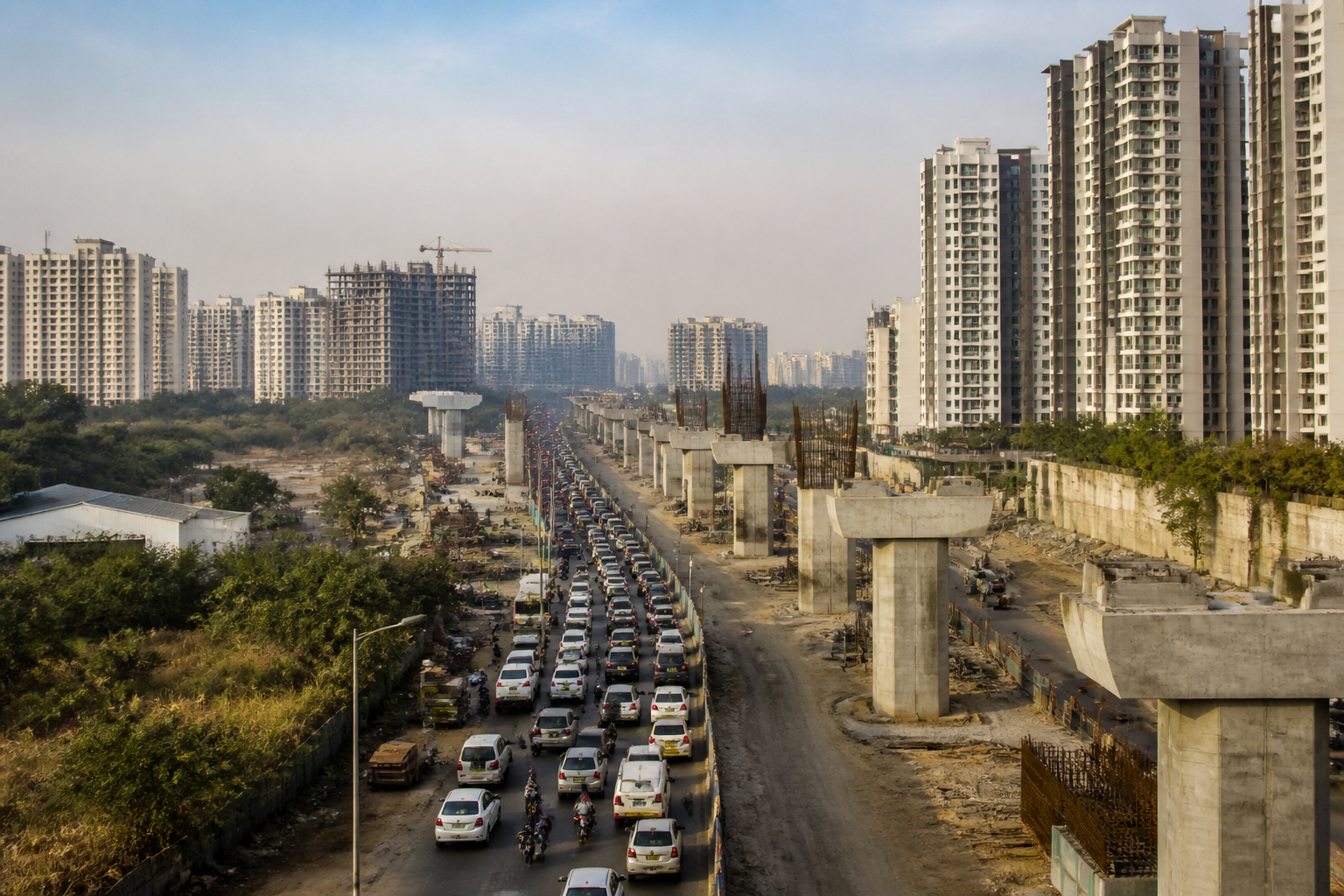
The road network presents the clearest implementation gap in the account. The PMC wants to complete the High Capacity Mass Transit Route, the ring road around the city and roads proposed in the development plan. It also intends to complete missing links that connect major roads. These projects are expected to support the city’s expansion, but the report indicates that several development-plan roads in the suburbs have not yet been acquired.
Land acquisition is therefore not a secondary administrative matter. It directly determines whether planned road capacity can reach the locations where new development is taking place. Ram said private landowners often insist on cash compensation during acquisition. This has slowed the process and left some suburban roads narrow, increasing the likelihood of congestion. The gap between a road shown in a development plan and a road available for public use remains a practical obstacle to coordinated growth.
The commissioner’s response is to bring the roads, construction and land-acquisition departments into closer coordination. That approach recognises that the city’s infrastructure constraints cannot be resolved by one department working alone. A road project may require land acquisition; land acquisition may need to be aligned with development permissions; and the timing of both may affect traffic and service provision around new buildings.
The institutional challenge is particularly visible in the relationship between development permissions and municipal investment. The report describes a city in which high-rise construction is expanding under the applicable development regulations, while the supporting infrastructure is being added at a slower pace. This does not by itself prove that approvals are being issued without regard to infrastructure. It does show, however, that the administration sees a risk in the gap between the two processes and is placing infrastructure projects among its priorities.
The available evidence points to four principal pressure points. The first is road capacity, including the width and continuity of existing roads. The second is the acquisition of land needed for development-plan roads and missing links. The third is the ability of water supply and sewage systems to support additional population and floor space. The fourth is pedestrian infrastructure, which the commissioner specifically included among the systems that could prove inadequate.
The construction forecast also illustrates how different urban growth patterns are converging in Pune. New housing is expanding in suburban and recently merged areas. Information technology centres and data centres are adding non-residential demand. Older central neighbourhoods are undergoing redevelopment. Each pattern generates a different infrastructure requirement, yet all depend on the same broad municipal systems. A new suburban housing project may require wider access roads and sewage connections, while redevelopment in a peth may intensify pressure on a constrained street network.
The only specific construction figure available in the report is the commissioner’s estimate of 6.5 crore square feet over four years, along with the observation that individual high-rise committee meetings may consider proposals covering 50 lakh to 60 lakh square feet. The source does not provide a citywide inventory of existing floor space, a projected population increase, water-demand calculations, sewage-capacity figures or a comparison between planned and completed infrastructure. Those missing figures limit the extent to which the forecast can be independently tested from the supplied material.
They also identify what the PMC would need to disclose if the construction estimate is to become a measurable planning framework. The city would need clarity on how much of the projected floor space is residential, commercial or related to data infrastructure; where it is expected to be built; which roads and services already exist in those areas; and which projects are scheduled to increase capacity. Without that location-wise and service-wise information, the 6.5 crore square feet figure remains a broad estimate rather than a complete infrastructure plan.
The commissioner’s remarks nevertheless make the administrative priorities clear. The PMC is seeking to accelerate ongoing projects, complete the HCMTR and ring road, take up development-plan roads, build missing links and coordinate the roads, construction and land-acquisition departments. These are described as efforts to prepare the city and its suburbs for the expected expansion.
The policy question is whether these measures will be implemented in the same time frame as the construction they are intended to support. The report does not specify completion dates for the individual road projects, nor does it state how much land has been acquired for the suburban development-plan roads. It also does not provide a schedule for water, sewage or pedestrian upgrades in the areas expected to see the most construction. Those details will determine whether the municipal response is proportionate to the forecast.
Pune’s larger urban question is therefore one of sequencing and capacity. Development regulations can enable additional floor space, and market demand can create housing, offices and data facilities. But the benefits of that growth depend on whether public infrastructure expands before congestion, service shortfalls and access constraints become entrenched. The commissioner’s estimate has brought that relationship into focus, but it is not itself evidence that the required capacity is already available.
What the supplied evidence confirms is that the PMC expects a major increase in construction over the next four years and recognises roads, water supply, sewage, footpaths and land acquisition as associated challenges. What remains uncertain is the precise location, timing and composition of the projected floor space, as well as the delivery schedule and capacity of the infrastructure projects identified by the administration. The next developments to monitor are progress on the HCMTR, ring road, development-plan roads and missing links, alongside coordinated action by the PMC’s roads, construction and land-acquisition departments.
