


Pune’s private bus fare dispute is not simply a seasonal pricing story. It exposes a regulatory system that appears to recognise a fare ceiling, yet struggles to protect passengers when demand rises, tickets are sold through multiple channels and complaints are processed after fares have already been paid.
Civic Mirror’s report describes private bus fares on routes from Pune to cities such as Indore and Yavatmal rising sharply during the Diwali travel period. In one cited example, an air-conditioned sleeper berth on the Pune-Indore route was reported to have increased from the usual fare of Rs 1,800 to Rs 7,850. On the Pune-Yavatmal route, an AC bus fare was reported to have risen from the normal range of Rs 1,500-1,800 to Rs 4,700.
These figures were presented in the context of passenger complaints and do not, by themselves, establish that every fare was illegal. The regulatory question is more specific: whether private contract-carriage operators charged more than the applicable ceiling linked to Maharashtra State Road Transport Corporation fares, and whether the ceiling for different service categories, including AC sleeper buses, was correctly applied.
The Pune Regional Transport Office told Civic Mirror that private contract-carriage bus operators cannot charge more than one-and-a-half times the fare of the corresponding MSRTC service. The office also said that a special enforcement drive had begun following directions from the Transport Commissioner. Inspection teams were instructed to examine buses, ticket offices and both online and offline ticket transactions.
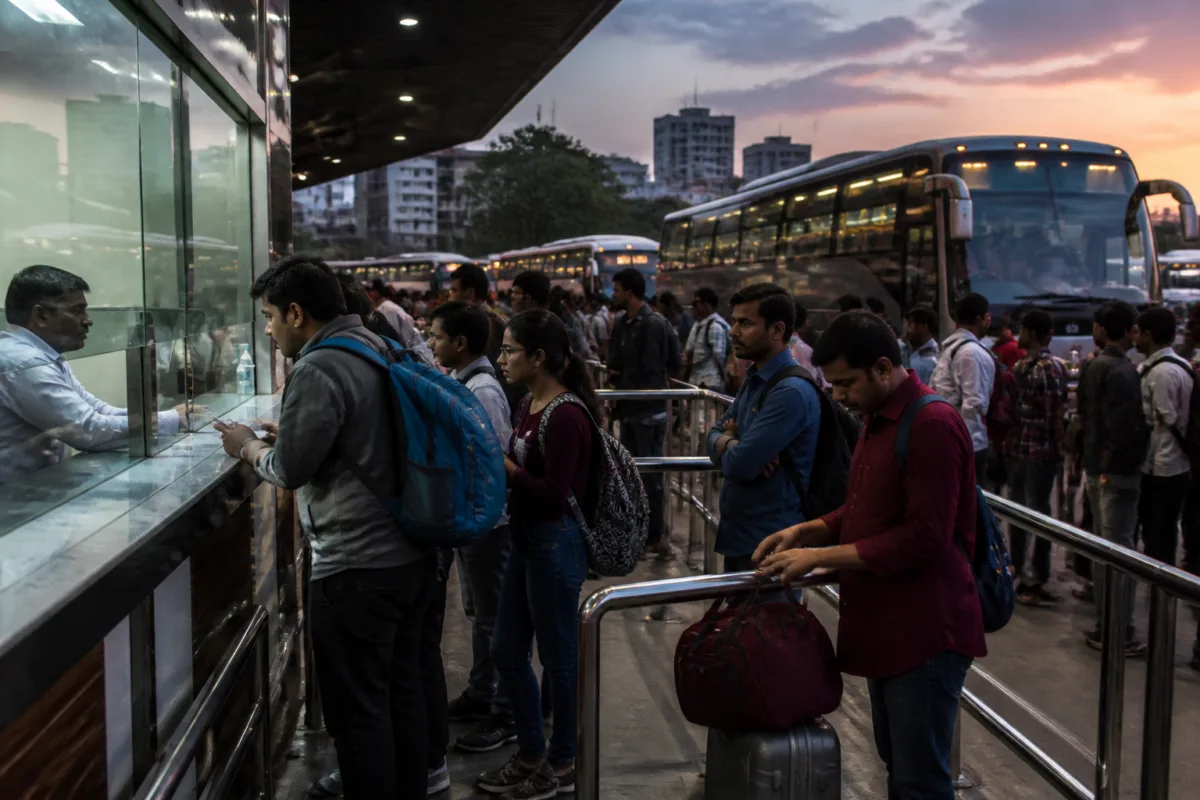
The gap between that stated rule and the passenger experience is where the larger urban governance problem lies. Passengers travel out of Pune in large numbers during festivals because the city functions as a major employment and education centre for people whose permanent homes are elsewhere. When demand peaks, the private bus market becomes an essential mobility channel for routes that may be difficult to access through ordinary public transport at short notice. A sharp increase in fares therefore affects more than discretionary travel; it can determine whether workers, students and families can return home during a fixed festival window.
Civic Mirror reported that passengers found regular fares of about Rs 1,000 being quoted at around Rs 3,000 during the festival period on some journeys. The report also cited complaints that online ticketing platforms displayed one fare on their main pages and a higher amount after a passenger selected a seat. Social activist Prajakta Kulkarni told the publication that fares for journeys on November 5 were shown at between Rs 6,000 and Rs 7,000 for operators including Rajratan Travels, Purple Travels and Verma Travels. She alleged that some applications initially displayed fares of about Rs 4,500, which rose above Rs 5,000 at the seat-selection stage.
That alleged difference is important because transparency is part of effective regulation. A fare ceiling cannot protect passengers fully if the price shown at the first stage of a booking process is not the price ultimately payable. Nor is enforcement straightforward when the bus operator, ticket seller and digital platform may play separate roles in the transaction.
Kulkarni said she filed a complaint with the Pune RTO on October 23 and submitted a written representation after meeting RTO official Archana Gaikwad. According to her account, the office said notices had been sent by post to the concerned bus operators. She questioned why direct action had not begun earlier, saying that fares had been elevated for around one and a half months before the festival rush reached its peak.
The timeline described in the report illustrates the weakness of a complaint-led enforcement model. By the time a passenger identifies a questionable fare, submits documents, receives an acknowledgement and waits for a notice to be delivered, the journey may already be over. The operator may have collected the money, the demand surge may have passed and the passenger may have little practical leverage beyond seeking a refund or filing another complaint.
The issue is further complicated when platforms are involved. Kulkarni said the RTO informed her that the transport department could take action against operators charging excess fares, while action against ticket-booking applications fell within the authority of cyber police. This division of responsibility may be legally understandable, but it creates an administrative gap for passengers. The person who paid the fare experiences one transaction, while the state may treat it as several separate questions involving permits, ticketing, digital conduct and consumer complaints.
The report also describes an offer of a lower fare after Kulkarni’s complaint. She said a ticket seller associated with Purple Travels offered an Indore ticket for Rs 3,000, which she declined. Her question was whether a reduced fare offered to a complainant could address the larger issue affecting passengers who had already paid more. That distinction matters. Individual settlements may resolve a complaint without establishing whether other passengers were overcharged or whether the pricing system has changed.
Another complaint cited by Civic Mirror came from passenger Pranav Tompe, who said he booked an AC sleeper ticket from Pune to Yavatmal for November 6, 2026, for Rs 4,497. His complaint asked the RTO to determine whether the fare complied with the applicable rules. The document reportedly referred to a Maharashtra government decision issued on April 27, 2018, under Section 67 of the Motor Vehicles Act, 1988. According to the complaint, the decision fixed a ceiling of one-and-a-half times the relevant MSRTC fare for private contract-carriage buses.
Tompe’s calculation used a published ordinary MSRTC fare of Rs 1,275 for the route. One-and-a-half times that amount is Rs 1,912.50. However, the report makes clear that this calculation was based on the ordinary bus fare and that the applicable ceiling for an AC sleeper service would need to be determined before concluding whether the operator had violated the rules. That distinction is central. Comparing unlike services can produce an apparently large discrepancy without resolving the legal fare question.
Tompe asked the RTO to verify the applicable reference fare, examine the amount actually collected, determine whether there had been a violation and direct the operator to return any excess amount. He also sought a complaint reference number and information about the action taken. His experience, as reported, points to another part of the system: a passenger may be able to submit a complaint but still lack a clear channel for tracking its progress or obtaining a decision.
The RTO’s position is that enforcement has been intensified. It said inspection teams were checking buses and ticket offices and verifying online and offline tickets to identify fares above the prescribed limit. The office also acknowledged that complaints of excessive fares increase when festival demand rises. The report does not provide the number of inspections conducted, operators penalised, notices issued, fares refunded or complaints resolved. Without those figures, the existence of a special drive cannot be assessed against its actual effect.
That missing performance information is significant for urban transport governance. A credible enforcement system needs more than a rule and occasional inspections. It requires a publicly understandable fare formula, consistent treatment of different bus categories, visible responsibility for digital platforms, records of complaints, time-bound responses and a mechanism through which passengers can recover money where excess collection is established.
The case also reveals how private bus services operate within the wider transport network. Festival demand is predictable, not an unforeseeable shock. Operators, regulators and booking platforms know that travel volumes will increase around Diwali. Yet the reported complaints suggest that administrative action began only after passengers and activists raised concerns. This raises a structural question about whether enforcement remains reactive even when the timing and geography of demand can be anticipated.
The facts available in the report do not establish the final legality of each fare cited, nor do they show whether the RTO has completed its inquiries. They do establish a conflict between passengers’ accounts of sharp price increases and the authority’s statement that a fare limit exists and inspections are under way. The next important developments are therefore concrete: the RTO’s findings on the cited operators, clarification of the applicable AC sleeper fare ceiling, action involving online booking platforms and any decision on refunds for passengers found to have paid more than permitted.

