


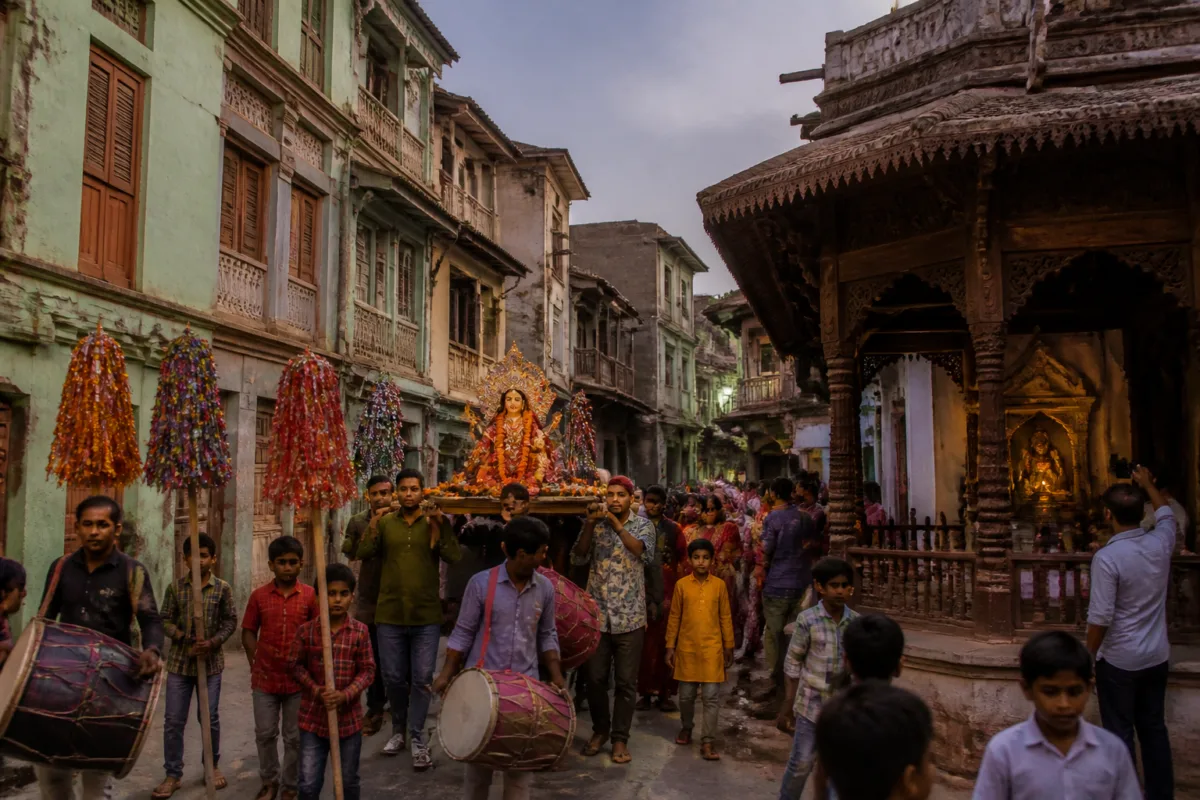
Ahmedabad pol culture is sustained not only by historic houses and narrow lanes, but also by rituals that turn shared residential space into a living community institution. In Vanmali Vanka ni Pol in Shahpur, residents have continued a Diwali tradition for around 150 years: they treat the local goddess as a daughter, invite her to return to her parental home, bring her into the pol at the start of the Gujarati New Year and worship her until the festival period ends.
The account published by Gujarat Samachar – Ahmedabad places this tradition within the wider identity of Ahmedabad’s pols. These neighbourhoods are commonly associated with old houses and havelis, but the report shows that their heritage also exists in repeated acts of collective participation. The ritual is not described as a private household ceremony. It involves residents moving together through the neighbourhood, using drums, visiting the temple regarded as the goddess’s marital home and installing her within their own pol.
That distinction matters for understanding the built environment. A pol is not presented here simply as a collection of historic structures. In this tradition, the neighbourhood functions as a social unit with a shared calendar, common spaces and a collective memory passed between generations. The physical setting provides the stage, but the ritual gives the setting continuity and meaning.
According to the report, residents visit the goddess before Sharad Purnima, accompanied by the sound of drums, to invite her to return to the pol on the day of Bestu Varas, the Gujarati New Year. The invitation is framed in familial terms: residents ask her to be ready because her parental family will come to take her home. On Bestu Varas, they return to the temple in a ceremonial procession and bring the goddess to Vanmali Vanka ni Pol.
The sequence establishes a temporary movement between two urban locations. The temple near Halim ni Khadki in Vastadhelji ni Pol is regarded as the goddess’s marital home, while Vanmali Vanka ni Pol becomes her parental home during the Diwali period. The report identifies this relationship as the basis of the tradition. It also records the explanation of local leader Jayendrasingh Rathod, who said the practice was started by elders around 150 years ago with the aim of maintaining peace and well-being in the pol.
The annual ceremony therefore links religious belief with a form of neighbourhood organisation. Residents do not merely attend a festival at a fixed site; they collectively organise an invitation, a journey, an installation and a period of worship. The arrangement gives residents a recurring role in maintaining the identity of their neighbourhood. It also places older residents and local leaders in the position of transmitting the meaning of the ritual to the next generation.
The goddess is installed in the pol on Bestu Varas and worshipped until Labh Pancham, according to the report. On Chhath, she is taken back in a farewell ceremony. These dates create a defined period during which the pol’s shared space is organised around the presence of the deity. The ritual thus temporarily changes how the neighbourhood is used: residents gather, processions move through it and a common site becomes the centre of activity.
Another material element of the tradition is the mandvi installed in front of the goddess. Local organisers describe it as approximately 150 years old and distinctive because it has no nails. The structure was made by shaping and joining wood, rather than fixing it with metal fasteners. The report does not provide technical details about the wood, the joinery or the structure’s conservation history, but its continued use adds a material dimension to the tradition.
This mandvi is important because it connects ritual continuity with craft and construction knowledge. Its significance is not limited to appearance. The account presents the object as part of a practice that has survived for generations, making it both a ceremonial structure and a physical record of the pol’s history. Its un-nailed construction is specifically remembered as a defining feature by local residents and organisers.
The tradition also illustrates how heritage can be maintained without being reduced to a monument. The source describes Vanmali Vanka ni Pol through its houses, religious relationships, annual procession and wooden mandvi. Each element reinforces the others. The neighbourhood’s identity is carried through architecture, religious practice, social participation and memory rather than through a single building alone.
That form of heritage is vulnerable to being overlooked because it is embedded in ordinary residential life. A procession that returns every year, a temple relationship understood by local families and a wooden structure assembled for worship may not appear as separate urban infrastructure. Yet together they determine how residents use and recognise their neighbourhood. The source’s account suggests that the pol remains meaningful because its residents continue to perform the relationship, rather than merely inherit the buildings.
The report also frames the ritual as a symbol of unity, faith and family relationships among residents. That framing comes from the local account and should be understood as the community’s interpretation of its own tradition. It shows how the language of family is used to describe a collective urban relationship: the goddess is treated as a daughter, the pol as a parental home and the annual procession as a shared act of welcome.
There is a governance dimension to this community practice, even though the source does not identify a formal municipal role. The event appears to be organised by residents and local elders, with the ritual’s timing and movement maintained through community participation. The evidence supplied does not establish whether the city administration provides logistical support, regulates the procession or has documented the mandvi as a heritage object. Those questions remain outside the report, but they are relevant to understanding how historic neighbourhood traditions interact with formal urban systems.
The same limitation applies to the scale of participation and the condition of the physical setting. The source does not provide the number of households involved, the size of the procession, the present condition of Vanmali Vanka ni Pol, or the conservation status of the mandvi and the temple. It also does not record whether the tradition has changed as the neighbourhood has evolved. What is established is narrower but significant: residents and local leaders describe an approximately 150-year-old practice that continues to connect two pols through a recurring Diwali ceremony.
For Ahmedabad’s old city, the larger urban question is whether heritage is understood only as built form or also as continued use. The Vanmali Vanka ni Pol tradition points to the second approach. A historic neighbourhood remains active not simply because old structures survive, but because people continue to gather, assign meaning to spaces and pass on practices that make those spaces socially legible.
The evidence in the report confirms the endurance of a distinctive Diwali ritual, its connection to the relationship between two neighbourhood temples and the role of a traditional wooden mandvi in the ceremony. It does not establish the broader condition of Ahmedabad’s pols or the future of this particular practice. The developments worth monitoring are whether the ritual continues to be carried forward by younger residents, how the mandvi and related spaces are maintained, and whether such living traditions are recognised alongside the physical architecture of the old city.

