


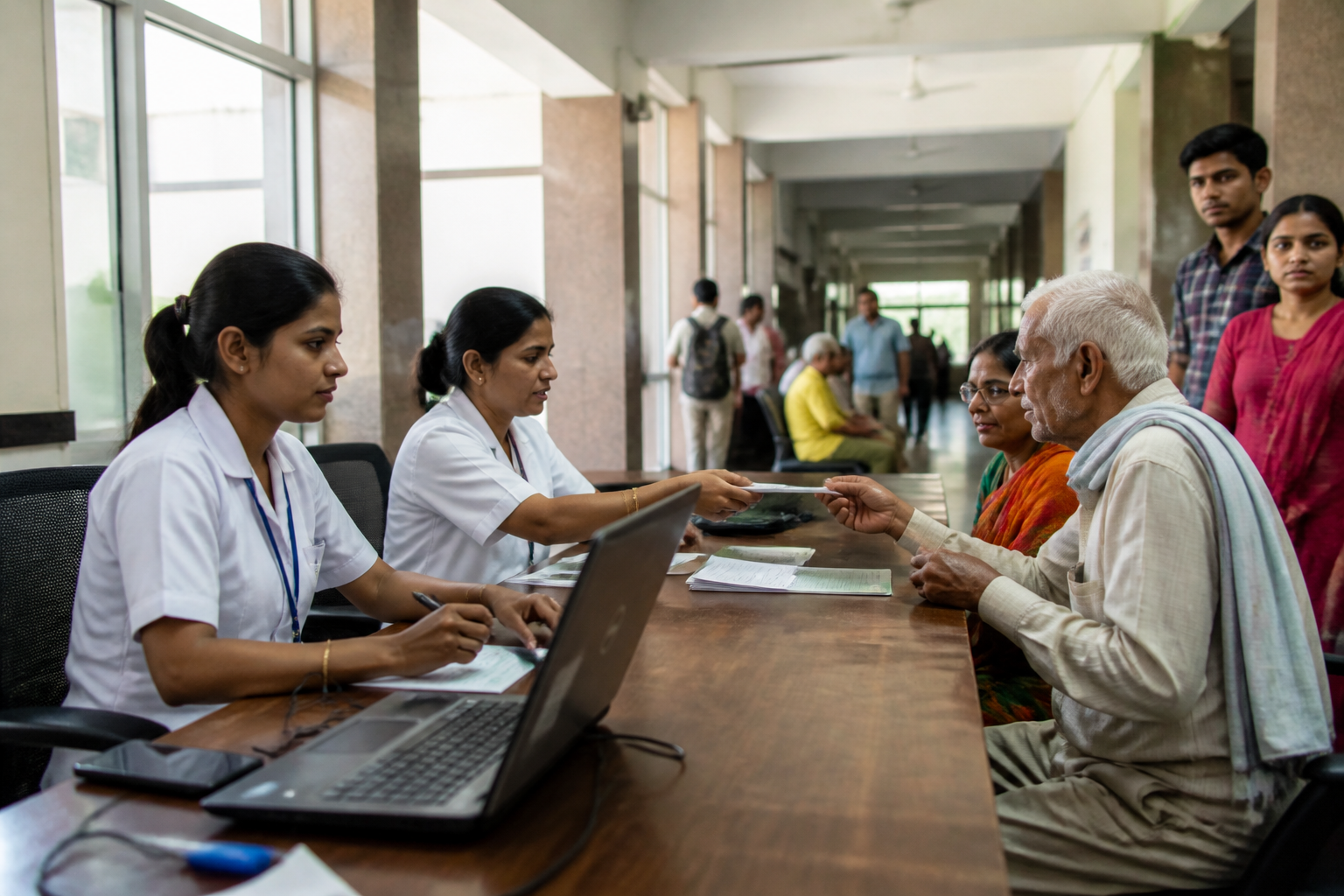
Uttar Pradesh’s next phase of Ayushman Bharat Pradhan Mantri Jan Arogya Yojana is being framed not around how many people have entered the system, but around what happens after they do. More than 9.5 crore beneficiaries have availed healthcare services under the scheme in the state since its launch, while over six crore Ayushman cards have been issued, according to SACHIS chief executive officer Archana Verma. The new emphasis on treatment outcomes, quality of care and provider accountability marks an important shift in how a large public health programme is judged.
The figures were presented at ‘Ayushman Samvad: From Coverage to Outcomes’ at Indira Gandhi Pratishthan in Lucknow. The event marked eight years of PM-JAY and five years of the Ayushman Bharat Digital Mission. Verma said the scheme’s success should not be assessed only through coverage numbers and that the state was prioritising data-based decision-making and effective service management.
That distinction matters because enrolment and treatment are not the same measure. The number of cards issued indicates the reach of the programme’s identification and registration system. The number of beneficiaries who have availed services indicates use of healthcare under the scheme. Neither figure, on its own, establishes whether treatment was timely, clinically appropriate, completed successfully or followed by adequate care. The state’s stated move towards outcomes therefore points to a more demanding phase of programme management.
The announcement also shows how public healthcare delivery is increasingly being managed through linked administrative systems. PM-JAY provides the coverage framework, while the Ayushman Bharat Digital Mission represents the digital infrastructure associated with health information and service delivery. SACHIS, which is overseeing the state-level implementation referenced in the announcement, is now placing data and service management at the centre of its next phase. The institutional question is how these systems will convert large volumes of records into better decisions for patients and providers.
The available figures establish the scale of the programme in Uttar Pradesh, but they do not yet explain the composition or quality of that use. The report does not specify how many treatments were carried out in public hospitals and how many in private facilities. It does not identify the procedures most frequently claimed under the scheme, the districts with the highest or lowest use, the number of patients receiving follow-up care or the share of cases in which treatment outcomes were assessed. Those details will be important if the shift from coverage to outcomes is to be evaluated beyond broad declarations.
The difference between a card and a completed episode of care is particularly important for a programme operating across a state as large as Uttar Pradesh. A card can enable access, but the patient’s experience also depends on whether an empanelled facility is available, whether the required service is offered, whether the provider accepts the case and whether the patient can complete the treatment pathway. The supplied announcement does not provide evidence on these operational stages. It does, however, indicate that the state now recognises that enrolment alone is an incomplete measure of performance.
The same applies to the figure of 9.5 crore beneficiaries who have availed services. It is a major utilisation number, but the announcement does not clarify whether the figure refers to unique individuals, treatment episodes or another administrative measure. Without that distinction, it cannot be used to calculate the proportion of enrolled people who received care or to compare access across locations and population groups. A stronger outcomes framework would need to make such definitions clear before the numbers can guide public evaluation.
This is where data-based decision-making becomes more than a technology question. Data can help administrators identify patterns in claims, treatment use and provider performance, but its value depends on what is collected, how consistently it is recorded and how it is acted upon. Verma’s reference to effective service management suggests that the state intends to use information for administrative oversight rather than merely for reporting programme reach. The announcement does not provide details of the indicators, review mechanisms or corrective actions that will form part of this approach.
Provider accountability is another central part of the transition. The next phase, as described by the SACHIS CEO, will focus on the quality of care delivered by healthcare providers. That places the provider—not only the beneficiary or the database—inside the definition of programme performance. Yet the report does not state how quality will be measured, which authority will conduct assessments or what consequences will follow when standards are not met. These unresolved operational details will determine whether accountability remains an objective or becomes an enforceable part of service delivery.
The policy architecture behind the announcement brings together two distinct but related goals. PM-JAY is being used as a mechanism through which eligible beneficiaries can access healthcare services, while the Ayushman Bharat Digital Mission represents a broader effort to strengthen digital systems in healthcare. The event’s focus on both programmes reflects the administrative importance of connecting coverage, records and service management. But digital integration cannot by itself demonstrate clinical success. The state’s own language about outcomes indicates that the next challenge is to connect administrative information with the quality and continuity of treatment.
The eight-year milestone for PM-JAY and the five-year milestone for the digital mission provide a point for institutional review. The programme now has a long enough operating history for the state to move beyond launch-stage measures such as enrolment and card issuance. The announcement does not include a year-by-year account of how use has changed, nor does it provide a comparison between coverage and actual treatment across the period. It therefore establishes the direction of policy but not yet the evidence of improvement in outcomes.
The scale of the reported numbers also raises a basic question about the relationship between volume and capacity. A high number of beneficiaries using a public health financing programme can indicate reach, but it can also create a continuing need for administrative scrutiny of facilities, claims and patient pathways. The source material does not provide information on hospital capacity, staffing, waiting times or geographic distribution, so no conclusion can be drawn about pressure on the healthcare system. What can be established is that the programme’s scale makes quality monitoring a significant governance task.
For citizens, the change in emphasis could eventually alter what counts as a successful experience under Ayushman Bharat. A card is a means of access; it is not the final public service. The relevant questions are whether the patient receives the required treatment, whether the care meets acceptable standards and whether the system records and responds to the outcome. The announcement does not claim that these goals have already been achieved. Instead, it signals that the state wants them to become the basis of the next phase.
The most important evidence to watch will therefore be the outcomes framework that follows the Lucknow event. Uttar Pradesh has announced a move towards treatment results, care quality and stronger accountability, but the supplied material does not identify the metrics, reporting schedule or public disclosure process. It also does not state how beneficiaries will participate in assessing care or how disputes and poor outcomes will be handled.
The reported 9.5 crore service figure and more than six crore cards show that PM-JAY has acquired considerable administrative reach in Uttar Pradesh. They do not, by themselves, show whether the scheme is delivering consistent, high-quality care. The state’s decision to move from coverage to outcomes is therefore both a policy shift and a test of institutional maturity. The next stage will be judged by whether the promised data-based management produces transparent evidence about treatment quality, provider performance and the experience of the people the programme is intended to serve.

