


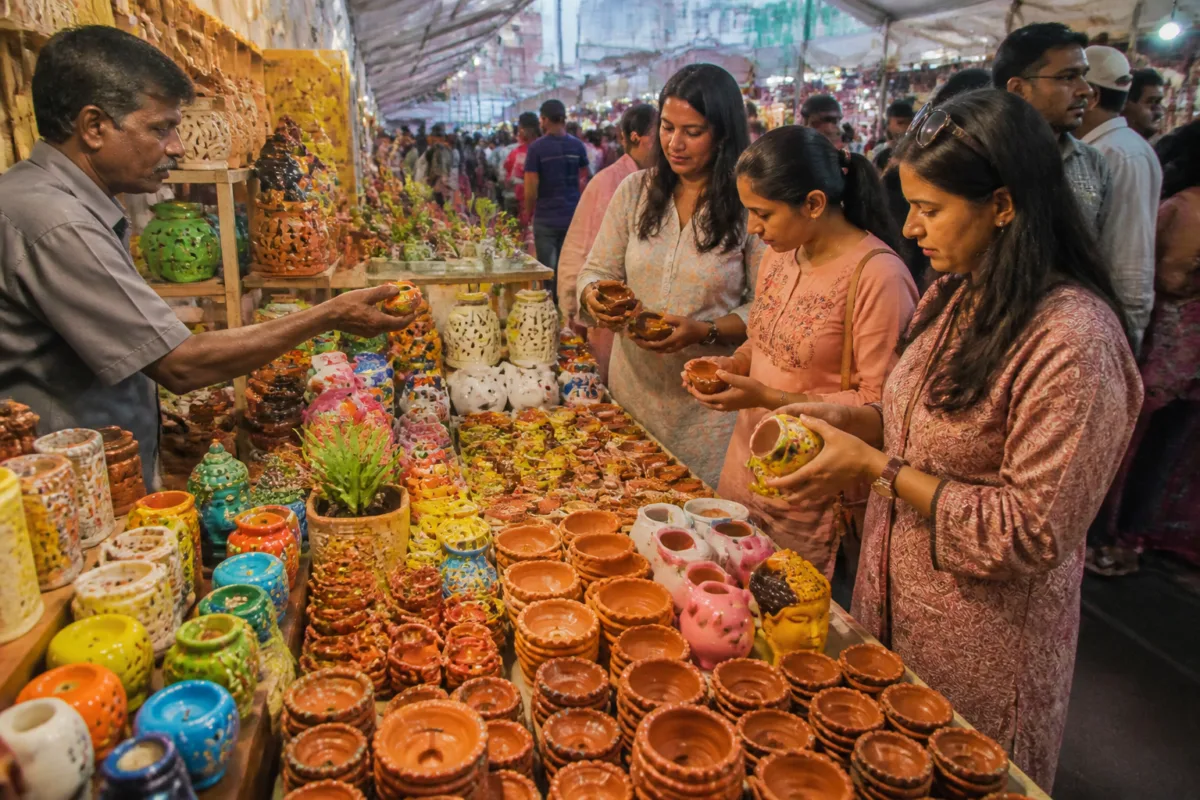
The Maati Kala Utsav in Lucknow is more than a seasonal display of diyas, idols and terracotta products. With around 60 stalls bringing together makers and sellers from across Uttar Pradesh, the government-backed event shows how the One District One Product (ODOP) programme is attempting to solve a persistent market problem: rural production may have skill and variety, but artisans still need access to urban buyers.
That connection is visible in the range of goods at the fair. Clay lamps from Chinhat, terracotta products from Gorakhpur, wax diyas and household cookware from Azamgarh, idols curated in Kolkata by a Lucknow resident, and women-prepared food products from Kanpur are presented in one urban marketplace. The fair therefore works as a small but visible piece of market infrastructure, bringing dispersed producers into a common consumer-facing setting.
The event also demonstrates that traditional craft is not being presented only as heritage. It is being sold as a functional, reusable and adaptable product. Painted diyas, planters, vases, piggybanks, whistles, cookware and decorative items sit alongside more conventional lamps and idols. The emphasis on use, design, price and durability indicates how artisans are responding to contemporary urban purchasing habits rather than relying only on ceremonial demand.
Raj Prajapati from Chinhat, for example, is selling diyas priced from Rs 1 to Rs 15 for two. He said some of the intricately designed pieces could be reused several times. Larger painted diyas are priced at Rs 40, with sellers highlighting washproof paint, durability and reusability. These details matter because they position clay products against the convenience of mass-produced festive goods. The sale is not based only on sentiment; it also depends on whether buyers see the product as affordable and useful beyond a single evening.
The fair’s product mix reveals the scale of coordination required to create such a marketplace. Artisans are not operating from one production cluster or serving one narrow category. The stalls bring together pottery, decorative craft, lighting, food processing, beekeeping and household goods. For consumers, this creates a convenient shopping environment. For producers, it creates an opportunity to meet customers directly and test which designs, price points and product categories attract attention.
That direct connection is especially important for makers whose work is produced outside major urban markets. Shubham from Gorakhpur is displaying a conch-shaped two-piece lamp along with vases, planters, Ganpati figures, piggybanks, whistles and other terracotta products. The variety suggests that the urban market is not simply absorbing a fixed traditional product. It is also becoming a place where producers can display new forms and combinations of familiar materials.
The same process is visible in the stalls selling wax products. A beekeepers’ team is offering candles and diyas made from beeswax, along with honey. Sabita, a member of the team, said the group moves from one state to another during the honey season and uses wax, a by-product, to make candles and diyas. This is a small example of value addition: an input associated with one livelihood is converted into another product that can be sold in an urban festive market.
The arrangement also brings questions of portability and livelihood continuity into view. The beekeepers’ team travels between states during the honey season, while other sellers are linked to specific districts or craft practices. Their participation in a city fair means that production, movement, display and retail are all part of the livelihood system. The marketplace is therefore not only a venue for final sales. It is also a meeting point between mobile producers, district-level skills and urban consumption.
Women’s economic activity forms another layer of the fair. Kanpur’s Gitanjali Sachan is selling pickles, spices, papad, badi, mungodi, mathri and thekua prepared by women. Her son Siddharth said the group’s buknu, a spice powder made with 21 spices, was its fastest-selling product and a distinct Kanpur speciality. The report does not provide the number of women involved, their production volumes or their earnings, so the scale of this activity cannot be measured from the fair alone. But the stall shows how urban retail can give visibility to food products made through distributed, women-led production.
A similar individual-to-market journey appears in the stall run by homemaker Rekha Tiwari, who uses her leisure time and talent to create toral and bandhanvaar strings, sourcing materials from different places. Her products indicate that the fair includes not only formalised artisan clusters but also small-scale makers whose work may begin as a household activity before entering a public market.
The fair’s importance, then, lies in the way it brings different forms of production into one urban setting. A clay lamp, a terracotta planter, a wax diya, a spice mix and a decorative string are not identical products. They require different materials, skills and supply chains. What links them is the need for a route from dispersed production to consumers who may not otherwise encounter the makers or understand the value of their products.
This is the institutional purpose described by the Uttar Pradesh Mati Kala Board. Its general manager, Shishir, said, “Through ODOP, we are bringing rural artisans to urban markets.” The statement is direct, but it also identifies the programme’s central challenge. Producing a distinctive item is only one part of sustaining a livelihood. The producer must also find buyers, communicate quality, manage pricing and reach a market large enough to make the work viable.
The Maati Kala Utsav addresses that challenge through physical concentration. Instead of requiring consumers to travel to several districts or depend on intermediaries, the fair assembles products in Lucknow. This reduces the distance between producer and buyer at the point of sale, at least temporarily. It also allows consumers to compare products, prices and designs in one location.
However, the supplied account does not establish how much income the participating artisans earn from the fair, whether sales are higher than in previous editions, or how many buyers come from outside Lucknow. It also does not show whether artisans retain the full retail value of their products or whether the event leads to repeat orders after the festival. These are important measures if ODOP is to be assessed as an economic intervention rather than only as a promotional programme.
The product details nevertheless provide clues about the commercial decisions being made. Reusability is emphasised for clay diyas. Durability is used to justify the Rs 40 price of larger painted lamps. Product innovation appears in water-activated lamps that need neither oil nor fire. The fair is therefore responding to several consumer expectations at once: affordability, convenience, visual appeal, novelty and repeated use.
The water-activated lamps displayed by Ibrar Ahmad are a particularly clear example of how a traditional category can be repositioned. The product remains recognisable as a lamp, but its operation differs from the conventional oil- or fire-based diya. Without more information, it is not possible to judge its production method, safety or sales performance. What can be observed is the attempt to make a familiar festive object distinctive enough to attract urban buyers.
The event also shows how seasonal demand can provide a concentrated sales opportunity. Diwali creates a short period when households actively purchase lamps, idols, decorations, food and gifts. A fair timed to that demand gives artisans a defined urban audience. But the report does not indicate whether the market-linkage model continues after the festival, when demand for many of these products may fall.
That question is central to the long-term significance of ODOP. A successful fair can generate sales and visibility, but a sustainable artisan economy needs more than a single seasonal window. It needs continuing access to customers, reliable input supply, suitable pricing and channels that connect district production to urban demand throughout the year. The material supplied for this story does not provide evidence on those wider systems. It does, however, show why the market connection is necessary in the first place.
For cities, the fair presents a less visible dimension of urban infrastructure. Markets are often understood through permanent shops, wholesale yards, transport networks and digital platforms. Temporary exhibitions also perform a market function when they organise access, information and trust between producers and consumers. The Lucknow event does this through a shared physical space where products can be seen, handled and purchased directly.
For rural producers, the urban buyer is not an abstract market segment. The buyer decides whether a diya is worth its price, whether a planter fits a home, whether an idol is affordable, and whether a regional food product is distinctive enough to purchase. The stalls make these decisions immediate. They also give producers a chance to observe what attracts attention, which designs sell out and which products remain difficult to move.
The Maati Kala Utsav therefore captures both the promise and the limits of a government-supported urban marketplace. Its promise is clear: district-based skills can be brought into the city, placed before a broad consumer audience and connected to seasonal demand. Its limits are equally clear from the evidence available: the fair’s sales impact, repeat-market potential and contribution to artisan incomes remain unquantified in the supplied report.
What the event confirms is that ODOP’s urban dimension is not simply about branding products by district. It is about building a bridge between production and consumption. In Lucknow, that bridge is represented by 60-odd stalls, where clay, wax, food and craft become visible to buyers who might otherwise remain separated from the people and places that make them. The next measure of success will be whether that connection lasts beyond the festive season and produces sustained market access for the artisans the programme is designed to support.

