


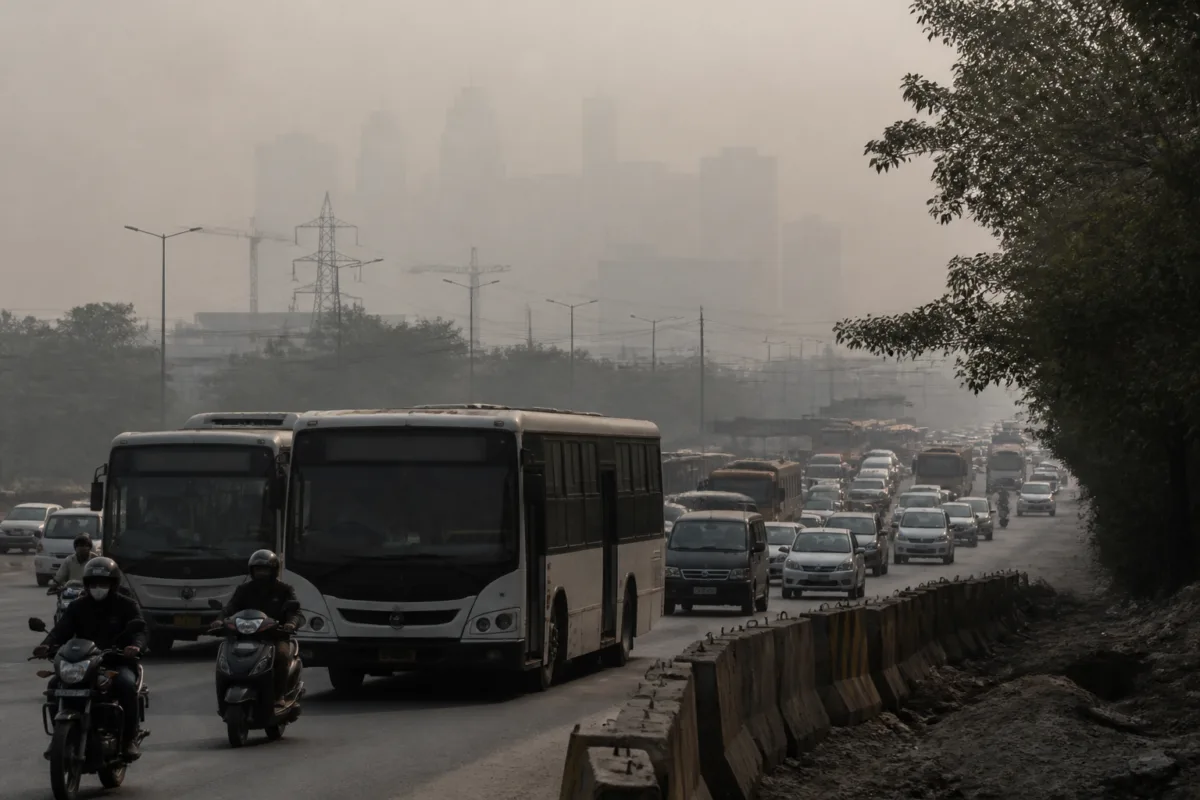
Delhi air pollution has worsened sharply after a brief improvement at the end of October, with the city’s average air quality index reaching 377 and the number of monitoring areas above 400 more than doubling in 24 hours. The deterioration is not only a seasonal weather event; it also exposes the limits of treating a structurally distributed problem through short-term restrictions.
According to a report by Live Hindustan – NCR, Delhi’s average AQI rose from 350 on Tuesday to 377 on Wednesday. The ITI area recorded an AQI of 455 at 6 pm, the highest among the locations cited. The number of areas recording AQI above 400 increased from 10 to 22 in a day, placing more parts of the capital in the severe category.
The report said relief was not expected immediately. The weather assessment cited in it indicated that clear skies would prevail for the next four days, with maximum temperatures between 27 and 29 degrees Celsius and minimum temperatures between 15 and 17 degrees Celsius. Light fog or haze was expected in some areas during the morning. The report also said air quality could remain in the very poor category on 5 November and deteriorate to the severe category on 6 and 7 November.
That sequence matters because Delhi’s pollution is shaped not only by the amount of pollution being emitted, but also by how weather conditions trap pollutants close to the ground. The report said Delhi had recorded an AQI of 60 on 30 October after heavy rain associated with Cyclone Arnab. Within six days, pollutant levels rose rapidly and the city returned to very poor and severe conditions. The contrast shows how quickly atmospheric conditions can change the measured air quality without resolving the sources that produce the pollution.
The central governance problem is that Delhi does not have one pollution problem with one source. It has multiple localised hotspots, each with a different combination of transport, industrial, waste and dust-related emissions. The report identifies Anand Vihar as an area affected by interstate buses, heavy-vehicle concentration and the presence of a landfill site. In Bawana and Narela, industrial waste burning and factory emissions are cited as major factors. Dwarka and Rohini face road dust and local construction activity, while Wazirpur and Mayapuri are associated with smoke from metal and scrap industries.
This distribution complicates the use of a single citywide response. A restriction designed for construction sites may have limited effect in a neighbourhood where industrial emissions or waste burning dominate. Similarly, a measure aimed at private vehicles may not address pollution generated by interstate buses, freight traffic, road dust or older commercial vehicles. The report quotes experts arguing that Delhi’s pollution hotspots resemble urban heat islands: geographically concentrated pockets where local conditions intensify a wider regional problem.
The distinction between citywide air quality and neighbourhood-level sources is important for administration. The city’s average AQI provides a clear warning, but it does not identify which agency, activity or enforcement failure is responsible for the pollution at a particular location. A useful response therefore requires monitoring and action at the level of the hotspot, not only at the level of the city average.
The figures cited in the report also show why seasonal emergency action has limited reach. Vehicle emissions accounted for about 18 per cent of Delhi’s pollution on Wednesday, while stubble burning contributed 15.6 per cent. The report places the contribution of other factors at more than 25 per cent and notes that these include emissions from Delhi and neighbouring states. These figures do not describe a single dominant source that can be switched off quickly. They point instead to a portfolio of sources operating across jurisdictions and throughout the year.
The report further cites findings that about 65 per cent of total PM2.5 reaching Delhi comes from outside the city. If that estimate is applied to the episode described, measures within Delhi alone cannot fully determine the air residents breathe. Local enforcement remains necessary, particularly in identified hotspots, but it operates within a regional airshed where emissions, wind and movement of polluted air cross administrative borders.
This is also why emergency measures can appear stronger on paper than in lived experience. Construction restrictions and vehicle curbs are visible and relatively easy to announce. They can be applied through permits, checkpoints or enforcement drives. By contrast, controlling road dust requires repeated mechanical cleaning and maintenance; preventing waste burning requires local surveillance and rapid response; reducing industrial emissions requires inspections and functioning pollution-control equipment; and addressing older vehicles requires a long-term transition in the transport system.
The report cites a 2026 study of the Graded Response Action Plan, or GRAP, which found that restrictions were often introduced after pollution had already crossed severe thresholds. That timing creates a structural weakness. Once pollutants have accumulated, a late restriction may reduce additional emissions without immediately clearing the existing concentration. The effectiveness of emergency action therefore depends partly on whether authorities can act before conditions reach the most dangerous levels.
The policy question is not whether GRAP should exist, but what it can realistically accomplish. A graded plan is designed to trigger progressively stricter actions as air quality deteriorates. It is not a substitute for year-round control of the sources that produce the deterioration. The report’s expert assessment specifically points to vehicle emissions, industrial pollution, road dust, waste burning and the gases that form secondary particles as areas requiring continuous attention.
Transport illustrates the limits of a narrow enforcement approach. The report says that restricting only selected categories of vehicles cannot control pollution across the entire transport system. Public transport capacity, freight movement, traffic congestion and the presence of older vehicles all affect emissions. Interstate buses and heavy vehicles are specifically identified as contributors in Anand Vihar, while the broader regional movement of polluted air means that Delhi’s transport policy cannot be considered separately from that of neighbouring areas.
The same principle applies to construction and urban development. Construction bans are administratively visible, but they do not automatically remove dust from existing roads or prevent emissions from industrial and waste-related activity. If restrictions are imposed unevenly or without hotspot-level monitoring, they can affect compliant projects while leaving other sources insufficiently addressed. The evidence in the report supports a more differentiated understanding of enforcement, although it does not provide enough detail to assess how consistently current measures are being implemented at each location.
The episode also reveals the institutional difficulty of managing air quality in a metropolitan region. Delhi’s municipal agencies, transport authorities, pollution-control bodies, industrial regulators and neighbouring state administrations influence different parts of the emissions chain. Landfills, bus terminals, roads, construction sites, factories and freight routes do not fall under one uniform operational system. Coordination is therefore not an administrative add-on; it is central to whether a pollution response can match the geography of the problem.
For residents, the immediate experience is uneven. A citywide average of 377 signals severe conditions, but the recorded AQI of 455 at ITI shows that exposure can be substantially worse in specific areas. People living near busy transport nodes, industrial clusters, waste sites or dusty construction corridors may face a different daily risk from residents elsewhere in the capital. This makes neighbourhood-level information and enforcement particularly important, even when public discussion is dominated by one headline AQI number.
The evidence supplied in the report confirms three things. First, Delhi’s air quality can deteriorate rapidly after a short period of rain-related improvement. Second, pollution is distributed across identifiable hotspots with different local causes. Third, a substantial share of PM2.5 comes from outside the city, limiting the effect of Delhi-only action. What remains unclear from the supplied material is how effectively the responsible agencies are enforcing source-specific measures at each hotspot and whether regional authorities are operating under a common implementation framework.
The next phase of the episode will be shaped by weather conditions, including the expected fog and haze, but the longer policy test is institutional. Authorities will need to track whether the predicted deterioration on 6 and 7 November is met with early action and whether interventions target the sources identified in each locality. Delhi’s recurring pollution crisis is therefore not only a question of how high the AQI rises. It is a test of whether urban governance can move from seasonal emergency response to coordinated, source-specific and regional pollution management.

