


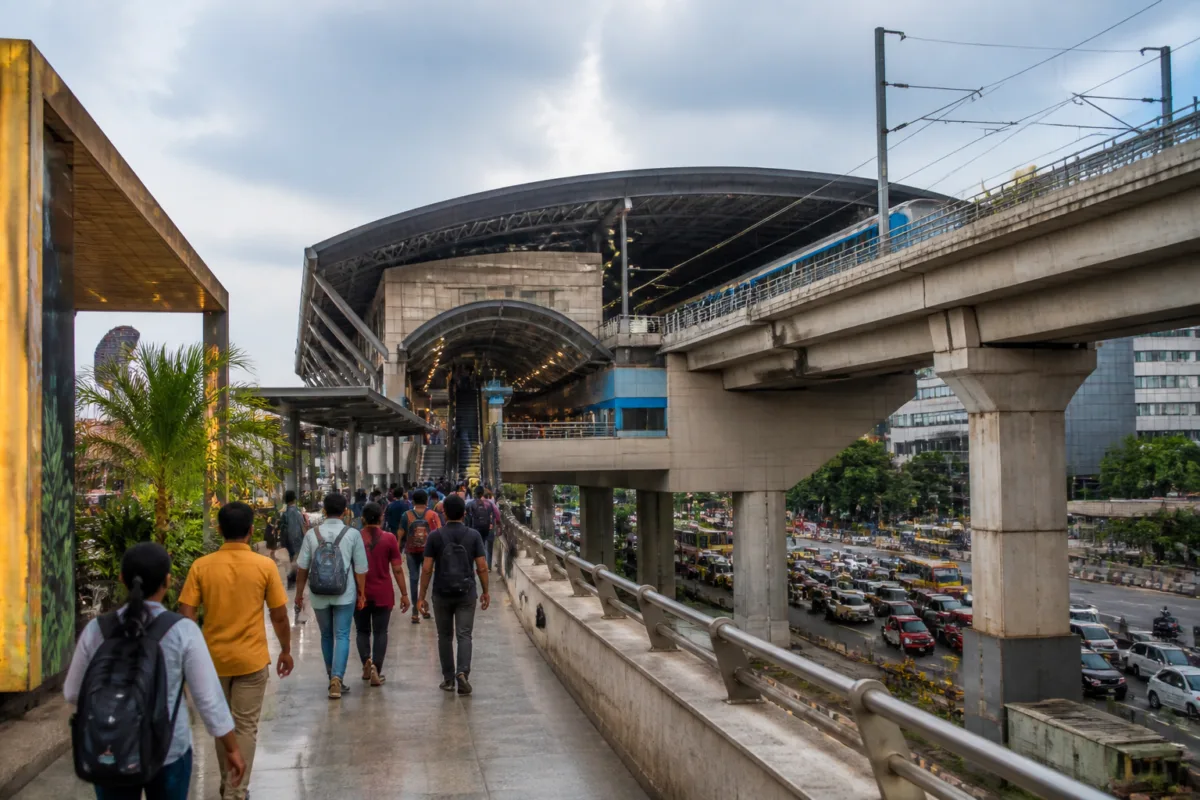
Kochi Metro’s decision to secure semi-naming rights for all 25 stations on its Blue Line is more than a branding exercise. It is a sign of how a metro system with lower-than-projected ridership is being pushed to extract greater value from its stations, trains, land and commercial relationships.
Kochi Metro Rail Ltd (KMRL) is expected to complete the process of awarding semi-naming rights for Vyttila Metro Station within a month. Once that happens, every active station on the Blue Line will carry a commercial brand name alongside its existing name. Eighteen stations had semi-naming rights last year, according to the report, but the expansion to all 25 stations will make Kochi Metro the first network in India to secure such rights across its entire operational station set.
The arrangement is expected to generate Rs 6 crore a year. KMRL is targeting non-fare box revenue of Rs 50 crore in the financial year 2026-27, compared with Rs 33 crore in the previous financial year. That represents a planned increase of 51.52%, at a time when the metro is having to replace a major source of non-ticket income that has ended.
The central financial pressure is the difference between the system’s original ridership assumptions and its current passenger base. The detailed project report prepared during the planning phase projected daily ridership of 3.8 lakh to 4.2 lakh after full stabilisation of Phase 1. Current average daily ridership, however, is reported at 1.25 lakh. That gap limits the revenue that can be generated directly from passenger fares and increases the importance of commercial income.
KMRL registered an operational profit of Rs 52.64 crore in 2025-26, while its net loss declined to Rs 352.49 crore from Rs 430.5 crore in the previous year. These figures show two different aspects of the metro’s finances. The operational result indicates that day-to-day operations generated a surplus, but the overall balance sheet continued to carry a substantial net loss. Non-fare revenue can therefore support the operating model, but it does not by itself resolve the larger financial burden.
The need to build new commercial sources has become more urgent because a significant earlier contribution to non-fare revenue has ended. Axis Bank paid Rs 209 crore over 10 years as part of an agreement connected with KMRL’s automated fare collection system. The annual contribution was more than Rs 30 crore, according to the report, and ended in 2025-26. The station-branding programme is consequently being developed not only as an additional income stream but also as part of a broader effort to compensate for a lost source of revenue.
KMRL’s commercial strategy now covers multiple parts of the metro system. Advertising opportunities include train interiors and exteriors, station spaces, pillars, medians and audio announcements. Audio advertisements have begun on trains on an experimental basis and are scheduled to play before a train reaches the station identified by the client. Film-poster advertising, film shoots inside stations and “Save the Date” video-making inside metro trains are also being used as revenue sources. A four-hour film shoot reportedly generated Rs 1 lakh.
The strategy extends beyond conventional advertising. KMRL has awarded median beautification along the 15-kilometre stretch from Edapally to Tripunithura. The arrangement is intended to improve green cover along the medians while allowing the metro authority to collect revenue through licence fees and advertising. The annual licence fee for the awarded contract is Rs 30 lakh.
The commercialisation of physical and digital infrastructure is another part of the plan. KMRL has tendered the leasing of optical fibre cables to telecommunications companies for services such as Wi-Fi connectivity. It is also examining the possibility of leasing space for telecom towers, with tenders expected to be issued. These initiatives treat the metro corridor not only as a passenger transport asset but also as a platform containing usable communications infrastructure.
Station property is being monetised in a similar way. KMRL has reported rental income from developments and facilities involving IIM-Calicut at Cusat station and “i by Infopark”, a nine-storey building at South Station. Other uses include electric vehicle charging stations at Muttom and Cusat, ATMs, bank branches, dormitories at Pathadipalam and MG Road, and a hotel at Aluva station. The range of tenants suggests that the commercial role of a metro station is being defined broadly, from retail and services to office space and supporting urban facilities.
This approach also changes the way the upcoming Phase 2 corridor is being planned. The JLN Stadium–Infopark corridor is expected to be completed by August 2027 and will have 11 stations. KMRL managing director G Priyanka has instructed department heads to prepare commercial opportunities in advance. Five prospective clients have already approached the authority for semi-naming rights, according to a KMRL official. The authority plans to deploy station branding, train advertising and advertising on pillars and medians when the corridor becomes operational.
The timing matters because Phase 2 is intended to connect the metro network to a major employment and commercial area around Infopark. The report does not provide projected ridership for the new corridor or details of the expected advertising and lease income. What it does establish is that commercial monetisation is being considered before the corridor opens, rather than being added after passenger services begin. In institutional terms, this represents a shift from treating non-fare revenue as a supplementary activity to making it part of corridor preparation.
KMRL is also moving ahead with the 31.43-acre Bliss City mixed-use development in Kakkanad. The project is transitioning into an active construction site, with the initial phase planned around commercial, shopping and entertainment facilities. A secondary 1.62-acre parcel has been tendered and is in the process of being handed over. The project places land development alongside station advertising, property leasing and infrastructure rental as part of the metro’s revenue architecture.
The model raises an important question about the relationship between metro finances and urban transport performance. A metro system is generally built around fare income supported by public investment and other revenue streams. In Kochi, the reported ridership gap means that commercial activity is being asked to carry a larger share of the financial burden than originally anticipated. The station itself becomes an income-producing asset, while the wider network supplies locations, audiences, land and infrastructure for commercial use.
That strategy can provide financial flexibility, but the available figures also show its limits. The planned Rs 50 crore in non-fare box revenue for 2026-27 is significant for KMRL, yet it remains small compared with the accumulated net loss reported for 2025-26. Station branding and advertising can improve cash flow, but they do not automatically increase passenger numbers or close the gap between projected and actual ridership.
The evidence also shows why the quality of the commercial model matters. Semi-naming rights alter how stations are identified in public communication and everyday navigation, while advertising and property development introduce commercial activity into spaces designed primarily for movement and access. The report provides details of the revenue opportunities but does not establish how branding will be displayed, how long individual agreements will run, or how the authority will prevent commercial names from weakening the recognisability of existing station names. Those details will be important as the model expands.
The same applies to mixed-use development and corridor advertising. These activities can make metro infrastructure more financially productive, but their urban value depends on how they are integrated with passenger circulation, public access, safety and the surrounding neighbourhood. The supplied information confirms that KMRL is pursuing these opportunities; it does not yet provide sufficient evidence to assess their wider effects on station design or commuter experience.
Kochi Metro’s current revenue push therefore reflects a structural challenge rather than a single branding decision. The network is operating with average daily ridership well below the range projected for the stabilised Phase 1 system, while a large earlier non-fare contribution has ended. KMRL’s response is to broaden the definition of the metro asset: stations are branding platforms, trains are advertising spaces, medians are licensed corridors, fibre networks are leasable infrastructure and adjoining land can support mixed-use development.
The next stages will show whether this wider commercial model can provide durable support for the network. Immediate milestones include the finalisation of Vyttila station’s semi-naming rights, the implementation of branding and advertising plans for the 11 Phase 2 stations, further telecom infrastructure tenders and progress on Bliss City. The central financial question remains whether these revenue sources can compensate for lower-than-projected ridership while the metro expands its physical and commercial footprint.

