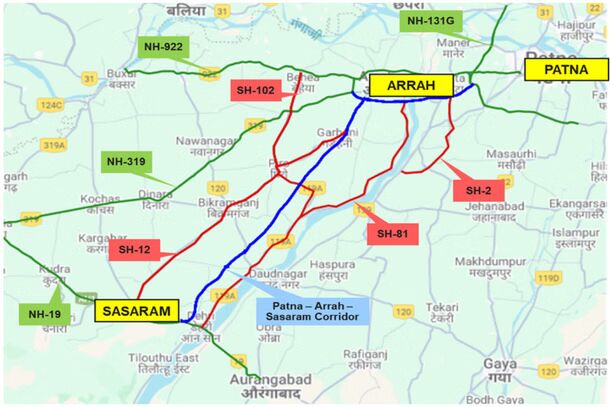
A proposed 150-km ring road encircling Patna is emerging as a defining infrastructure intervention under the national highways expansion programme, with implications that extend beyond traffic decongestion to reshaping regional urban growth. The project, aligned with the Bharatmala framework, aims to redirect through-traffic away from the city core while strengthening connectivity across neighbouring districts.
Planned as a multi-lane corridor, the ring road will link key districts such as Saran, Vaishali and Samastipur, enabling seamless inter-district travel without entering Patna’s already strained urban network. The broader Patna ring road project is designed to intersect multiple national and state highways, creating an alternative freight and passenger movement grid around the capital. Urban mobility experts view the project as a necessary response to rising vehicular pressure in Patna, where rapid population growth and spatial expansion have outpaced road capacity. By diverting heavy vehicles and long-distance traffic, the corridor is expected to reduce congestion within the city while improving travel time reliability across the region. However, the significance of the Patna ring road project extends beyond transport efficiency. Infrastructure planners suggest that ring roads often act as catalysts for peri-urban development, opening up new land parcels for housing, logistics hubs, and commercial activity. In Bihar’s case, this could accelerate the expansion of the Patna metropolitan region across both sides of the Ganga and into adjoining districts.
This raises important questions around land use planning and sustainability. Without robust zoning frameworks, such projects risk triggering unplanned real estate growth, fragmented settlements, and pressure on agricultural land. Experts emphasise that aligning the corridor with transit-oriented development principles and environmental safeguards will be critical to ensure balanced growth. The project is part of a larger national effort to enhance freight efficiency and reduce bottlenecks through ring roads, bypasses, and economic corridors. Under Bharatmala, such interventions are intended to streamline logistics and cut travel times, thereby improving economic productivity. For Patna, this could translate into stronger regional trade linkages and improved access to markets. At the same time, implementation challenges remain. Land acquisition, compensation frameworks, and environmental clearances have historically slowed highway projects in the state.
Recent progress on individual stretches suggests momentum is building, but timely completion will depend on coordination between central agencies and state authorities. For citizens, the project offers a mixed outlook—promising reduced congestion and better connectivity, while also signalling potential shifts in land values and settlement patterns. As construction advances, the focus will increasingly shift to how effectively the corridor integrates with urban planning goals, climate resilience strategies, and equitable access to infrastructure.