


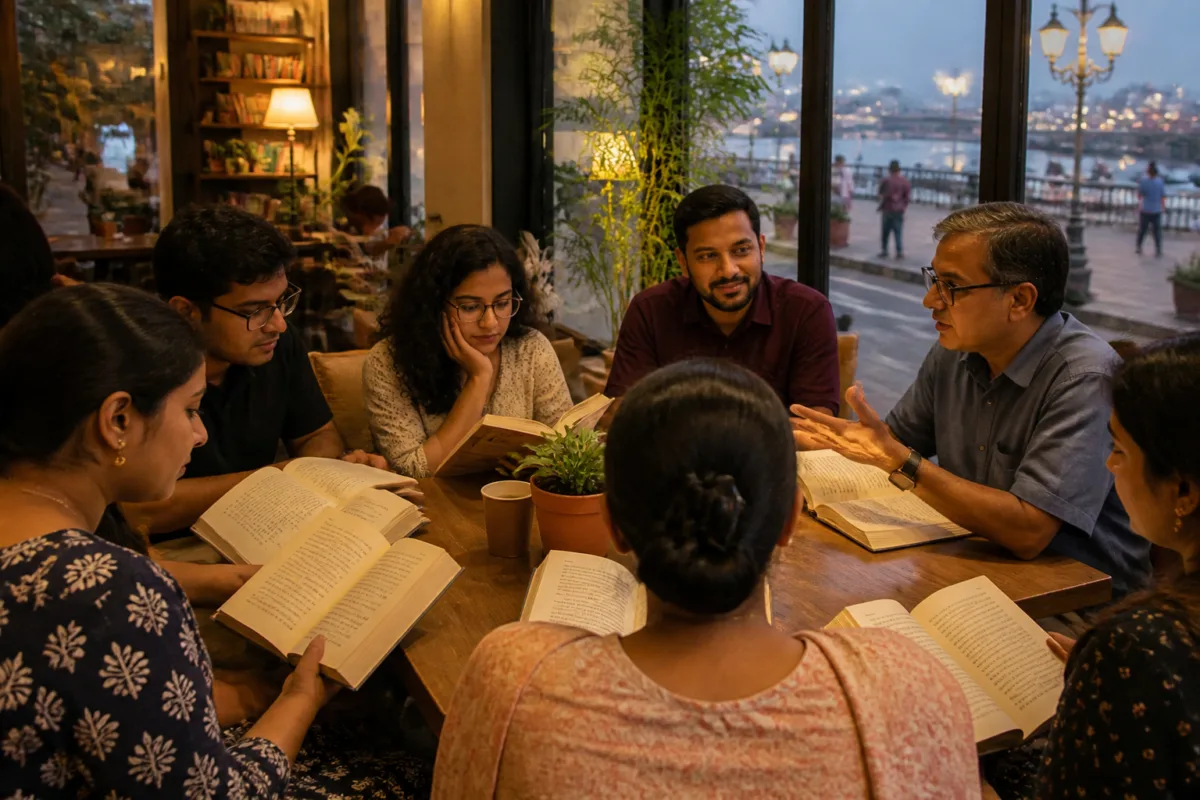
Patna book clubs are doing more than reviving reading habits. Through silent reading sessions, discussions and meetings with writers, communities such as Bookvalent and Kreativ Beings are creating small but significant spaces for people to meet away from screens, work routines and the pressure of constant digital interaction. Their activities point to an urban need that is rarely captured by conventional measures of city life: the need for accessible places where strangers can gather, talk and build relationships around a shared interest.
These groups are not operating from dedicated cultural institutions. Their meetings take place in cafés, restaurants and parks, often for an hour or two. That modest format matters. It allows reading to become a shared activity without requiring a large venue, formal membership system or extensive infrastructure. The city’s existing commercial and public spaces are being used as informal meeting points, giving ordinary places a social function beyond consumption or transit.
The pattern also shows how urban communities can form without being entirely dependent on digital platforms. Both groups use online tools in some way, but their central appeal lies in the move from online interaction to physical presence. Bookvalent organises silent reading sessions and discussions, while Kreativ Beings combines weekly online meetings with a monthly offline gathering. The result is not a rejection of technology but an attempt to establish a different balance between digital access and face-to-face participation.
That distinction is important in a city where many social interactions increasingly begin and end on phones. The source account describes reading circles as a response to a screen-driven routine in which notifications, instant replies and endless scrolling can crowd out slower forms of attention. The groups do not claim to solve that condition. Their contribution is narrower and more practical: they create scheduled occasions in which people can read, listen and speak without the expectation of constant digital availability.
Bookvalent’s origins reflect this shift. Founder Rahul Deo Sharma said the idea took shape during the Covid-19 pandemic, when restrictions on physical interaction highlighted the importance of human connection. The community was formally launched in 2021. Its development suggests that the experience of isolation did not simply increase demand for online communication; it also renewed interest in physical communities once meeting in person became possible again.
The organisation now has a regular readership of more than 20 members, according to Sharma, with millennials forming a significant part of the group. This is not a large membership by the standards of a city-wide cultural programme. But it is large enough to sustain recurring activity and varied discussion. In urban terms, the group demonstrates how small communities can produce continuity: a regular gathering, a recognisable set of participants and a shared reason to return.
Its reading choices also make the group more than a narrow literary circle. Hindi and English works receive equal space, and the discussions include writers such as Ramdhari Singh Dinkar, Premchand and Harivansh Rai Bachchan alongside contemporary authors including Divya Prakash Dubey and international writers such as Khaled Hosseini, Paulo Coelho and George Orwell. Arundhati Roy’s works are also discussed. The range allows participants to move across languages, periods and literary traditions rather than treating reading as a single cultural category.
That variety creates one of the most valuable functions of a reading circle: it makes discovery collective. A reader may encounter an unfamiliar author through another member, while a familiar book can be reconsidered through a different interpretation. The group therefore adds a social layer to an activity that is often treated as private. Reading remains individual, but the meaning attached to a book is tested and expanded through conversation.
Kreativ Beings follows a different route. Founder Gaurav Sinha first ran an online book club for nearly a year before beginning offline meetings in Patna. The group continues to meet online every week and gathers physically once a month. This hybrid structure suggests that digital and physical formats can support each other when they serve different purposes. Online meetings provide regular contact, while in-person gatherings offer a setting for more direct interaction and informal exchange.
The group also brings budding authors into contact with readers. Experienced and aspiring writers are invited to discuss their work and the process of writing and publishing. That interaction helps readers understand the labour involved in producing a book, while giving authors an audience beyond the immediate writing community. Different moderators lead sessions, encouraging participation and allowing conversations to move beyond a single organiser’s perspective.
This is where the reading circles begin to resemble informal cultural infrastructure. Infrastructure is usually associated with roads, transport systems, utilities and buildings. Yet cities also depend on less visible arrangements that help people participate in public life. A recurring reading session, a café willing to host it, a park that can accommodate a gathering and a group capable of organising discussion together form a small network of social infrastructure. It may not appear in a municipal plan, but it affects how residents experience belonging and connection.
The distinction between a venue and a public place is central to this process. A restaurant or café is primarily a commercial space, while a park is a public amenity. When reading groups use such places for conversation, they temporarily transform them into sites of cultural participation. The activity does not require a new building, but it does depend on the availability of spaces where people can remain for a period of time, interact without excessive pressure and feel comfortable enough to return.
The source does not establish how many such groups operate across Patna, how their membership has changed over time or how widely their meetings are distributed across the city. It also does not provide attendance data, demographic information beyond the observation that millennials form a significant part of Bookvalent, or evidence about whether these initiatives have influenced library use or other cultural institutions. Those limits are important. The reading circles should not be presented as a city-wide movement on the basis of two examples alone.
What can be established is the form of participation they offer. Bookvalent has been operating since its formal launch in 2021 and reports a regular readership of more than 20 members. Kreativ Beings combines weekly online meetings with monthly physical gatherings after nearly a year of online activity. Both initiatives use books as a basis for interaction, but their stated objectives extend to learning, belonging, discussion and contact between writers and readers.
Their experience also raises a question about how cities understand cultural life. Formal cultural infrastructure is valuable, but it is not the only route through which residents create communities. Small groups can activate existing spaces without waiting for a large institutional programme. At the same time, their reliance on cafés, restaurants and parks indicates that informal culture still needs suitable urban conditions: places that are reachable, welcoming and available for gatherings that may not generate immediate commercial returns.
The groups’ screen-free or screen-light formats further underline the relationship between attention and place. A digital platform can connect people quickly, but it does not necessarily provide the same setting for sustained conversation. In these reading circles, the physical meeting is the activity rather than merely the location of an activity organised elsewhere. Participants read together, discuss books and meet authors in a shared environment. The value lies partly in the content and partly in the act of being present.
For Patna, the larger urban question is not whether book clubs can replace libraries, schools or cultural institutions. The evidence does not support such a conclusion. The more precise question is whether cities provide enough ordinary, accessible settings for residents to form communities around interests that are not primarily commercial or political. The reading circles described here suggest that the demand exists, even if it is being met through small self-organised initiatives.
Their future significance will depend on whether such activity remains regular, whether participation expands and whether more spaces can support similar gatherings. For now, Bookvalent and Kreativ Beings show how a book, a meeting place and a recurring schedule can produce a modest form of urban connection. In a city shaped increasingly by digital communication, their work makes the case for taking offline social spaces seriously—not as nostalgic alternatives to technology, but as part of the everyday infrastructure through which urban belonging is built.

