


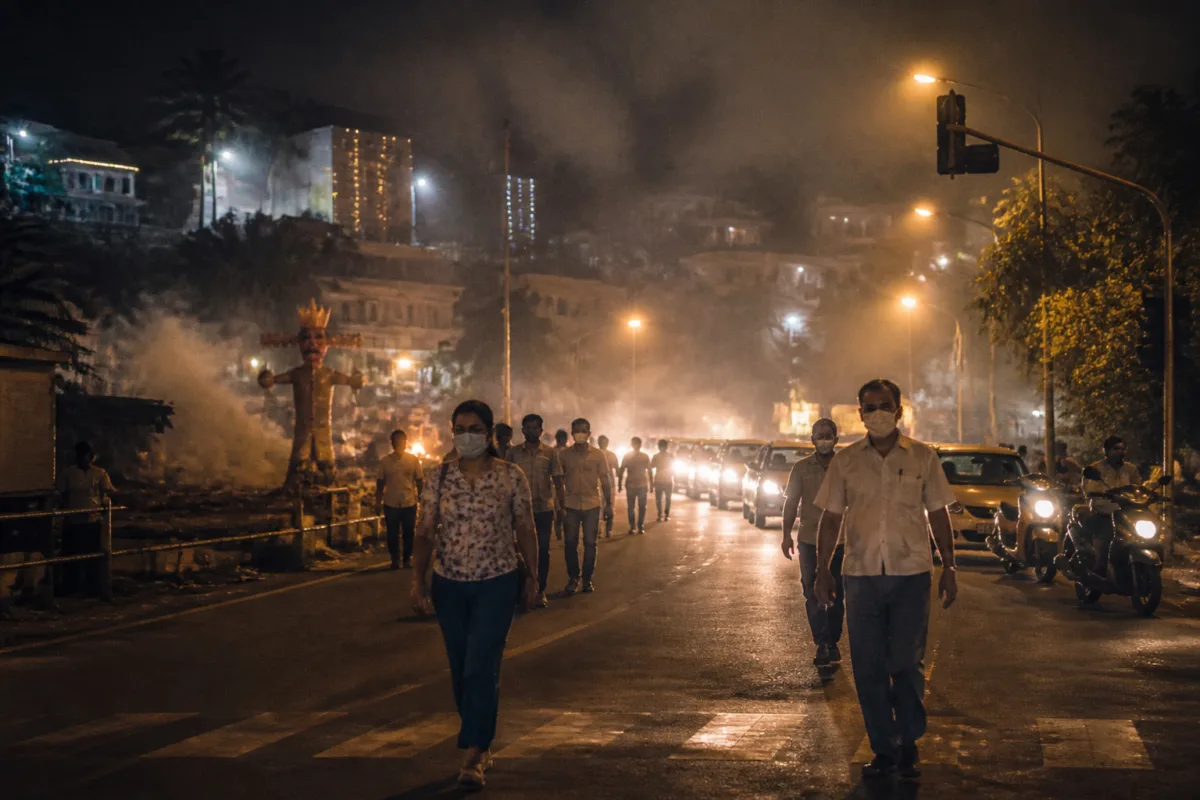
Panaji’s Diwali air quality has deteriorated sharply since 2020, with the city recording an AQI of 133 on November 8, 2026, according to data reported by AQI.in. The reading placed Panaji in the poor category and marked its worst Diwali air in six years. The episode is significant not only because pollution rose during a festival associated with firecrackers and effigy burning, but also because the available reading now has to be tested against a more formal assessment by the Goa State Pollution Control Board.
The reported daily average masked a sharper overnight spike. Panaji’s air quality reached an AQI of 216 during the night of November 8, while the average for the day stood at 133. AQI.in’s figures therefore describe a period in which exposure was not uniform: pollution levels were substantially higher at certain times than the daily average suggests. For residents, the timing matters because the spike coincided with Naraka Chaturdashi and Diwali celebrations, when Narkasur effigies were burned and firecrackers were used.
AQI.in’s historical figures show how unusual the 2026 reading was in comparison with the same festival period in earlier years. Panaji recorded an AQI of 16 on November 14, 2020, followed by 60 on November 4, 2021, and 114 in 2022. The figure fell to 98 on November 12, 2023, and 94 on October 31, 2024. It eased further to 87 on October 20, 2025, before rising to 133 in 2026. The sequence does not show a steady annual increase, but it does show a substantial deterioration from the cleanest reading in the series and a renewed increase after the improvement recorded in 2025.
That pattern is the central urban question behind the latest reading. A festival-day AQI captures a short period, but a multi-year comparison can reveal how an event interacts with the city’s wider air-quality system. It raises questions about the sources of pollution, the timing of emissions, the role of weather and dispersion, and the extent to which a city’s monitoring network can distinguish between different contributors. In this case, the data indicate deterioration, but they do not by themselves establish the precise cause.
The Goa State Pollution Control Board has acknowledged that gap. Its chairperson, Pradip Sarmokadam, said the board would ask its team to deploy an ambient air quality monitoring van to conduct a more scientific assessment and verify the reported readings. He said the conditions could be attributed to emissions from firecrackers, but added that this needed to be verified. The board’s proposed response is important because AQI.in and the state regulator perform different functions in the reported account: one provides the real-time and historical readings, while the other is responsible for a formal assessment and for examining the actual cause of the reported levels.
The distinction is particularly relevant when pollution rises around a specific event. A monitoring platform can identify a high reading, but attributing that reading requires more than observing that it occurred during Diwali. The timing of the peak, the pollutants measured, the meteorological conditions and the presence of other local emissions would all affect the assessment. The material supplied for this report does not provide those details. The GSPCB’s proposed deployment of an ambient air-quality monitoring van is therefore the next step in establishing whether the reported increase was primarily linked to firecrackers or reflected a combination of factors.
Panaji’s festival calendar adds another layer to the episode. Goans mark Diwali with the burning of Narkasur effigies on Naraka Chaturdashi, typically at dawn before the main Diwali celebration. In 2026, Narkasur effigies were erected through the night of November 7 and burned at dawn on November 8, with the main Diwali celebrations following soon afterwards. This compressed sequence places multiple sources of smoke and particulate emissions within a short period, although the available evidence does not quantify the contribution from each activity.
The regulatory framework described in the report also illustrates an important distinction between different forms of festival control. Before the celebrations, the Bombay High Court ordered a strict ban on loudspeakers and sound amplifiers during Narkasur effigy-burning celebrations from midnight on November 7 until 6am on November 8. The order addressed noise during a specified time window. It did not impose restrictions on firecrackers. As a result, the measures reported for the festival dealt with one type of environmental impact while leaving another activity outside the restrictions described in the source.
This separation matters for city administration because festivals are managed through multiple regulatory channels. Noise controls, air-quality monitoring, public safety and event permissions may involve different authorities and operate under different legal orders. A ban on loudspeakers cannot be treated as an air-pollution intervention, and a high AQI reading cannot by itself establish whether existing event controls were effective. Panaji’s experience shows how environmental governance can become fragmented when a single public celebration produces several types of urban impact.
The available numbers also need to be read carefully. AQI.in described the November 8 reading as poor and reported a peak of 216. Its estimate that breathing Panaji’s air was equivalent to smoking three cigarettes a day, or about 90 cigarettes a month, was attributed to Berkeley Earth and calculated using the average PM2.5 concentration over the preceding 24 hours. The estimate assumes continuous exposure and is an illustrative way of communicating pollution exposure. It is not a literal count of cigarettes smoked and does not constitute an individual medical-risk assessment.
That qualification is essential because simplified exposure comparisons can make an air-quality reading easier to understand while also creating a risk of misinterpretation. The more useful information in the supplied evidence is the measured AQI trend, the timing of the peak and the regulator’s decision to verify the reading. Residents need to know both that the reported pollution was elevated and that the source attribution remains under examination.
AQI.in recommended precautions including using indoor air purifiers, wearing N95 masks outdoors, ensuring vehicle air filters were functioning properly and limiting outdoor exposure while pollution remained elevated. These steps place immediate responsibility on households, but the longer-term institutional responsibility lies with the monitoring and regulatory system. The GSPCB’s assessment will determine whether the reported AQI can be confirmed and whether the episode can be linked to firecrackers or other sources with greater confidence.
The historical series makes clear that Panaji’s cleanest Diwali reading is no longer an adequate description of the city’s festival-air experience. The AQI rose from 16 in 2020 to 133 in 2026, although the intervening years included both increases and declines. That variation means the figures should not be presented as proof of a simple linear trend. They do, however, establish a wide gap between the lowest and highest reported readings and show why year-on-year monitoring is necessary rather than relying on a single festival-day snapshot.
The episode also highlights the limits of treating air pollution as a temporary festival issue. A short-lived spike can still affect residents during the hours when pollution is highest, while the absence of a verified source leaves policymakers without a clear basis for designing targeted controls. The supplied account does not establish whether Panaji’s wider annual air quality has deteriorated, nor does it provide pollutant-specific data, weather conditions or health-impact measurements. Those gaps should remain visible in any assessment of the event.
What the evidence confirms is narrower but still significant: Panaji recorded a reported AQI of 133 on November 8, 2026, reached 216 during the night, and experienced its highest Diwali reading in the six-year series cited by AQI.in. What remains to be established is the cause of the increase and how the reading compares with measurements from the state’s own monitoring system. The GSPCB’s planned deployment of an ambient air-quality monitoring van is the next institutional milestone, because it is expected to verify the readings and examine the factors behind the reported pollution.

