


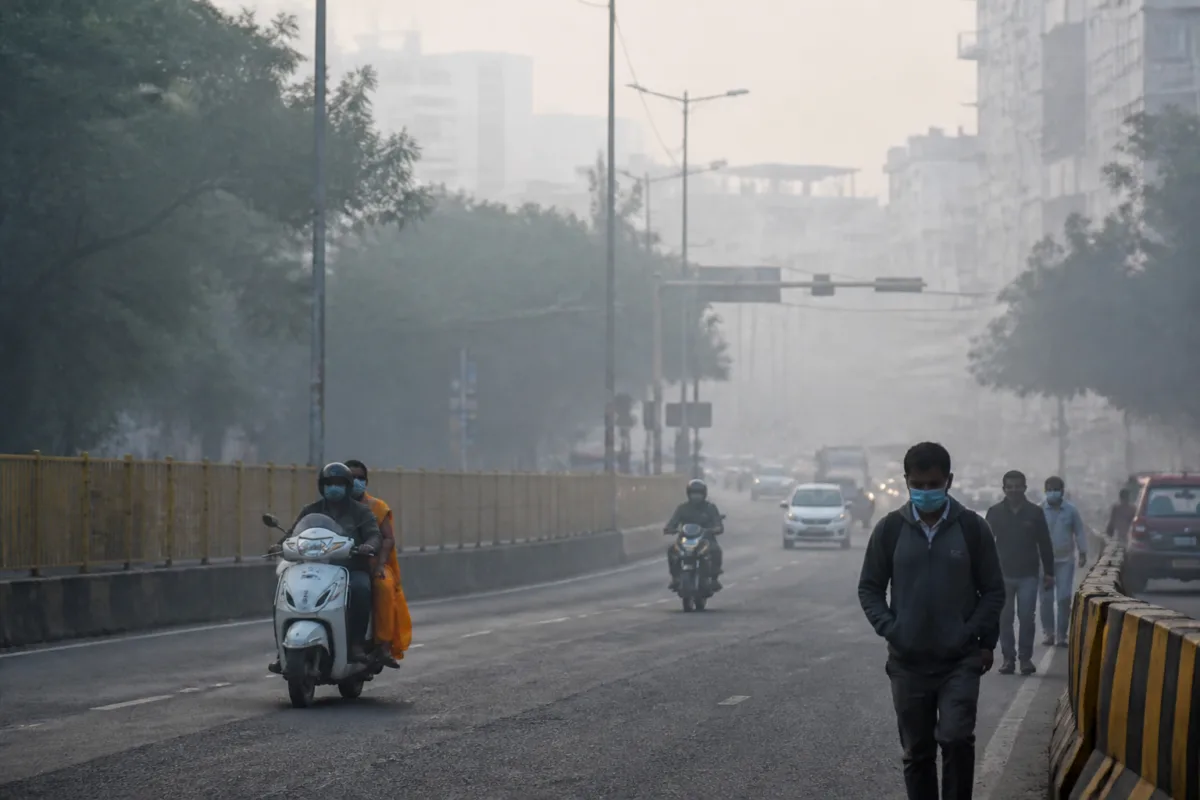
Bhopal’s air quality deteriorated to the severe category after Diwali fireworks, with the city’s average AQI reaching 404 at the TT Nagar monitoring station by Monday evening, according to data reported by the Times of India. The reading was almost twice the level recorded before the celebrations and was higher than post-Diwali levels reported in recent years.
The 24-hour average at TT Nagar, calculated from 6pm on Diwali day to 6pm on Monday, stood at 404. Under India’s AQI classification, a reading between 301 and 400 is considered very poor, while 401 to 500 falls in the severe category. Severe air quality affects healthy people and can seriously worsen the condition of those with existing diseases.
The deterioration began within hours of fireworks starting. At 6.15pm on Sunday, PM2.5 was recorded at 42 micrograms per cubic metre and PM10 at 121. By 8pm, the levels had increased to 106 and 288 respectively. At 9pm, PM2.5 surged to 829 micrograms per cubic metre. PM10 reached a peak of 864 an hour later, while PM2.5 stood at 591.
The pollution remained elevated through the night. PM2.5 rose again to 839 micrograms per cubic metre at 4am on Monday. At 5am, PM10 measured 593 and PM2.5 was 459. Although concentrations declined during the morning, they remained high for several hours, indicating that the deterioration continued well after the peak period of firecracker bursting.
Other pollutants also increased during the same period. Nitrogen oxides, which are among the pollutants used in calculating the AQI, rose from 14.8 parts per billion at 6.15pm to 40.2 by 10.45pm and reached 65.9 at 1am. Sulphur dioxide increased from 15.5 micrograms per cubic metre in the evening to 49 at 2am.
The latest reading was higher than the post-Diwali levels cited for Bhopal in recent years. The city’s AQI was reported to be between 300 and 350 in 2025 and around 300 near Paryavaran Parisar in 2024. In 2023, the AQI reached 353 at Paryavaran Parisar and 356 at TT Nagar.
The readings at TT Nagar show the speed with which particulate pollution can rise during concentrated bursts of fireworks in a dense urban area. They also show that the public-health impact can continue into the following morning, even after firecracker activity has reduced. The monitoring period reported by the Times of India ended at 6pm on Monday, with the 24-hour average AQI recorded at 404.

