


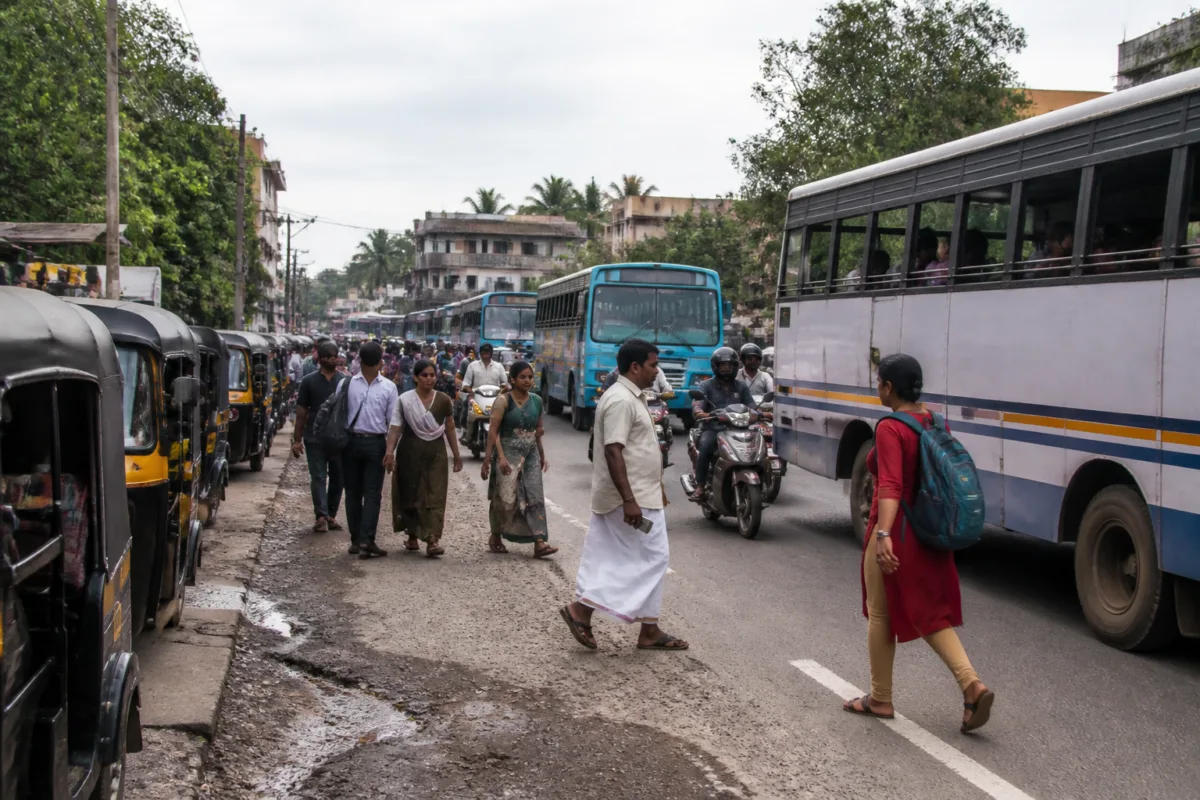
Thrippunithura bus stand was created to organise bus operations, but the report from Mathrubhumi describes a system in which only a few buses enter the facility. Many private and KSRTC buses instead stop in the middle of the busy Stand–Statue Road to pick up and drop passengers. The result is not simply inconvenience: passengers are pushed into moving traffic, vehicles are blocked and the designated bus stand loses its basic purpose.
The most immediate risk falls on people who must cross the road to board a bus. Students and other passengers waiting inside or near the stand reportedly run in different directions when a bus stops outside. They do so because the bus may not enter the stand and because several services compete for passengers on the road. A passenger’s journey therefore begins with an unplanned movement into a congested carriageway rather than from a controlled boarding area.
The report identifies the location as the busy stretch between the bus stand and Statue Road. One side of the road is occupied by an autorickshaw stand, while private and KSRTC buses stop in the centre of the carriageway. Vehicles following behind, including two-wheelers, are reportedly unable to move forward. This creates a conflict between buses loading passengers, autos using their stand and through traffic attempting to pass through the same limited road space.
The road conditions add another layer of danger. Passengers have reportedly fallen after tripping in potholes while trying to board buses or move through the area. That detail is important because the problem is not limited to driver behaviour. The safety of a bus interchange depends on the entire boarding environment: where buses stop, where pedestrians wait, how vehicles circulate and whether the surface allows people to move without entering active traffic lanes.
The central institutional question is why buses are not consistently using the municipal bus stand. Mathrubhumi attributes the practice to competition among buses for passengers. If operators believe that stopping outside the stand helps them pick up passengers before competing services, the road becomes an informal platform. Each bus’s attempt to gain an advantage then imposes costs on everyone else: passengers are made to cross unpredictably, traffic is obstructed and other road users are exposed to sudden stops.
This pattern also shows the limits of infrastructure when operations are not enforced. A bus stand can provide a physical space for boarding, but it cannot perform that function if services routinely stop outside it. The existence of a municipal facility is therefore not evidence that the city has solved passenger management. The relevant question is whether buses enter, stop, load passengers and leave according to a system that is visible and consistently applied.
The report says municipal authorities, the police and the Motor Vehicles Department have not taken effective action to prevent the practice. The responsibilities are divided but connected. Municipal authorities control or oversee the bus-stand environment and road-side arrangements. The police are responsible for traffic regulation and obstruction control. The Motor Vehicles Department can inspect vehicle operations and enforce applicable transport rules. When none of these functions produces sustained control, the road effectively becomes self-regulated by bus operators and passenger demand.
That division of responsibility can make a recurring problem appear ownerless. A police inspection may address vehicles for a short period, while the municipal authority may control the stand but not the movement of buses outside it. Transport enforcement may identify violations without changing the physical arrangement that encourages them. The result is a cycle in which the problem is visible to all agencies but remains unresolved at the point where passengers experience it.
The report links a recent inspection near the bus stand to the death of a young woman who was walking in the Kakkanad area after being hit by a bus. It says the police and Motor Vehicles Department conducted an inspection at the Thrippunithura bus-stand area, but describes it as a one-day exercise carried out only for appearances. The account does not provide details of the inspection’s findings, the number of vehicles checked, penalties imposed or any continuing enforcement plan. Those missing details matter because a one-day inspection cannot establish whether the underlying operating pattern has changed.
The evidence supplied also does not establish how many buses use the stand, how many stop outside it, how many passengers are affected each day or how many crashes and falls have occurred at the location. There is no traffic count, enforcement record or official response included in the report. These gaps prevent a numerical assessment of the scale of the problem, but they do not remove the immediate public-interest concern: passengers are reportedly boarding in the middle of the road while buses obstruct traffic in a congested area.
The physical arrangement described by the report makes the safety problem particularly difficult for vulnerable road users. Students waiting for buses may have limited control over where a service stops. People unfamiliar with the route may follow others into the carriageway. Two-wheelers approaching from behind may have little time to react when buses stop suddenly. Passengers moving around potholes must divide their attention between the road surface and moving vehicles. Each risk is manageable in isolation; together, they create a hazardous interchange.
The situation also exposes a gap between transport infrastructure and transport governance. A bus stand is not merely a shelter or a paved area. It is an operating system that requires route discipline, stopping rules, pedestrian access and enforcement. If buses can attract passengers by stopping before entering the facility, the system rewards behaviour that undermines the facility. Unless the operating incentives are changed, physical improvements alone may not prevent the same practice from returning.
The report does not record any announced redesign, new traffic plan, permanent police deployment, repair schedule or formal direction to bus operators. It also does not identify a responsible official or quote an authority explaining why buses continue to stop outside the stand. That absence makes the next administrative step significant. A credible response would need to clarify who will control stopping locations, how compliance will be monitored and what action will follow when buses obstruct the road or load passengers outside the designated area.
For residents, the issue is ultimately about whether an everyday trip can begin without entering an unsafe road space. The problem is concentrated at a specific location, but the institutional pattern is broader: infrastructure can fail when transport operators, traffic enforcement and local administration do not act as one system. Thrippunithura’s bus stand may exist on the map, yet the reported passenger experience is governed by what happens outside its boundary.
The supplied report confirms an ongoing conflict between the formal bus stand and informal roadside boarding on Stand–Statue Road. It records traffic obstruction, pedestrian exposure, pothole-related falls and limited enforcement, but does not establish the outcome of any inspection or provide an official corrective timetable. The developments that now require monitoring are sustained enforcement, bus-entry compliance, road-surface repairs and a clearly assigned administrative response.

