


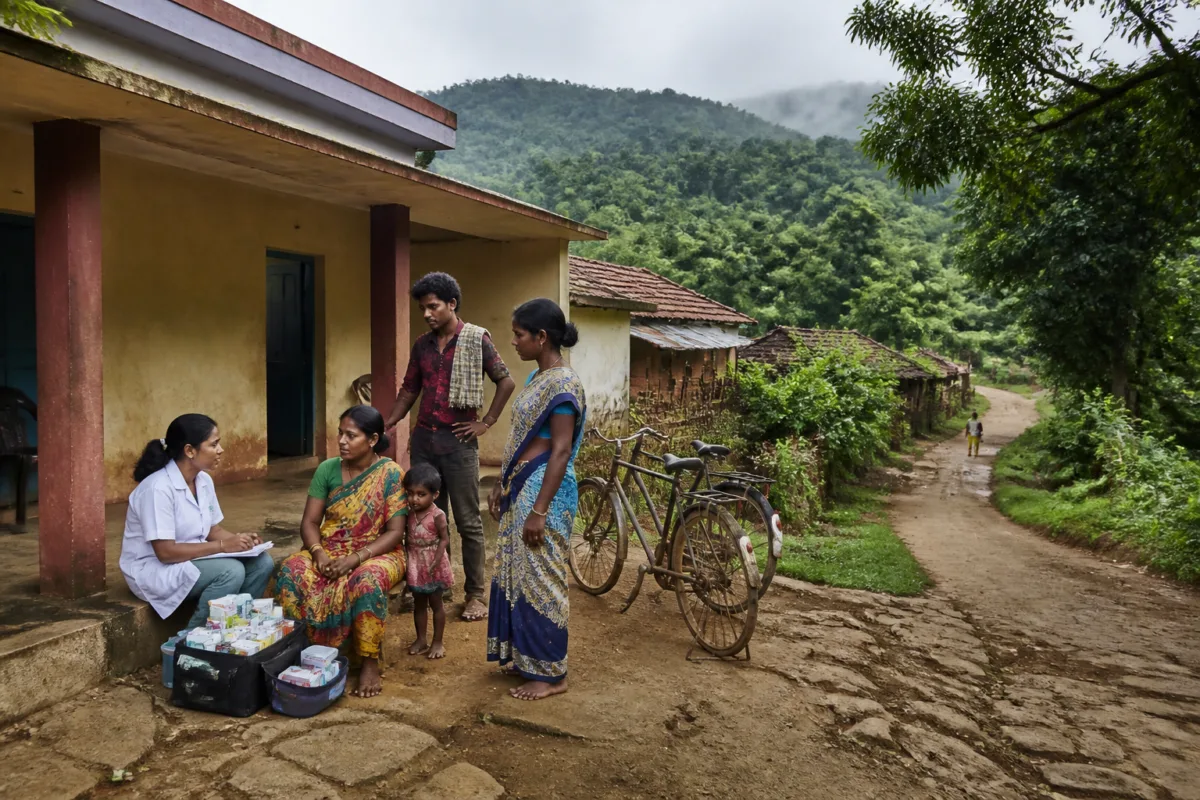
A new study on Odisha’s tribal communities reveals a central weakness in India’s healthcare infrastructure: insurance coverage does not guarantee access to diagnosis, medicines or sustained treatment. Although 94.6% of tribal households covered by the Odisha Tribal Family Health Survey reported health insurance coverage, only about 40% knew how to access insurance claims. The gap is not simply financial. It is also geographical, institutional, behavioural and digital.
Published in the Indian Journal of Community Medicine, the study was led by researchers from ICMR-National Institute of Health Research, Bhubaneswar, and SUM Hospital. It analysed discussions involving policymakers, clinicians, academicians and community representatives alongside findings from the Odisha Tribal Family Health Survey, described as one of the state’s largest tribe-specific health assessments.
The evidence points to a healthcare system that reaches households through schemes but remains less capable of delivering complete care in remote tribal regions. Limited diagnostic services and shortages of essential medicines were identified as major challenges. Health facilities often lack adequate infrastructure to screen and manage chronic diseases such as hypertension and diabetes, leaving residents vulnerable to delayed diagnosis and treatment.
The numbers indicate that the problem is not confined to occasional service disruption. Among older adults covered by the survey findings, 28.2% had undiagnosed hypertension, while 25.6% reported multiple chronic conditions. These figures suggest that primary healthcare access is being measured too narrowly when the presence of a facility or insurance card is treated as evidence of effective coverage.
The same infrastructure gap appears in maternal and child health. More than half of tribal children under five, or 51.9%, were stunted, including nearly 29% who were severely stunted. About 43% of pregnant women were underweight at their first antenatal visit. Anaemia affected more than 76% of women and 71.3% of children aged six to 59 months, according to Jaya S Kshatri, the study’s primary author.
These findings connect nutrition outcomes to the functioning of local health systems. The researchers identified shortcomings in the coverage and adherence of iron-folic acid and calcium supplementation programmes. They also pointed to dietary and cultural practices that can worsen nutritional deficiencies. The study cited the practice of giving black tea to infants as one example because it can inhibit iron absorption.
Healthcare utilisation is also shaped by whether residents trust, understand and can physically reach formal services. Traditional beliefs can discourage people from seeking medical care, while practices such as open defecation remain prevalent in some areas. Only 56.2% of children suffering from diarrhoea were taken to a health facility, Sanghamitra Pati, director of ICMR-NIHR Bhubaneswar, said while quoting the survey findings.
This is where the distinction between nominal access and functional access becomes important. A household may be enrolled in an insurance scheme, but that benefit remains limited if residents do not know how to file a claim, cannot reach a facility offering the required service, or encounter a centre without medicines and diagnostic capacity. The study’s insurance finding therefore exposes an administrative gap as much as a financial one.
The digital divide adds another layer to this problem. Only 15.7% of women reported using the internet, compared with 32.7% of men. Any health system that increasingly relies on digital information, online awareness, remote consultations or electronic claims must account for this unequal access. The figures also indicate that digital delivery cannot substitute for local health workers and accessible physical facilities in remote communities.
The study’s recommendations place primary healthcare and local delivery systems at the centre of the response. Stakeholders called for stronger laboratory services, more reliable medicine supply chains and expanded telemedicine. They also recommended trained community health navigators, or Swasthya Mitras, to help residents negotiate the health system, understand entitlements and connect with formal care.
This proposed role is significant because the barriers identified in the study do not sit within one department. Diagnostic capacity belongs to facility planning and health administration. Medicine availability depends on procurement and supply-chain management. Insurance claims require awareness and administrative support. Nutrition outcomes depend on antenatal care, supplementation, household practices and community engagement. Digital access depends on connectivity, devices, literacy and gendered patterns of internet use.
The study also calls for culturally sensitive health education and greater involvement of traditional leaders and local influencers. That approach recognises that healthcare delivery in remote communities is not only a question of building facilities. It also involves the relationship between formal institutions and communities whose practices, beliefs and decision-making structures shape when and where care is sought.
The evidence further points to the need for targeted disease programmes. Among tribal women surveyed, 6.5% carried the sickle cell trait and 4.5% had beta-thalassaemia. The researchers identified genetic disorders including sickle cell disease and beta-thalassaemia as priorities for intervention and implementation research, alongside community-based health models and microbiome research.
The call to move from descriptive surveys to intervention and implementation research is an important shift in the study’s logic. The survey establishes the scale of the gaps, but it does not by itself establish which delivery model will work best in different remote areas. The next stage therefore concerns how services are organised, monitored and adapted to local conditions. The researchers also recommended independent audits and stronger participation in health programmes.
For Odisha’s tribal regions, the larger policy question is whether public health coverage is being evaluated through inputs or outcomes. Insurance enrolment is an input. A functioning laboratory, available medicines, timely diagnosis, completed treatment and informed claims are outcomes experienced by residents. The contrast between 94.6% insurance coverage and roughly 40% claims awareness shows why the two cannot be treated as equivalent.
The study does not establish that one intervention can resolve the problem. It does, however, identify a connected set of weaknesses: inadequate diagnostic and medicine infrastructure, high levels of anaemia and undernutrition, incomplete chronic-care capacity, limited awareness of insurance procedures, unequal internet access and low utilisation of formal care for some illnesses. Together, these findings show that healthcare access is a systems issue rather than a single-scheme problem.
The developments that now merit monitoring are whether Odisha evaluates specific community-based delivery models, strengthens primary facilities and medicine supplies, expands support for claims and telemedicine, and creates independent mechanisms to measure implementation. The study’s evidence makes one conclusion clear: insurance coverage has expanded faster than the practical ability of many tribal households to use the healthcare system it is meant to support.

