


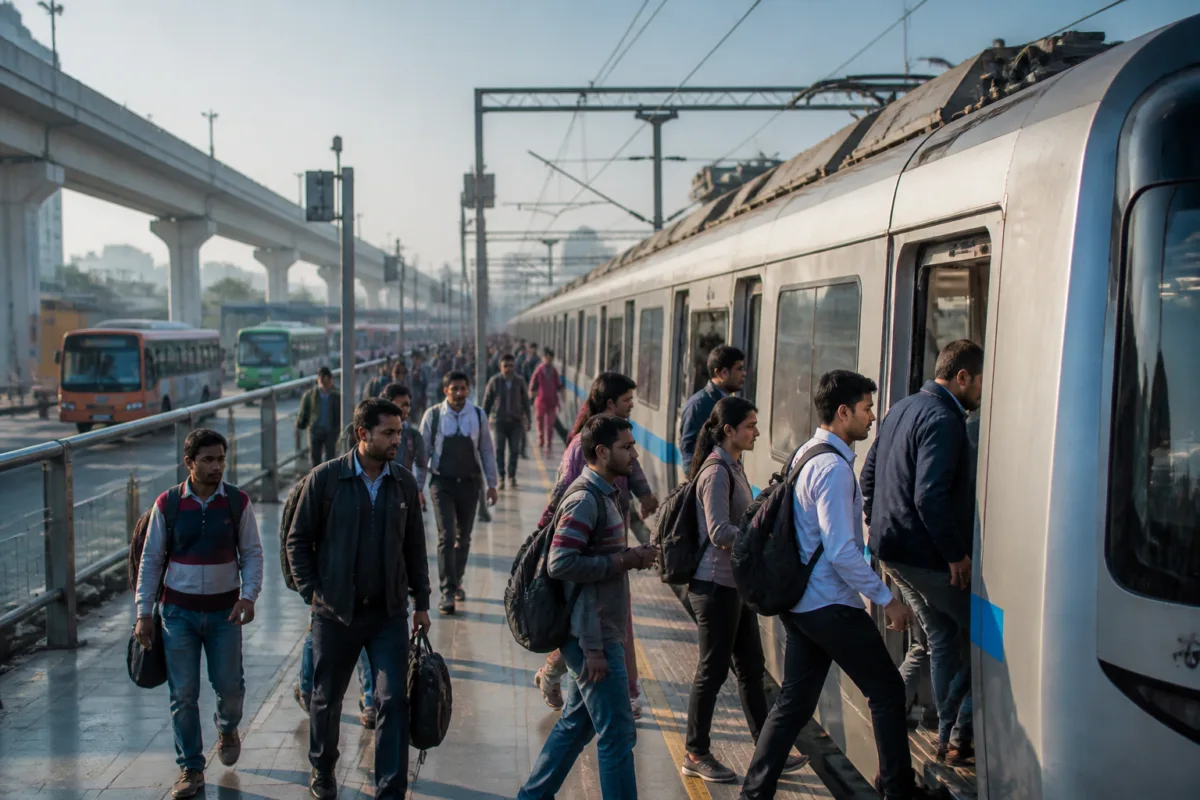
Namo Bharat passengers have crossed the five-crore mark, but the more revealing fact is the speed at which the latest one crore users joined the system. According to a report by Jagran – New Delhi, the corridor added one crore passengers in just 93 days, after taking 101 days to move from three crore to four crore and 143 days to reach three crore from two crore. The sequence points to a rapid increase in use of India’s first Regional Rapid Transit System as the Delhi-Ghaziabad-Meerut connection has expanded its role in regional travel.
The Namo Bharat service began operations on 21 October 2023, when the 17-kilometre priority section between Sahibabad and Duhai Depot was inaugurated. The first one crore passengers were recorded on 16 May 2025, after 574 days of operations, the report said. The next crore was added in 211 days, followed by the third crore in 143 days, the fourth in 101 days and the fifth in 93 days. The falling interval between each milestone is the central evidence in the ridership story.
These figures do not simply describe a larger passenger base. They show that the system’s usage has accelerated as more of the corridor became operational and as passengers encountered a service designed for regional journeys rather than only for short urban trips. The report attributes the increase to growing confidence in the Regional Rapid Transit System and to its speed, comfort and reliability. It also identifies the corridor’s links between Delhi, Ghaziabad and Meerut as a factor that has made regular travel easier.
The distinction between the initial 17-kilometre section and the later operation of the full corridor is important. A transport system’s usefulness is shaped not only by the trains themselves but also by the number of destinations they connect and the ease with which people can transfer to other modes. The report says that convenient interchange with metro, rail and bus services has helped passengers choose Namo Bharat for work, education, business and other journeys.
That combination of regional reach and interchange is significant for the way the Delhi metropolitan region functions. Employment, education and commercial activity do not stop at municipal boundaries. People may live in one city, work in another and rely on a chain of transport services to complete a daily trip. A regional rapid transit system can serve this pattern only when it is sufficiently fast, dependable and connected to the wider public transport network. The passenger milestones suggest that the corridor is increasingly being used in that wider mobility system.
The reported numbers also offer a useful way to understand public acceptance. The first crore took 574 days, although that period included the early phase when only the priority section was operating. The second crore arrived 211 days later. The time then reduced to 143 days, 101 days and 93 days for successive crores. The data therefore show two changes at once: the absolute number of passengers is rising, and the pace of additions is increasing.
The figures do not, by themselves, establish why every individual passenger chose the service or whether each journey replaced a car, bus, two-wheeler or another train trip. The supplied report does not provide a mode-share comparison, daily ridership series, passenger kilometres, fare data or station-level usage. It also does not identify how much of the growth came from new users, transfers from other public transport services or passengers who previously made the same journey by road. Those limits matter when interpreting the five-crore figure.
What the evidence does establish is narrower and more useful: the system has moved through successive passenger milestones at a faster pace, and officials see the pattern as evidence of growing trust in the service. The report describes air-conditioned coaches, reliable operations and convenient interchange as features supporting that adoption. These are not secondary amenities for a regional transport system. They influence whether a service can compete for repeat journeys, particularly where travel involves long distances between urban centres.
The corridor’s institutional importance is also clear from the way the milestone is described. Namo Bharat is the country’s first Regional Rapid Transit System, placing it in a category distinct from a conventional city metro. Its stated role is to connect Delhi with neighbouring urban centres, including Ghaziabad and Meerut. That means its performance cannot be assessed only through the lens of station access within one city. Its relevance lies in how it joins multiple settlements into a more connected regional network.
This creates a different administrative and planning challenge from operating an isolated urban rail line. Passengers must be able to reach stations, transfer between systems and complete their final trips after leaving the train. The Jagran report specifically points to links with metro, rail and bus services, but it does not provide details on feeder routes, interchange volumes, station access conditions or last-mile facilities. Those areas remain important indicators for understanding whether rising train use is translating into a genuinely integrated public transport network.
The acceleration in passenger numbers also needs to be read alongside the system’s expansion. The initial service began on a 17-kilometre priority section. Later, the report refers to the operation of the complete corridor and says the five-crore achievement came within months of that development. It does not provide the precise date of full-corridor operations in the supplied material, nor does it state the total operational length at the time of the latest milestone. The available evidence therefore supports a clear association between expanded connectivity and faster ridership growth, but not a precise calculation of the effect of each operational stage.
For Delhi, Ghaziabad and Meerut, the wider question is whether regional rail can make movement across the metropolitan area more predictable. The report says passengers are using the service for jobs, education, business and other purposes. These trip purposes indicate that the corridor is connected to everyday urban opportunity, rather than serving only occasional or recreational travel. Faster and more reliable movement between cities can alter the practical distance between homes, workplaces and institutions, although the supplied material does not quantify those effects.
The five-crore milestone also highlights the importance of publishing more detailed operating evidence as the system matures. Passenger totals communicate scale, while the intervals between milestones communicate momentum. To understand performance more fully, readers and planners would need additional information on daily ridership, peak and off-peak demand, station-level distribution, interchange use and service reliability. None of those figures is included in the source report, so they cannot be used to make a broader performance claim here.
There is also a difference between popularity and universal accessibility. The report records growing use and identifies comfort, speed, reliability and interchange as reasons for passenger preference. It does not provide information on fares, affordability for different income groups, accessibility for persons with disabilities, parking demand, feeder connectivity or the distribution of benefits between different parts of the corridor. These omissions do not weaken the passenger milestone, but they define the questions that must accompany it.
The institutional message from the milestone is therefore twofold. First, a regional rail system can build usage progressively as its network becomes more useful and its connections improve. Second, rising ridership creates a need for more granular public reporting on how the system is being used and who it serves. Aggregate passenger counts are an important measure of adoption, but they are only the starting point for evaluating regional mobility.
The available evidence confirms that Namo Bharat passengers reached five crore and that the latest crore was added in 93 days, the shortest interval reported between successive crore milestones. It also confirms that the service has become a significant link between Delhi, Ghaziabad and Meerut. What remains unclear from the supplied material is the system’s daily operating profile, passenger mix, affordability and effect on other modes. Those indicators will determine whether the current acceleration represents only expanding use or a deeper shift in how the region travels.

