


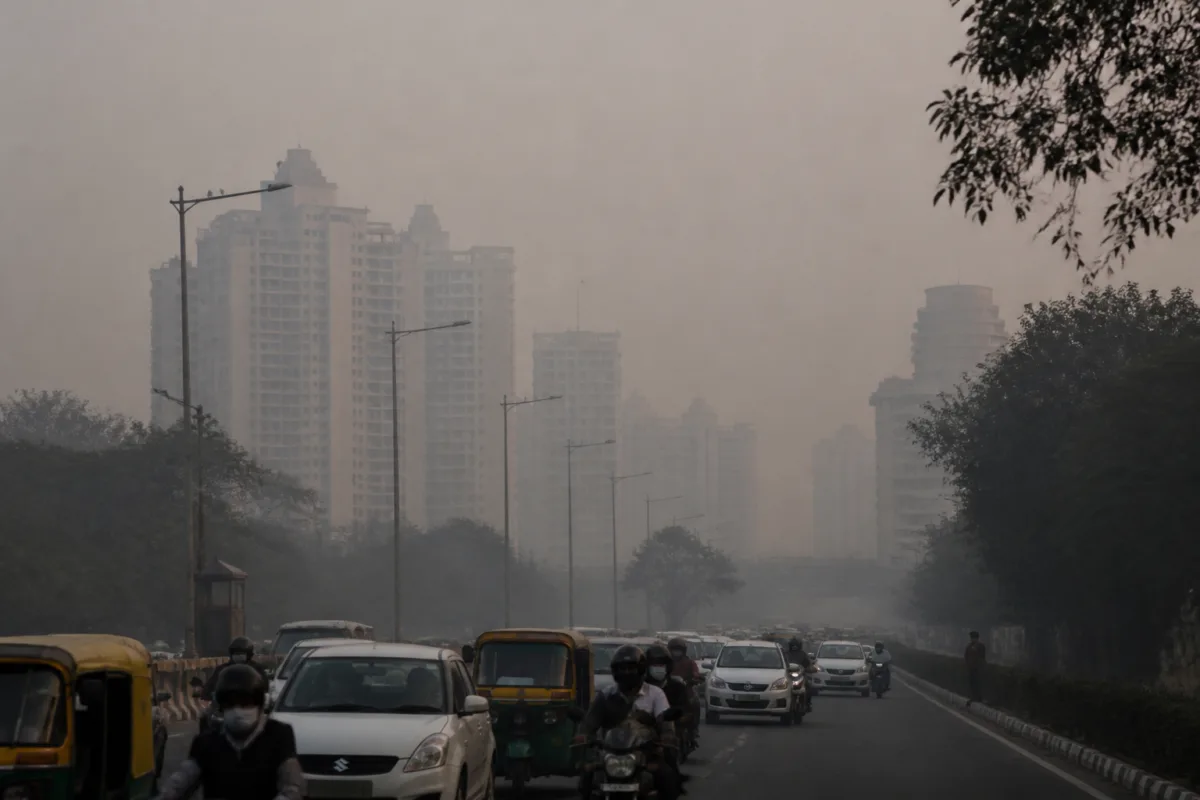
Delhi’s air quality remained in the ‘very poor’ category on Thursday, with the city-wide Air Quality Index settling at 323 and several monitoring stations recording levels above 400, according to Central Pollution Control Board data. The deterioration follows Diwali and comes as stubble burning in neighbouring states contributes to worsening pollution across the national capital region.
The IIT Delhi and Delhi IITM monitoring stations recorded an AQI of 416, placing them in the ‘severe’ category. NSUT Jaffarpur and Delhi DPCC also reported readings of 404. Other stations recorded lower but still unhealthy levels, including Anand Vihar at 319 and DTU Delhi at 372.
Under the CPCB classification, an AQI between 0 and 50 is considered ‘good’, while 51-100 is ‘satisfactory’. Readings from 101 to 200 are classified as ‘moderate’, 201 to 300 as ‘poor’, 301 to 400 as ‘very poor’ and 401 to 500 as ‘severe’. The readings at IIT Delhi, Delhi IITM, NSUT Jaffarpur and Delhi DPCC therefore crossed the threshold for severe air pollution, even as the city-wide average remained in the very poor range.
The station-level variation shows how pollution exposure differs across Delhi rather than affecting every part of the city uniformly. Areas recording readings above 400 faced conditions categorised as severe, while Anand Vihar and DTU Delhi remained in the very poor band. Such differences are relevant to residents, commuters, schools, outdoor workers and local authorities because city-wide averages can conceal sharper pollution peaks in particular neighbourhoods.
The reported deterioration has followed Diwali, when firecracker emissions can add to the seasonal pollution load. The source also attributed part of the worsening air quality to stubble burning in neighbouring states. These factors are occurring during a period when winter weather conditions can make dispersion more difficult, although the supplied report does not quantify the contribution of each source.
Weather conditions forecast by the India Meteorological Department were expected to include fog or mist during the early morning and a partly cloudy sky on Thursday. Safdarjung, Delhi’s base weather station, recorded a minimum temperature of 16.5 degrees Celsius, three degrees above normal. The maximum temperature was expected to settle at 28 degrees Celsius.
The CPCB readings place Delhi’s air-quality challenge within the city’s recurring winter pollution cycle, in which emissions from multiple sources are measured alongside changing weather conditions. The immediate official data point is the continued presence of very poor city-wide air and severe readings at several stations. Further monitoring by the CPCB and changing weather conditions will determine how the index moves across Delhi’s neighbourhoods.

