


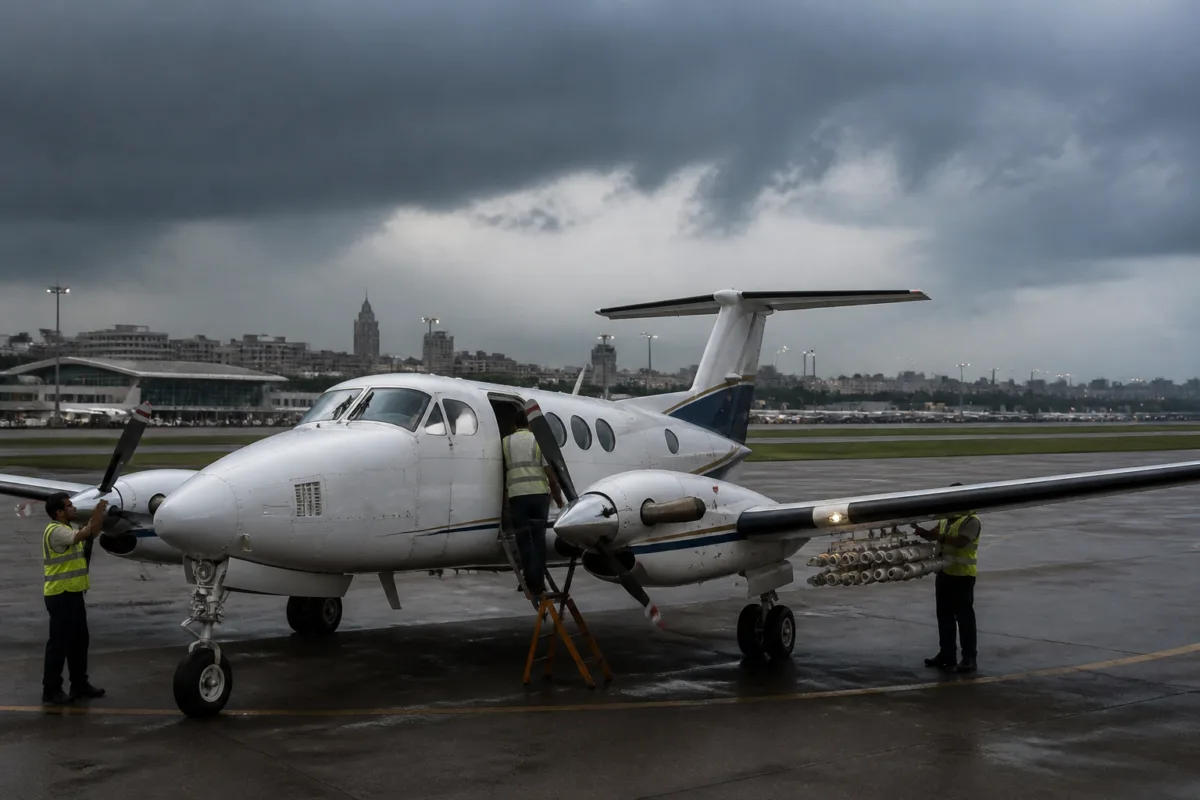
Delhi’s cloud seeding plan to induce artificial rain as a possible response to air pollution has moved into a new phase, with a specialised Beechcraft-200 aircraft stationed at Indira Gandhi International Airport and prepared for higher-altitude operations.
The aircraft, operated by Bengaluru-based Kyathi Climate, will be used by Delhi International Airport Limited, the Delhi government and IIT Kanpur for cloud-seeding trials, according to information reported by Navbharat Times. The experiment will be conducted only if suitable clouds and sufficient atmospheric moisture are available.
Delhi Environment Minister Manjinder Singh Sirsa said IIT Kanpur had been conducting cloud-seeding trials as part of its research work. He said the complete details would be shared after the study is completed and positive results are obtained. His statement indicates that the current operation remains a research trial rather than a confirmed city-wide rainmaking programme.
The aircraft has already reached Delhi and can fly up to 25,000 feet, substantially higher than the aircraft used during last year’s attempt, which had a maximum operating altitude of about 10,000 feet. The additional altitude could allow the research team to work with cloud formations that are not accessible to a lower-flying aircraft, although the success of any operation will depend on the availability of suitable weather conditions.
IIT Kanpur’s team is studying the clouds and moisture present in the atmosphere before deciding whether a flight can take place. Cloud seeding cannot create rain in clear or dry skies; it requires appropriate cloud conditions and adequate moisture. The report does not provide a confirmed flight date, the expected quantity of rainfall or any assessment of how much pollution reduction the experiment could achieve.
The change in launch location follows difficulties faced during last year’s operation. The aircraft was expected to take off from Meerut, but dense fog there created operational problems even though clouds were present over Delhi. Launching from IGI Airport is intended to reduce the logistical distance between the aircraft and the area under study, while also allowing the team to respond to suitable weather conditions over the capital.
The timing of the trial is being assessed against the short-term forecast. The India Meteorological Department has indicated that Delhi could see partly cloudy conditions between November 12 and 15, while Skymet has forecast the possibility of light drizzle during the period. Clearer skies are expected from November 16. These conditions could influence whether the aircraft is deployed, but no flight has been confirmed in the supplied report.
The initiative reflects the continuing search for emergency measures during Delhi’s pollution episodes, but its immediate outcome will depend on scientific and operational conditions rather than the presence of an aircraft alone. The next step is for IIT Kanpur and the participating agencies to complete the atmospheric assessment and determine whether the weather is suitable for a trial.

