


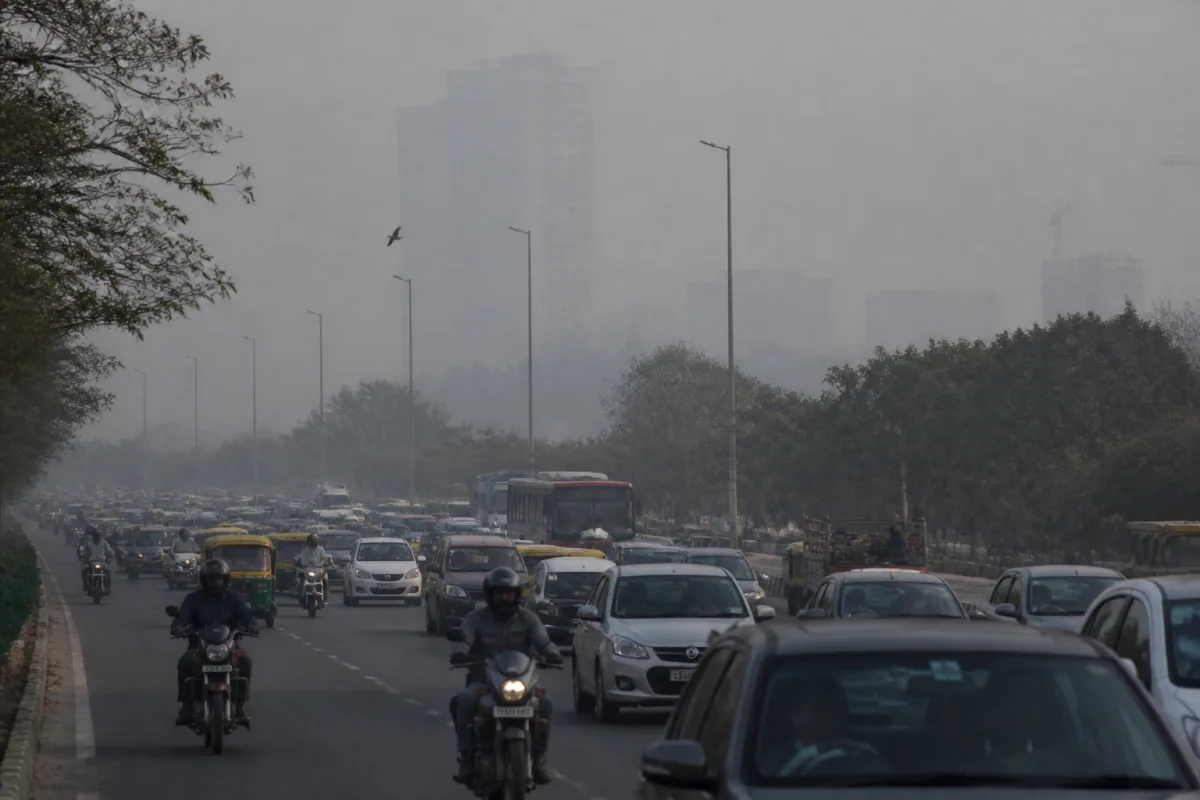
Delhi air pollution has intensified at the beginning of the winter season even as the contribution from stubble burning has declined, according to an analysis by the Centre for Science and Environment (CSE) reported by Navbharat Times. The finding shifts attention from a familiar seasonal explanation towards the wider urban system: emissions generated within Delhi, pollution transported from other National Capital Region cities, and weather conditions that allow pollutants to accumulate over the capital.
The CSE analysis found that the average PM2.5 concentration in Delhi during the week before Diwali was 236 micrograms per cubic metre. The report described this as the highest average for the corresponding period in the past three years. The level was 97% higher than in 2025 and 32% higher than in 2024, according to the figures cited in the report.
The numbers matter because they show that a reduction in one highly visible source has not translated into cleaner air overall. Stubble burning has long occupied a central place in public discussions about Delhi’s winter pollution. However, the CSE assessment cited by the report indicates that the seasonal pollution episode cannot be understood through farm fires alone. The contribution of local emissions and pollution arriving from other parts of the NCR remains substantial.
The distinction is important for governance. A source that is geographically outside Delhi may still affect the city’s air, while sources within the capital’s boundaries may be harder to control because they are dispersed across transport, households, construction and commercial activity. This makes the problem less amenable to a single emergency measure and more dependent on coordination across jurisdictions.
The report identifies vehicles as the largest contributor among Delhi’s local pollution sources, with a 52% share. Domestic activities account for 13% and industries in surrounding areas for 11%, according to the CSE analysis. These figures do not mean that every vehicle or household contributes equally, nor do they describe the total pollution load from every source in the wider region. They indicate the relative contribution of the local sources identified in the analysis and place transport at the centre of the city’s pollution-control challenge.
That transport finding has a direct urban implication. Vehicle emissions are produced across the ordinary daily functioning of the city rather than at one identifiable facility. Commuting, freight movement, deliveries, private vehicle use and traffic congestion all occur through the road network and are distributed across neighbourhoods. The source material does not provide a further breakdown of the vehicle category, so it does not establish which vehicle types, corridors or travel patterns are responsible for the largest share. It does, however, identify vehicles as the dominant local source in the CSE assessment.
The regional component is equally significant. Between 1 and 8 November, pollution entering Delhi from other NCR cities accounted for 54.43% of the contribution cited in the analysis. Local sources accounted for 33.06%, while stubble burning accounted for 14.29%. These percentages are presented in the report as the respective contributions during that period. Because the figures describe contribution shares rather than a complete account of every emission activity, they should be read as an attribution of the measured pollution episode, not as a simple ranking of all annual sources.
The figures also illustrate why administrative boundaries can complicate air-quality management. Delhi’s municipal and state agencies can regulate activities within the capital, but pollution transported from nearby cities requires action across the NCR. The report does not identify the individual neighbouring cities responsible for the incoming share, nor does it set out the enforcement responsibilities of each agency. It nevertheless points to a coordination problem: an intervention limited to Delhi may not address pollution generated or carried across the region.
The timing of the data adds another layer. On 4 November, stubble burning contributed 16.2% of Delhi’s PM2.5 pollution, which the report describes as the season’s highest level for that source. By 6 November, when Delhi’s Air Quality Index reached 382 and the third stage of the Graded Response Action Plan was in force, the contribution from stubble burning had fallen to about 8%.
This comparison suggests that the deterioration in air quality continued even after the share attributed to crop-residue burning dropped. It does not show that stubble burning is irrelevant. Rather, it demonstrates that its influence varies over time and that the most severe pollution readings can coincide with a lower contribution from that source. The report’s central evidence therefore challenges a narrow seasonal narrative without eliminating the need to address farm fires when they contribute to the city’s air pollution.
GRAP-3 is designed as an emergency response to deteriorating air quality, but the report’s findings expose the difference between restrictions and structural control. Emergency measures can limit selected activities during a pollution episode. They cannot, by themselves, replace long-term changes in mobility, vehicle use, industrial operations, household fuel practices or regional coordination. The supplied report does not list the specific GRAP-3 restrictions in force or assess their compliance, so it cannot establish which measure succeeded or failed.
The evidence does establish that GRAP-3 was in effect when the Air Quality Index was reported at 382 on 6 November, while stubble burning accounted for about 8% of PM2.5 pollution. That combination raises a clear administrative question: whether emergency restrictions are being applied to the sources that dominate the pollution mix at a particular moment. The answer would require source-specific enforcement data, which is not included in the report.
The same limitation applies to the vehicle contribution. A 52% share makes transport the most prominent local source in the CSE analysis, but the material supplied does not provide information on public transport capacity, traffic volumes, vehicle classifications, fuel standards, parking policy, road congestion or enforcement against visibly polluting vehicles. Without those details, the evidence cannot support a claim about which transport intervention would have the greatest impact.
Weather remains an important condition in the pollution episode. The Meteorological Department forecast partly cloudy skies in Delhi from 12 to 15 November, while Skymet forecast the possibility of drizzle during that period. The report said clearer skies were expected from 16 November. These forecasts are relevant because atmospheric conditions affect how pollutants disperse, but the supplied material does not quantify the relationship between the forecast weather and expected pollution levels.
This distinction between emissions and dispersion is essential. A high pollution reading can reflect both the quantity of pollutants released and the atmosphere’s ability to disperse them. The CSE figures identify contributions from local, regional and stubble-burning sources, while the weather forecasts describe conditions that may influence the immediate episode. They do not, in the material provided, establish whether a change in weather would permanently reduce emissions or only temporarily improve air quality.
For city administration, the evidence points to three connected responsibilities. Delhi must address the sources within its jurisdiction, particularly transport and domestic emissions identified in the analysis. NCR authorities must respond to pollution moving across administrative borders. And emergency air-quality measures must be linked to reliable, timely source-apportionment information so that restrictions match the pollution profile of each episode.
The report does not provide a policy timetable, budget, compliance assessment or institutional response from Delhi or NCR authorities. It therefore cannot show whether the agencies responsible have changed enforcement priorities in response to the CSE findings. Nor does it establish whether the reduction in stubble burning will continue through the winter or whether regional pollution will remain at the reported level.
What the evidence confirms is narrower but consequential. Delhi recorded a pre-Diwali weekly average PM2.5 concentration of 236 micrograms per cubic metre, the highest in the three-year comparison cited by CSE. Vehicles represented 52% of Delhi’s local pollution sources in the analysis. Pollution from other NCR cities accounted for 54.43% of the cited contribution between 1 and 8 November, while stubble burning accounted for 14.29% across that period. On 6 November, the stubble-burning share was about 8% even as the AQI reached 382 and GRAP-3 was active.
The larger urban question is whether Delhi-NCR’s clean-air strategy can move from seasonal blame and emergency restrictions towards coordinated management of the complete airshed. The available evidence does not answer that question by itself. It does show why the issue cannot be reduced to crop fires: the city’s own transport emissions and pollution entering from the wider region remain central to the winter air-quality crisis. The next developments to monitor are the pollution trend after the forecast weather changes, the implementation of regional controls and the availability of more detailed source-specific data.

