


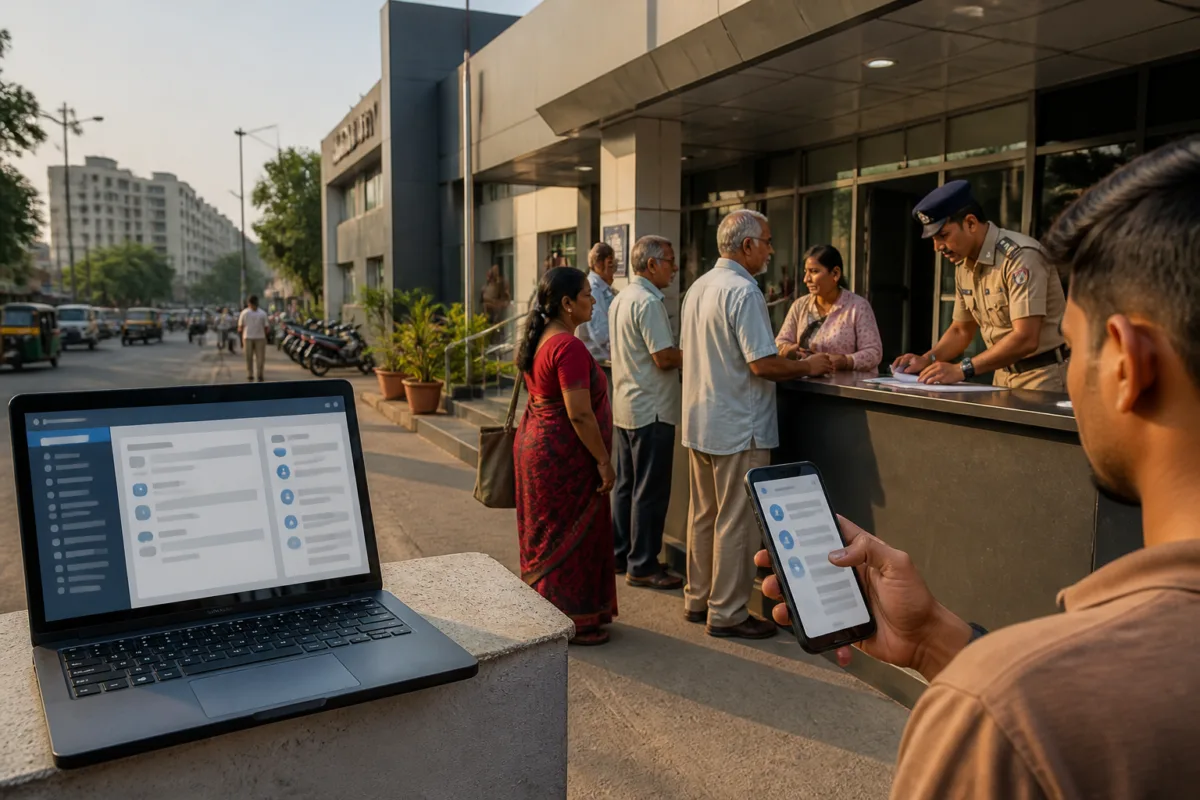
The opening of three police stations in Ahmedabad was meant to bring law-and-order services closer to residents. Instead, the reported absence of Motera and Hanspura police stations from the Gujarat Police online portal has exposed a less visible but important weakness in urban administration: a public facility can become operational on the ground while remaining incomplete in the digital system through which citizens are expected to access it.
According to a report by Gujarat Samachar, the three stations at Motera, Hanspura and Vastral were inaugurated on 5 November. Station diary entries and routine operations reportedly began at all three locations. However, only Vastral police station was available in the relevant sections of the Gujarat Police website and mobile application when the report was published on 12 November. Motera and Hanspura were not listed for online FIR-related services.
The gap matters because the digital portal is not merely an information directory. The report says registered users can use the “Search Details” section and the “Copy of FIR” option to obtain details or copies of complaints recorded at police stations across cities and districts. When a newly functioning police station is missing from that system, residents who need records connected to it may have to visit the station physically instead of completing the process remotely.
That creates a mismatch between the administrative boundary recognised by the police department and the service boundary visible to the public. On paper, Motera and Hanspura had begun functioning. In the digital interface, however, they remained absent from the system used to identify stations and retrieve FIR information. For citizens, the distinction between an operational station and a digitally enabled station is not administrative. It directly affects how much time, travel and effort are required to access a public record.
The reported problem also shows why the launch of a public institution is not complete when the building opens or the station diary begins. Police stations depend on several connected systems: jurisdiction mapping, station identifiers, records management, online service directories and mobile applications. If these components are not updated together, the physical expansion of public services can produce an incomplete citizen experience.
The report identifies Vastral as the exception. Its name had reportedly been uploaded to the online system 15 days before the inauguration, and FIR information from the station was available online. The different status of Vastral, Motera and Hanspura indicates that the issue was not necessarily the absence of a digital service across the state. Rather, the problem lay in ensuring that every newly created station was added to the system at the correct time and in the correct service categories.
This distinction is important for understanding digital governance. A portal may be technically functional while still failing at the level that citizens experience. The availability of a website or mobile application does not guarantee that its database reflects the latest administrative changes. In this case, the reported failure was an update and coordination gap between the newly opened stations and the digital platform operated for police services.
The timing makes the lapse more significant. Gujarat Samachar reported that the inauguration had been planned in advance and took place in the presence of senior political leadership and the police chief. That meant the relevant departments had prior notice of the date on which the new stations would begin functioning. The report says the associated IT cell or Home Department units did not link Motera and Hanspura to the portal before the inauguration.
This points to an institutional question: who is responsible for certifying that a new public facility is digitally ready? The supplied report does not identify a formal checklist, service-level agreement or named official responsible for the omission. It does, however, describe a clear coordination problem between the physical policing network and the digital service layer. Without a defined handover process, each department can complete its own task while the citizen-facing service remains unfinished.
The problem is also connected to how governments measure the success of digital public services. A launch announcement can establish that a facility exists, but it cannot by itself show whether residents can use all associated services. For police stations, that includes finding the station online, identifying its jurisdiction, submitting or tracking information where permitted, and obtaining records such as an FIR copy. The absence of a station from one of these functions can make the larger service appear unavailable.
For residents of Motera and Hanspura, the immediate consequence reported by the newspaper is the need to visit the police station in person for FIR copies or details. The report does not quantify the number of affected users, the distance residents must travel or the duration of the delay. It also does not state how long it would take for the two stations to be added to the website and application. Those details remain important because the burden of a digital service failure depends on how widely the affected facility is used and how quickly the omission is corrected.
The episode illustrates a broader urban governance pattern in which physical growth and administrative digitisation move at different speeds. Ahmedabad’s police network can expand by creating new stations in growing or changing neighbourhoods. But every expansion also requires a corresponding update to the systems through which residents search for services and records. If that update is delayed, the city’s institutional map and its digital map no longer match.
That mismatch can affect trust even when the underlying police service is functioning. Residents may reasonably assume that a station absent from the official portal has not been integrated into the wider system, or that online records are incomplete. The report does not document such reactions systematically, but it records a demand that Motera and Hanspura be connected to the portal and application at the earliest.
The case also has implications for the design of public-service technology. A government portal should not be treated as a static publication platform that is updated only after a department changes its internal records. It must reflect operational changes as they occur. The information architecture should connect the creation of a station, its jurisdiction, its station diary, its records and its online service listing through a coordinated process. The supplied report does not establish whether Gujarat Police has such an integrated workflow; the differing status of the three stations suggests that the handover was not completed uniformly in this instance.
The evidence available in the report confirms a specific gap rather than a wider assessment of Gujarat’s police digitisation programme. It establishes that three stations were inaugurated on 5 November, that Vastral was listed online, and that Motera and Hanspura were reportedly missing from the relevant online FIR services seven days later. It does not establish whether FIR records from the two stations were unavailable in every digital channel, whether other services were affected, or whether the omission was later corrected.
The next meaningful development is therefore administrative rather than ceremonial: the inclusion of Motera and Hanspura in the Gujarat Police portal and mobile application, along with the availability of their relevant FIR records. Until the physical and digital systems are aligned, the reported opening of the stations will remain only a partial expansion of citizen access.

