


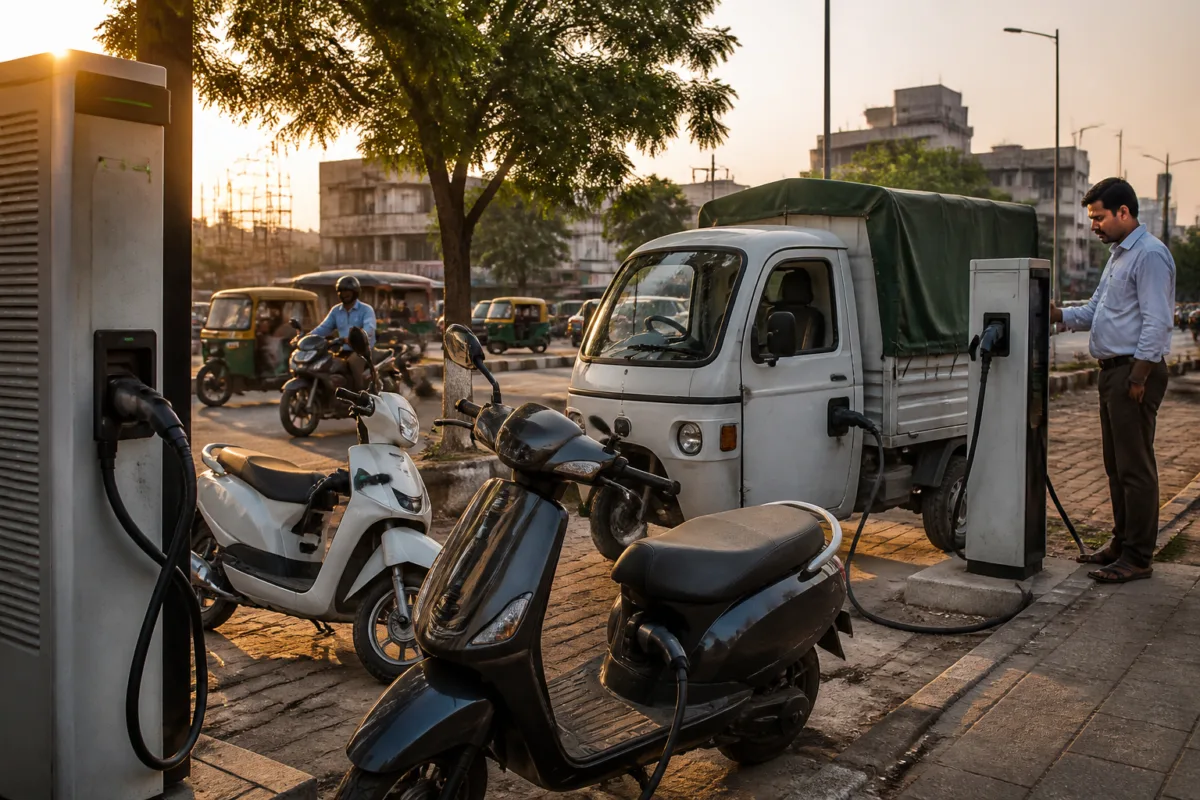
Nagpur’s electric-vehicle growth is putting increasing pressure on the district’s charging network, with a Times of India report citing more than 1.41 lakh cumulative registrations and 467 charging stations. The figures, attributed to official data, point to a rapid shift towards electric mobility, but the report contains a material discrepancy in its registration totals that requires clarification before the numbers can be treated as established.
The report says Nagpur East’s Regional Transport Office, or RTO, recorded 65,479 electric vehicles up to September 2026. Nagpur Rural recorded 53,112 and Nagpur City recorded 23,205. These figures add up to 1,41,796 registrations, broadly corresponding to the report’s stated total of more than 1.41 lakh.
However, the same report’s year-wise table lists 15,152 registrations in 2022-23, 23,258 in 2023-24, 25,323 in 2024-25, 25,370 in 2025-26 and 20,247 between April and September of the current financial year. Those figures total 1,09,350, or approximately 1.09 lakh. The report does not explain whether the two tables use different time periods, vehicle categories, registration databases or methods of aggregation.
That distinction matters because the registration count is the basis for assessing whether Nagpur’s charging infrastructure is keeping pace with demand. Using the reported total of 1.41 lakh and 467 charging stations produces a ratio of approximately 304 registered electric vehicles per station. Using the year-wise total instead would produce a substantially different ratio. Until the transport authorities reconcile the figures, the scale of the infrastructure gap cannot be measured reliably.
The available data nevertheless indicates a sustained increase in annual registrations. The year-wise figures published in the report rise from 15,152 in 2022-23 to 23,258 in 2023-24, 25,323 in 2024-25 and 25,370 in 2025-26. A further 20,247 electric vehicles were reportedly registered between April and September of the current financial year. If that table is complete and comparable across years, the current year’s six-month figure already represents a substantial share of the previous full-year totals.
Electric two-wheelers are reported to account for the largest share of demand. A market expert quoted by the Times of India attributed the shift partly to the narrowing price gap between electric and petrol-powered two-wheelers and to concerns over fuel efficiency. The report also links adoption to fuel prices, citing petrol at around Rs112 per litre and diesel at around Rs99 per litre.
For households and commercial operators, the attraction of an electric vehicle is not limited to the purchase price. Lower running and maintenance costs can influence the economics of daily commuting, local deliveries and passenger transport. The report says electric passenger vehicles, e-rickshaws and goods carriers are also gaining favour among commercial users seeking to reduce operating expenses.
The report further attributes part of the demand to the growth of rooftop solar systems. It quotes experts saying that households with rooftop solar can use their own electricity for vehicle charging, potentially reducing both electricity and fuel expenses. The extent of this link in Nagpur is not quantified in the supplied material, but it highlights the growing connection between transport electrification and distributed energy systems.
Charging infrastructure is being developed with Maharashtra State Electricity Distribution Company Ltd, or MSEDCL, identified as the nodal agency responsible for setting up stations. This makes the charging network an electricity-distribution and urban-access issue as well as a vehicle-market issue. The location, capacity, operating status and public accessibility of the 467 reported stations are not provided in the report, leaving open questions about how evenly the infrastructure is distributed across the city, rural areas and major travel routes.
A simple station count also cannot show whether supply matches actual charging demand. A station may contain one or several charging points, and charging requirements vary by vehicle type, battery size, usage pattern and whether vehicles are privately owned or commercially operated. High utilisation in a concentrated urban area could create pressure even when the district-wide station-to-vehicle ratio appears adequate.
The RTO distribution adds another layer to the infrastructure question. Nagpur East has the highest reported cumulative registration count, followed by Nagpur Rural and Nagpur City. These figures suggest that charging provision needs to be assessed across different settlement patterns rather than only within the municipal core. Rural users, intercity commuters and commercial operators may require different forms of access from residents charging at home.
The report’s figures also raise an administrative data question. Transport registration records, electricity-distribution records and charging-station inventories are generally maintained by different institutions. Without a common reporting framework, totals may vary because of differences in vehicle classification, registration dates, geographic boundaries, duplicate records or whether inactive vehicles are included. The supplied report does not identify the precise methodology behind either registration table.
For policymakers, the immediate task is therefore not only to add more charging stations but also to establish a consistent baseline. A credible district-level assessment would need to reconcile the RTO totals, publish the number and capacity of individual charging points, identify station locations and distinguish operational stations from installations that are not currently available to users.
The reported rise in electric-vehicle registrations is significant for Nagpur’s mobility planning even though the exact total remains unresolved. More electric two-wheelers and commercial vehicles could alter demand for fuel retail, parking, electricity distribution and roadside services. It could also shift the operating economics of local transport, provided charging access is reliable and sufficiently distributed.
What the evidence currently confirms is that Nagpur’s electric-mobility market is expanding and that charging infrastructure has grown alongside it. What remains uncertain is the correct cumulative registration figure and, consequently, the actual vehicle-to-station ratio. The next essential step is for the relevant transport and electricity authorities to reconcile the conflicting totals and provide a transparent account of charging capacity across the district.

