


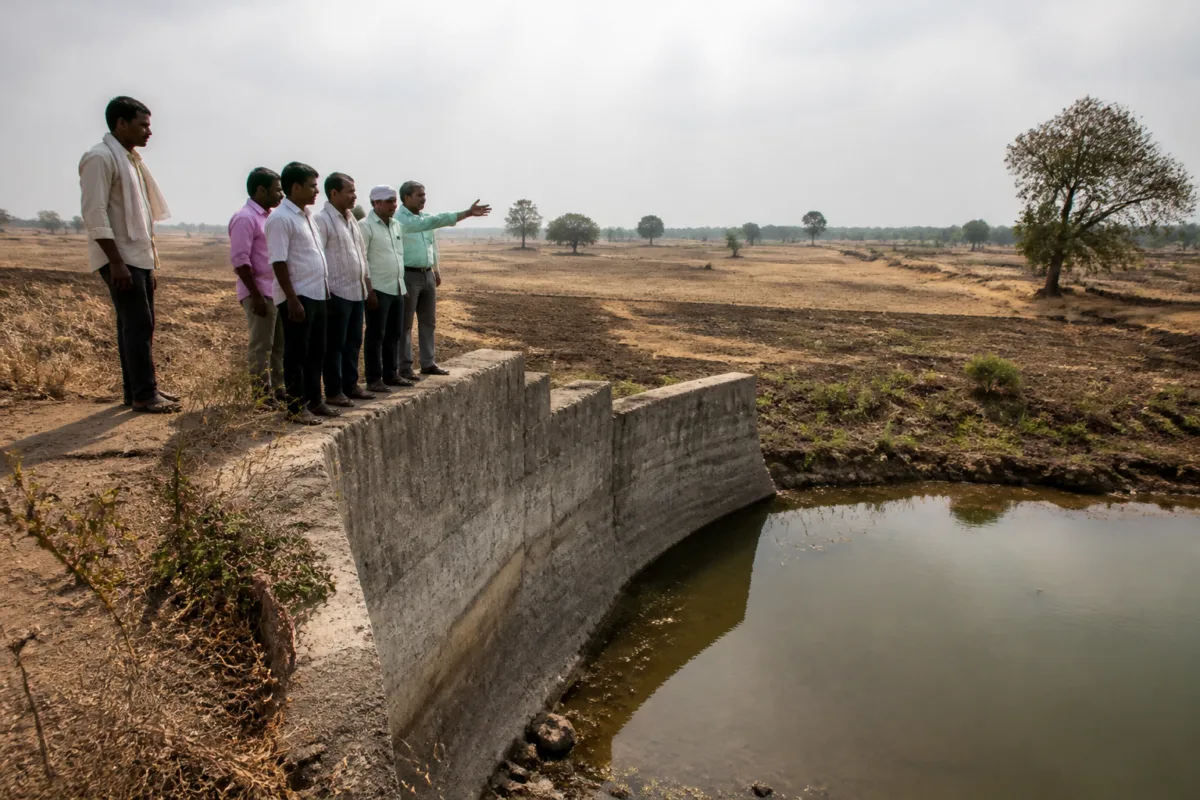
The call to make Vidarbha drought-free has been framed as a political appeal, but the substance of the challenge lies beyond party lines. Union minister Nitin Gadkari’s message at an organising committee meeting for Agrovision in Nagpur placed water conservation, crop planning, modern farming technology and delivery of government schemes at the centre of the region’s rural future. It also exposed the administrative difficulty of converting a broad drought-management goal into coordinated action across villages, talukas, districts and elected representatives.
Agrovision, scheduled to be held in Nagpur from November 27 to 30, will use “Tackling drought: water management and crop planning” as its theme this year. The event is positioned as a platform for bringing farmers and the agriculture sector together, but the issues identified in the meeting extend into the wider built and managed environment: how available water is conserved, how it is allocated, how farming decisions respond to limited resources and how public schemes reach the people they are intended to support.
Gadkari asked elected representatives, rural workers at taluka and district levels, MLAs and MPs to set aside political differences and work towards making Vidarbha drought-free. According to the Times of India report, he said the objective could be pursued through collective effort, proper planning and effective use of available resources. The political appeal matters because the responsibilities involved are distributed across several layers of public administration rather than being controlled by one institution.
The source report does not identify a single authority responsible for the drought-free Vidarbha objective, nor does it provide a dedicated budget, implementation timetable or list of specific projects. That absence is important. A regional water-management goal can be publicly shared while its execution remains divided between departments, elected representatives, local workers and farmers. Without clearly defined responsibilities, coordination can become a slogan rather than an operating system for drought response.
The meeting’s emphasis on taking government schemes to “the last person in society” points to another central issue: access to information and administrative delivery. Gadkari asked local representatives and taluka-level workers to provide farmers with accurate information and guidance. Minister of State for Finance Ashish Jaiswal, who also spoke at the meeting, discussed agriculture-department schemes being run during the drought and said farmers should receive government assistance.
This places communication alongside physical water infrastructure as a determinant of rural resilience. A farmer may have access to a scheme in principle, but its practical value depends on whether information reaches the household, whether eligibility and application procedures are understood, and whether support arrives in time to influence sowing or crop decisions. The supplied report does not establish how these schemes are performing, how many farmers have benefited or where delivery gaps are concentrated. It does, however, show that scheme awareness was treated as a significant part of the response.
Crop planning is the second major component of the proposed approach. Jaiswal asked farmers to plan sowing according to the resources available and assured them of state government help. Gadkari similarly stressed the importance of the right choice of crops, frugal use of water and management of available water sources. Together, the statements shift the focus from drought as a purely climatic event to drought as a planning problem involving the relationship between water availability and agricultural choices.
That relationship is difficult because decisions are made locally while water conditions can vary across districts and talukas. The meeting did not provide a crop-wise plan, water-availability thresholds or a framework for deciding which crops should be prioritised in particular areas. It therefore remains unclear how the call for resource-based sowing will be translated into guidance for individual farmers. The stated principle is clear; the operational detail is not yet established in the supplied material.
Gadkari attributed part of the present difficulty to climate change and uncertain rainfall. He said water conservation, management of available sources, economical water use and appropriate crop selection had become especially important. This is a significant framing of the drought question because it combines environmental uncertainty with human decisions about storage, use and agricultural production. Yet the report contains no rainfall data, groundwater figures, reservoir levels or comparison across years. The scale and location of the current crisis cannot therefore be assessed from the announcement alone.
The limited data in the report also defines what Agrovision can and cannot demonstrate. The event will take place over four days in Nagpur and focus on water management and crop planning. It may provide a forum for technology demonstrations, scheme information and discussions with farmers, but the source does not specify its programme, participating agencies, expected attendance or measurable outcomes. Nor does it say whether the exhibition will result in formal agreements, project commitments or monitoring arrangements.
Modern farming technology was identified by both the meeting’s broader message and Jaiswal’s remarks as an area requiring greater introduction in the region. The report does not define the technologies involved. That makes it impossible to assess whether the reference concerns irrigation, crop monitoring, farm machinery, information systems or another category of intervention. For policy purposes, the distinction matters: technology is useful only when it fits local water conditions, farmer capacities, affordability and access to support.
The governance challenge is therefore one of alignment. Gadkari called for political cooperation, while the statements by both ministers also referred to local workers, farmers, agriculture officials and government schemes. These actors do not perform the same function. Elected representatives can help communicate priorities and mobilise local attention; departments administer schemes; local workers provide information; farmers make production decisions; and water managers oversee available sources. A drought response that links these roles would be more consequential than a general appeal for cooperation, but the supplied report does not yet describe such a mechanism.
The public-interest significance extends beyond agriculture because a stressed rural economy affects livelihoods and the wider regional economy. Gadkari said that farmers and farming must become prosperous and that effective water planning could strengthen Vidarbha’s rural economy. The report offers no figures on farm incomes, crop losses, migration or rural employment, so the economic impact cannot be quantified here. Still, the official emphasis indicates that drought is being treated not only as a water shortage but also as a threat to household welfare and regional prosperity.
The statements also reveal a preference for conservation and improved management of existing resources. Gadkari described water conservation as an urgent need and said the current crisis should be treated as an opportunity to plan for the future. This language suggests a move from emergency response towards longer-term preparedness. However, the report does not establish which conservation works are planned, who will fund them, how they will be maintained or how success will be measured. Those are the institutional questions that will determine whether the policy message produces durable change.
For Vidarbha, the next stage is likely to be judged by the quality of information and coordination that emerges around the stated priorities. A drought-free regional objective requires more than identifying water as a scarce resource. It requires matching crop decisions to available water, making schemes understandable and accessible, introducing suitable technology, and ensuring that action at district and taluka levels is connected. The meeting identified each of these elements, but it did not provide the evidence needed to measure progress.
Agrovision’s November programme will offer the next visible test of how the drought discussion is organised. The event’s stated theme creates an opportunity to bring water management and crop planning into the same conversation. What remains to be established is whether that conversation produces specific guidance, institutional commitments or measurable follow-up. Until those details emerge, the evidence supports a clear conclusion: political cooperation is being presented as necessary, but the success of drought management will depend on how that cooperation is converted into accountable planning and delivery on the ground.

