


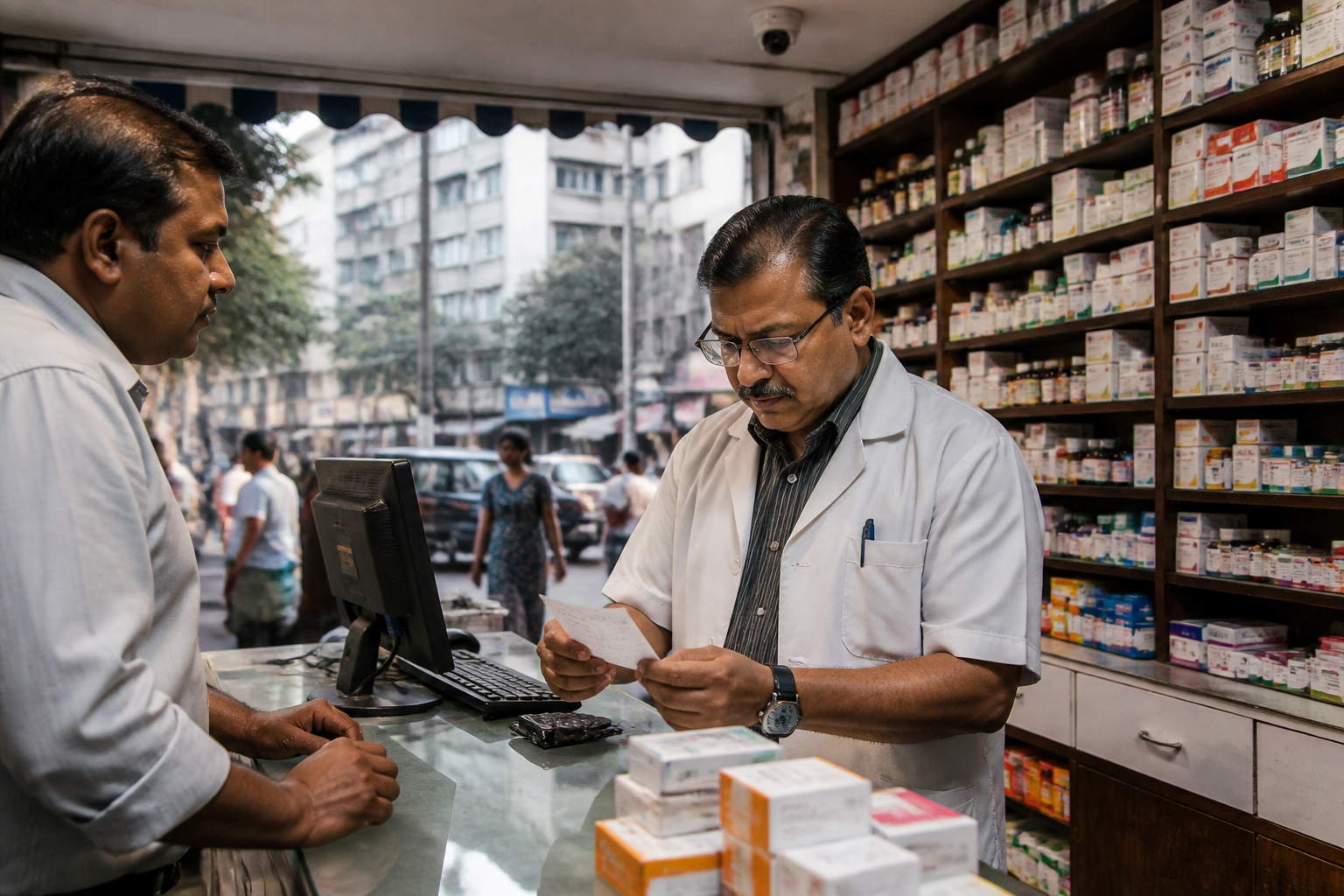
Mumbai’s prescription medicine system is showing a wide gap between regulation on paper and access on the ground. A LocalCircles survey found that 71% of consumers in the city said chemists never or rarely refused to sell medicines without a doctor’s prescription, while only 28% said they were assisted by a qualified pharmacist most of the time or always. The findings have arrived alongside a proposed Union rule requiring CCTV surveillance at medical stores selling prescription medicines and an intensified enforcement drive by the Maharashtra Food and Drug Administration (FDA).
Taken together, the developments point to a problem that is larger than individual chemist shops. Mumbai’s medicine supply system is heavily dependent on neighbourhood retailers, phone calls and WhatsApp deliveries, yet the safeguards intended to govern prescription drugs appear inconsistently applied across these channels. The resulting gap affects not only how medicines are sold, but also how accountability is established when a prescription is not checked, a qualified pharmacist is absent or a sale is not properly documented.
The survey, published on September 18, 2026, received more than 20,000 responses across its questions. In Mumbai, 36% of 3,697 respondents said chemists never refused to provide medicines without a prescription, while another 35% said such refusals happened very rarely. Only 9% said chemists refused these sales most of the time and 5% said they always did so.
The figures are not a direct audit of every pharmacy in the city. They record consumer experiences and perceptions. But they identify where the enforcement system is most visible to residents: at the point of purchase. A prescription requirement has limited practical effect if consumers do not expect it to be checked, or if the process changes when medicines are ordered remotely rather than purchased across a counter.
Home delivery is especially important in this respect. Of 3,122 Mumbai respondents, 18% said their chemist never demanded a doctor’s prescription during ordering or delivery, while 40% said this happened very rarely. Only 23% said a prescription was sought most of the time or always. The survey therefore suggests that the compliance challenge extends beyond the physical shop and into informal digital ordering systems managed by local retailers.
That matters because Mumbai consumers continue to rely primarily on neighbourhood chemists. Among 3,012 respondents, 57% said they visited a local chemist or sent someone to do so. Another 26% ordered from their chemist by phone or WhatsApp for home delivery. Only 17% primarily used e-pharmacy applications. The dominant medicine network in the city is therefore local, decentralised and frequently mediated through channels that may not create the same documentation trail as a formal online transaction.
The survey also raises questions about professional supervision. While 28% of Mumbai respondents said they were assisted by a qualified pharmacist most of the time or always, 21% said they were assisted by someone who was not a qualified pharmacist. The remaining responses indicate that qualified assistance was not consistently available. This is significant because the presence of a licensed retail outlet does not automatically tell consumers who is making the dispensing decision at a particular moment.
The billing responses reveal another part of the accountability chain. Seventy-six per cent of respondents said they generally received a printed GST invoice and 3% received a manually prepared GST bill. That leaves 20% who effectively did not receive a proper GST bill. An invoice is not merely a tax document in this context. It can establish what was purchased, from whom and when, creating a record that may be important for consumers, regulators and enforcement agencies.
The Maharashtra FDA’s enforcement figures show that the state is already confronting these operational failures. Between June and August 2026, it inspected 2,902 drug establishments, including 2,295 sales establishments and 607 manufacturing units, and initiated action against 880 licensees. The actions included 677 licence suspensions and 203 cancellations. Retailers and wholesalers accounted for 740 of the 880 actions.
During the same three-month period, the FDA carried out 104 search-and-seizure operations, seized illegal drugs and cosmetics worth Rs 11.41 crore, registered 20 FIRs and made 21 arrests. Inspectors identified several violations that correspond closely to the concerns reported by consumers: medicines sold without registered pharmacist supervision, prescription drugs dispensed without valid prescriptions, incomplete Schedule H1 records and sales without proper invoices.
The enforcement list also included expired medicines being kept in sale stock and inadequate temperature controls for products such as insulin and vaccines. These are not identical problems. Prescription verification concerns the authorisation for a sale; pharmacist supervision concerns professional responsibility; temperature control concerns the physical integrity of a product. Together, however, they show that medicine safety depends on a chain of retail controls rather than on one inspection point.
The proposed national intervention focuses on that chain through surveillance. The Union Ministry of Health and Family Welfare has floated draft amendments to the Drugs Rules, 1945, through Gazette notification G.S.R. 791(E) dated September 8. The draft proposes inserting a new sub-rule after Rule 65(2), requiring retail supply of prescription medicines to take place under CCTV surveillance installed and maintained at the premises.
The proposal covers medicines sold on a registered medical practitioner’s prescription and is aimed at strengthening oversight of Schedule H, H1 and X drugs. The government has invited objections and suggestions before finalising the amendment. Until the amendment is finalised, its precise implementation requirements, compliance burden and enforcement mechanism remain to be established in the supplied material.
CCTV can create a record of transactions and may help investigators examine whether regulated medicines were supplied without a valid prescription. But surveillance does not by itself establish that a qualified pharmacist was present, that a prescription was genuine or that records were correctly maintained. Those issues would still depend on inspection, documentation and the responsibilities assigned to retailers, pharmacists and regulators.
The Mumbai findings also show why a rule designed for physical medical stores may need to account for the way consumers actually buy medicines. More than a quarter of surveyed respondents relied on phone or WhatsApp ordering through neighbourhood chemists. The FDA has identified prescription checks, pharmacist verification and proper invoices as enforcement concerns, while LocalCircles has called for prescription checks during phone and WhatsApp deliveries and better documentation of medicine sales.
This places responsibility across multiple institutions. The Union Health Ministry is handling the proposed amendment to the Drugs Rules. The Maharashtra FDA is responsible for inspections and enforcement within the state. Retailers and wholesalers are the point at which prescriptions, invoices, pharmacist supervision and storage conditions must be translated into practice. Consumers, meanwhile, often encounter the system as a simple transaction at a local shop or through a message on a phone.
The national comparison reinforces the scale of the issue while also showing that Mumbai has some sharper gaps. Across India, 64% of surveyed consumers said chemists never or rarely insisted on a doctor’s prescription, compared with 71% in Mumbai. Only 15% nationally said chemists sought prescriptions most of the time or always. Qualified pharmacist assistance was reported most of the time or always by 31% of national respondents, compared with 28% in Mumbai.
For home deliveries, 41% of respondents nationally said chemists never or rarely sought prescriptions, compared with 58% in Mumbai. The national survey drew more than 106,000 responses from consumers across 327 districts. The comparison does not prove why Mumbai’s reported experience differs, but it establishes that the city’s medicine retail network deserves attention not only because of its size, but because its delivery and neighbourhood-shopping patterns may be intensifying the compliance challenge.
The evidence confirms three distinct facts: consumers report limited prescription checks; many do not consistently encounter qualified pharmacist assistance; and state inspections have found violations involving prescriptions, records, invoices and storage. What it does not establish is how widespread each violation is across all Mumbai pharmacies, whether consumers accurately identified pharmacist qualifications in every interaction, or how proposed CCTV requirements would work in phone and WhatsApp transactions.
The next stage will depend on two processes. The Union government must consider objections and suggestions before deciding whether to finalise the draft amendment. Maharashtra’s FDA will continue the enforcement activity that has already produced hundreds of licence suspensions and cancellations. For Mumbai residents, the more meaningful test will be whether prescription verification, professional supervision, delivery records, invoicing and storage controls become routine parts of medicine access rather than safeguards encountered only during inspections.
