


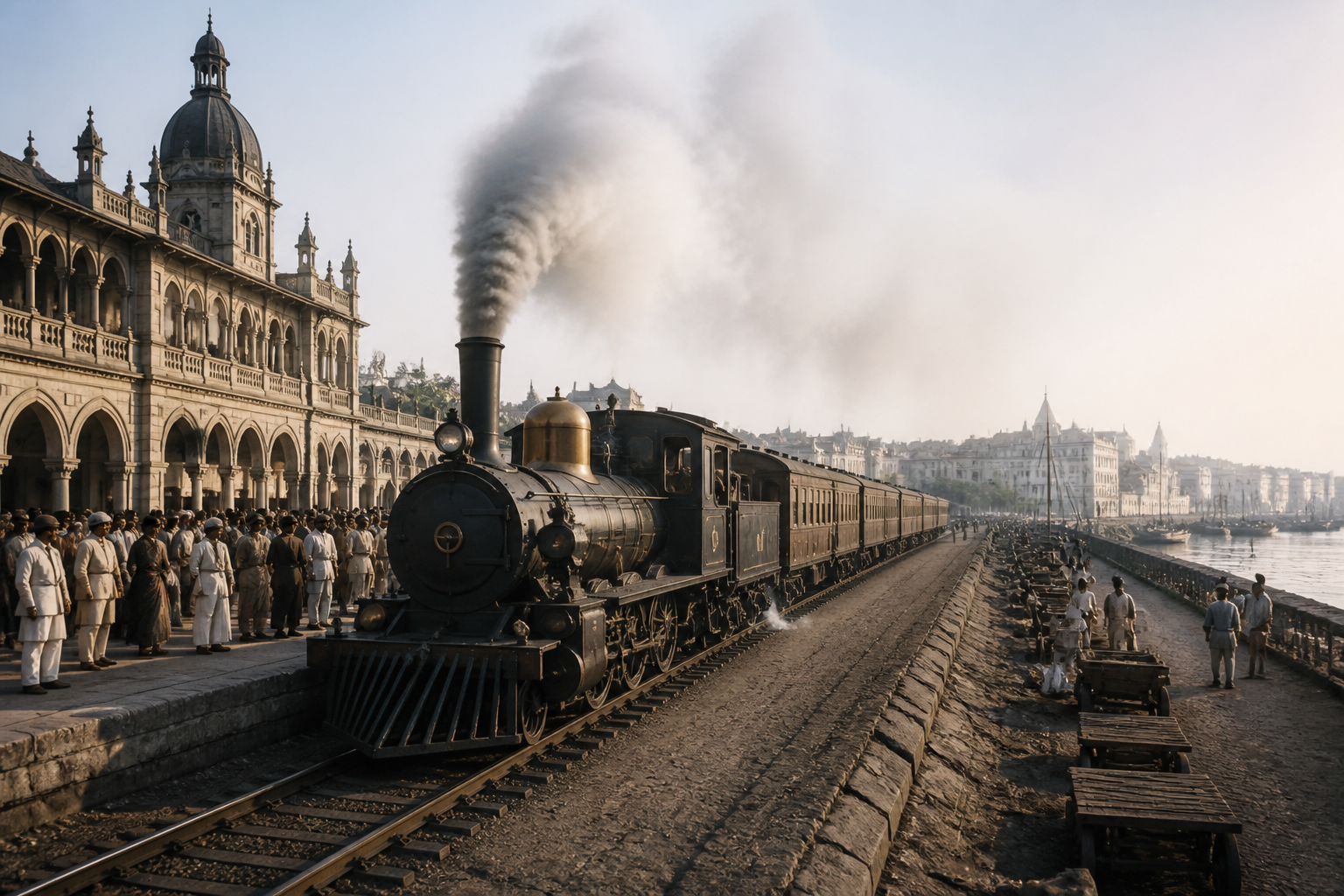
Mumbai’s railway story began with a 34-kilometre journey that lasted about 1 hour and 15 minutes. On April 16, 1853, a train operated by the Great Indian Peninsula Railway left Bori Bunder in Bombay for Thane with around 400 passengers in 14 coaches. The service was more than a transport experiment: it established commercial passenger rail travel in India and created an infrastructure link that would become central to the growth of the Mumbai region.
The distance was modest by present-day standards, but the institutional and urban consequences were significant. The Bombay–Thane line connected a growing port city with an important settlement to its north and demonstrated that a railway could move people in a regular, organised manner between urban locations. The journey offered an early example of how transport infrastructure could extend the practical geography of a city beyond its immediate core.
The launch itself was staged as a major public event. April 16 was declared a public holiday in Bombay, crowds gathered at Bori Bunder and a 21-gun salute accompanied the departure. The ceremony reflected the importance attached to the railway at a time when steam transport represented a major change in the movement of people and goods. The train was documented as being hauled by three steam locomotives named Sahib, Sindh and Sultan.
Bori Bunder, the departure point, stood near the site of present-day Chhatrapati Shivaji Maharaj Terminus. Its location placed the first passenger railway service close to the port city’s commercial centre. The route to Thane therefore did not merely join two points on a map. It established a connection between Bombay’s urban and economic core and a settlement outside it, creating an early framework for expansion along a transport corridor.
That distinction matters when considering the later development of Mumbai. The railway did not arrive in an already dispersed metropolitan region. It helped create the conditions for movement across a wider area. The supplied historical account records that the Great Indian Peninsula Railway expanded beyond the first stretch and that the network became important to Bombay’s growth by connecting the city with industrial areas and towns in the region. The railway’s significance, therefore, lay not only in the first train but in the network effect that followed.
The Bombay–Thane service is also important because it is often described as India’s first passenger train, while the historical record requires a more precise explanation. Earlier railway experiments and train operations had taken place in India, including services used to transport construction material. The 1853 journey was distinctive because it marked the beginning of commercial passenger railway service. The difference is crucial: a railway used for a specific construction or logistical purpose is not the same as a service designed to carry members of the public as passengers.
This distinction also places the event within the evolution of public transport. The 1853 train carried around 400 passengers, a figure that made the opening service a substantial public demonstration but also illustrates how limited the system was at the beginning. It consisted of a single 34-kilometre connection, 14 coaches and three steam locomotives. Its capacity and geography were narrow compared with the railway system that Mumbai would eventually rely on.
Yet the basic urban function was already visible. A railway reduces the friction of distance by making travel more predictable and organised. In the Bombay–Thane case, the line linked the city to an adjoining settlement and made movement between them part of a scheduled transport system. The report does not provide passenger numbers, operating frequencies or land-use data from the period, so it cannot establish the precise scale of development that followed. It does, however, document the line’s role as the foundation of a network that later connected Bombay to industrial areas and towns across the region.
The railway’s urban importance can also be seen through the relationship between infrastructure and identity. Mumbai’s suburban railway is now described in the source account as one of the world’s busiest suburban railway systems, but its historical beginning was a steam-powered service carrying a few hundred passengers. The contrast is not simply a story of technological progress. It shows how a city’s transport system can grow alongside the city itself, becoming part of its daily structure and public identity.
The first line also reveals the importance of corridors in urban development. A transport link does not operate in isolation from the places it connects. By joining Bombay and Thane, the railway created a route along which people and goods could move more efficiently. As the network expanded, the railway became associated with the city’s connection to surrounding industrial areas and towns. The available account does not specify the land-use changes, employment patterns or population shifts produced by the line, but it establishes the broader institutional direction: rail infrastructure became an organising element in the region’s growth.
The administrative structure behind the service was equally important. The Great Indian Peninsula Railway operated the line, making the first passenger service part of a formal railway enterprise rather than an isolated technological demonstration. This institutional basis allowed the route to become the starting point for further network expansion. The event therefore combined three elements that remain important in urban infrastructure: a physical corridor, an operating institution and a public service.
The public character of the launch also deserves attention. The holiday, crowds and ceremonial salute show that the railway was presented as a civic event, not merely as a private engineering achievement. People were invited to witness a new form of mobility entering the city. The public spectacle helped establish the railway as a symbol of modern transport and connected it to the wider story of Bombay’s development.
More than 170 years later, the physical and operational conditions are entirely different. The original steam journey has become part of a much larger railway history, while Mumbai’s present suburban services carry millions according to the supplied account. The available material does not provide current route lengths, daily ridership, train frequencies or capacity figures, so the scale of that transformation cannot be quantified here. The historical contrast is nevertheless clear: a service built around a short route and several hundred passengers eventually became associated with a metropolitan system on which millions depend.
That long transition raises a central urban question: when does transport infrastructure become part of the city’s structure rather than simply a service within it? In Mumbai’s case, the answer appears to lie in the railway’s continuing relationship with urban expansion. The first line connected the historic core with Thane; the later network connected the city to a wider regional geography. Railways thus became both a response to urban growth and one of the systems through which that growth was organised.
The 1853 journey should therefore be remembered with historical precision. It was not India’s first railway operation of any kind, but it was the beginning of commercial passenger railway service in the country. It did not resemble Mumbai’s present suburban network, but it established the first passenger corridor from Bombay to Thane. And while the available evidence does not explain every social or economic consequence of the line, it confirms the infrastructure’s foundational role in the city’s transport history.
The enduring significance of the Bombay–Thane railway lies in this connection between a specific event and a larger urban system. A 34-kilometre steam ride created the first formal passenger link in a network that would shape how Mumbai and its surrounding settlements were connected. What began at Bori Bunder with 14 coaches and around 400 passengers remains the starting point for understanding why railways occupy such a central place in Mumbai’s urban identity.
