


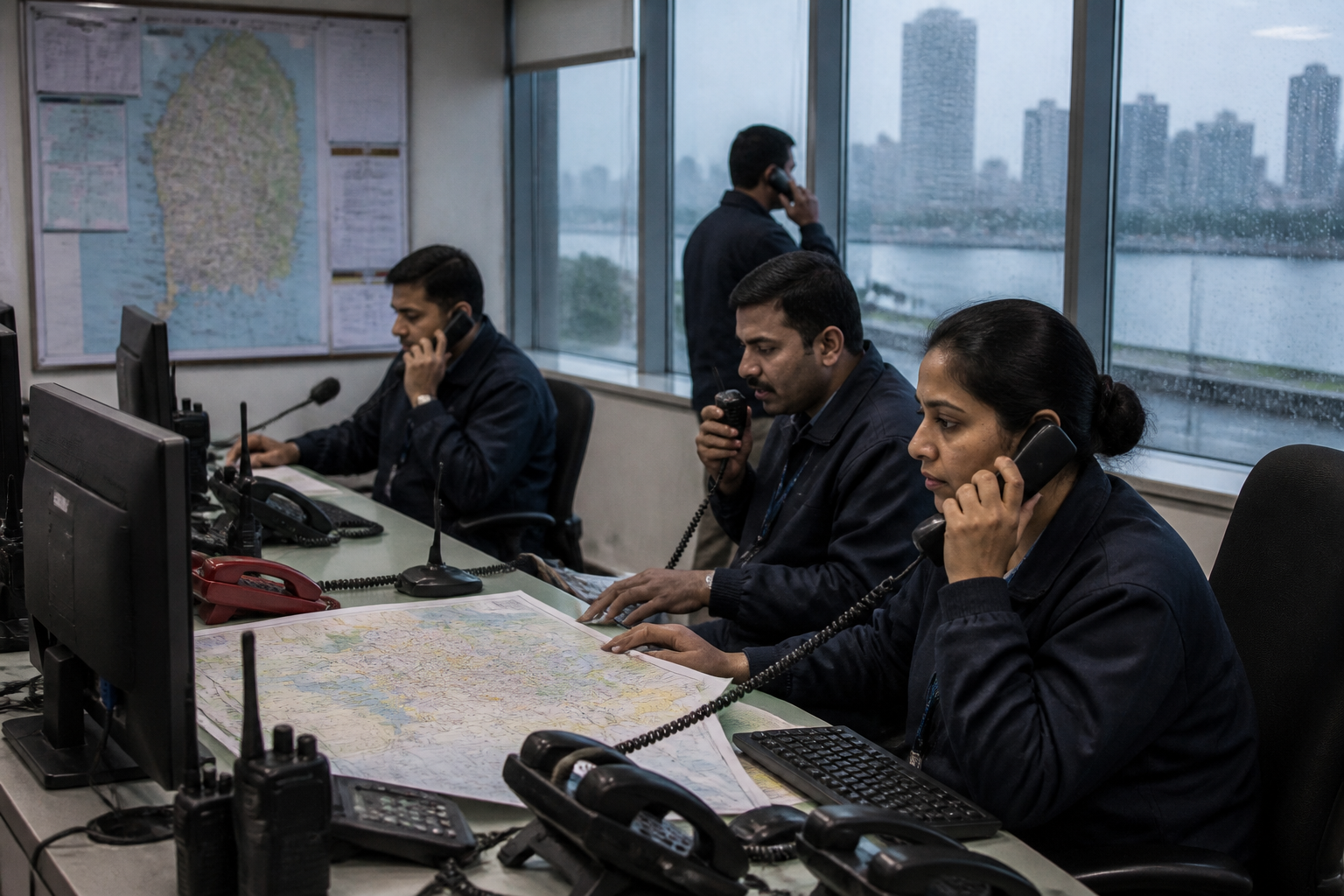
Mumbai’s BMC 1916 helpline was disrupted twice during the 2026 monsoon, with the latest outage lasting more than six hours on September 1. The immediate cause, according to Mahanagar Telephone Nigam Limited officials cited in the report, was a technical problem at an MTNL telephone exchange. The larger issue is how a city’s central public contact point performs when the infrastructure carrying its calls fails during the season when demand for civic and emergency services rises.
The Brihanmumbai Municipal Corporation’s 1916 service is a 24-hour centralised helpline for civic complaints and emergency calls. Incoming calls are received by the civic body’s Disaster Management Department, which coordinates responses with relevant municipal departments and other agencies, including hospitals, the police and the fire brigade. That arrangement makes the helpline more than a general information number. It functions as an entry point into Mumbai’s emergency coordination system.
The September 1 disruption lasted from 1:45 a.m. to 8 a.m., according to the information reported by Mid-Day. BMC informed citizens about the outage through a post on X. MTNL officials attributed the failure to a technical issue at the telephone exchange. The report also records another outage on July 1 that lasted 14 hours, split across two periods, and a five-minute disruption on July 6. In total, civic officials said two major disruptions had been observed during the monsoon.
The precise count matters because the service handles a substantial flow of calls. BMC officials said the helpline usually receives between 500 and 700 calls during a single eight-hour shift. During the peak monsoon period, the number rises to about 1,000 calls. The data does not establish how many emergency calls were missed or delayed during the outages, but it shows the scale of the public interface that is exposed when the primary telephone route becomes unavailable.
The official explanation also separates the failure of the public-facing number from the functioning of the disaster management cell itself. BMC officials said the department continued operating through alternative communication channels while 1916 was unavailable. These include a separate MTNL hotline, a private operator, an advanced digital remote radio system and ham radio. The department also maintains alternative helpline numbers and ward-level disaster cell contacts.
The alternatives indicate that the civic response system has more than one communications layer. Direct numbers listed for citizens include 1916, 180021916, 22694725 and 22694727, while other emergency and support numbers include 100, 101, 108 and 1077. The report also refers to individual ward-level disaster cell telephone numbers. Yet the existence of alternatives does not automatically mean that the public can use them effectively during an outage. Their value depends on whether residents know they exist, whether the numbers are easy to find, and whether calls are answered and routed with the same coordination as those reaching 1916.
That distinction is central to understanding the problem. A resilient emergency system is not defined only by whether officials can continue communicating internally. It must also preserve the public’s ability to reach the system. The BMC’s internal coordination may continue through radio, private operators and other hotlines, but a resident who knows only the widely used 1916 number may not be able to access those parallel channels without prior information.
A civic official quoted in the report acknowledged this gap, saying that disruptions cause inconvenience to callers who are unaware of alternative helpline numbers. The official also said that internal communication, coordination across agencies and incoming calls continue through other routes. This suggests that the immediate operational risk is not necessarily the complete shutdown of disaster management activity. It is the break between residents seeking help and the network that receives, classifies and forwards their requests.
The institutional arrangement also creates a shared-responsibility problem. The BMC operates the service and uses it to coordinate civic responses, while MTNL provides the telephone exchange infrastructure blamed for the latest outage. For the caller, however, that distinction is largely invisible. A failed number is experienced as a failed civic service, regardless of whether the fault lies with the municipal department, the telecom exchange or the connection between them.
The report indicates that BMC is already considering a change in the system. A civic official said discussions were under way to shift to an operator with less downtime, similar to the migration of the corporation’s internal hotline to a private operator in April. Additional Municipal Commissioner Avinash Dhakne, who oversees the Disaster Management Department, said 1916 services had been restored and that alternative communication channels were always available. He also said those channels had recently been upgraded and that the process of upgrading the 1916 helpline was ongoing.
The reported sequence points to a transition from dependence on a single telephone route towards a more distributed communications model. However, the supplied information does not establish the technical design of the proposed upgrade, the operator selection process, the expected completion date, the service-level standards being considered or the budget involved. It also does not state whether the BMC will publish a formal uptime target or an independent review of the outages. These are important unknowns because the number’s reliability depends not only on replacing an operator but also on redundancy, monitoring, escalation protocols and public communication.
The July 1 outage is particularly significant in this context because it lasted 14 hours, considerably longer than the September 1 disruption. The report does not provide a detailed incident review for that failure, but an MTNL official attributed it to an optical fibre issue. The different explanations for the two incidents—a fibre problem in July and a telephone-exchange technical issue in September—suggest that the system can be affected at more than one point in the communications chain. The available material does not show whether the incidents were related or whether they exposed a common vulnerability.
What the evidence does show is a mismatch between the service’s public role and the reliability problems affecting its access route. The BMC describes 1916 as a 24-hour helpline, and call volumes increase during the monsoon. At the same time, the number has experienced multiple disruptions during that period, including one that lasted through much of the early morning. The report does not show that the outages caused a broader breakdown in disaster response, but it does establish that public access was interrupted while the city’s emergency communications network had to rely on alternatives.
This is also a question of information design. Alternative channels work only when they are communicated before an emergency, not merely after the primary line fails. A public notice about an outage can inform people who see it, but it may not reach residents who are offline, in distress or attempting to report a rapidly changing incident. The report says the BMC maintains multiple routes, but it does not establish how frequently those routes are publicised or whether they are consolidated in a single, easily accessible civic directory.
The 1916 issue therefore illustrates two different meanings of continuity. For the administration, continuity means that the Disaster Management Department can keep coordinating through hotlines, radio and other networks. For citizens, continuity means being able to place a call and receive a response through a number they recognise. Both are necessary, but the second is harder to guarantee when the public-facing service depends on infrastructure managed across institutional boundaries.
The BMC’s next steps will determine whether the recent disruptions remain isolated incidents or become a prompt for a more durable redesign of the helpline. The available evidence supports the need to monitor the proposed operator change, the ongoing upgrade, the publication of alternative contact routes and the performance of the service during future periods of peak monsoon demand. For now, the confirmed position is that 1916 has been restored, the Disaster Management Department retains alternative communication channels, and the civic body is working on further upgrades. What remains unestablished is whether those changes will deliver a demonstrably more reliable public connection.
