


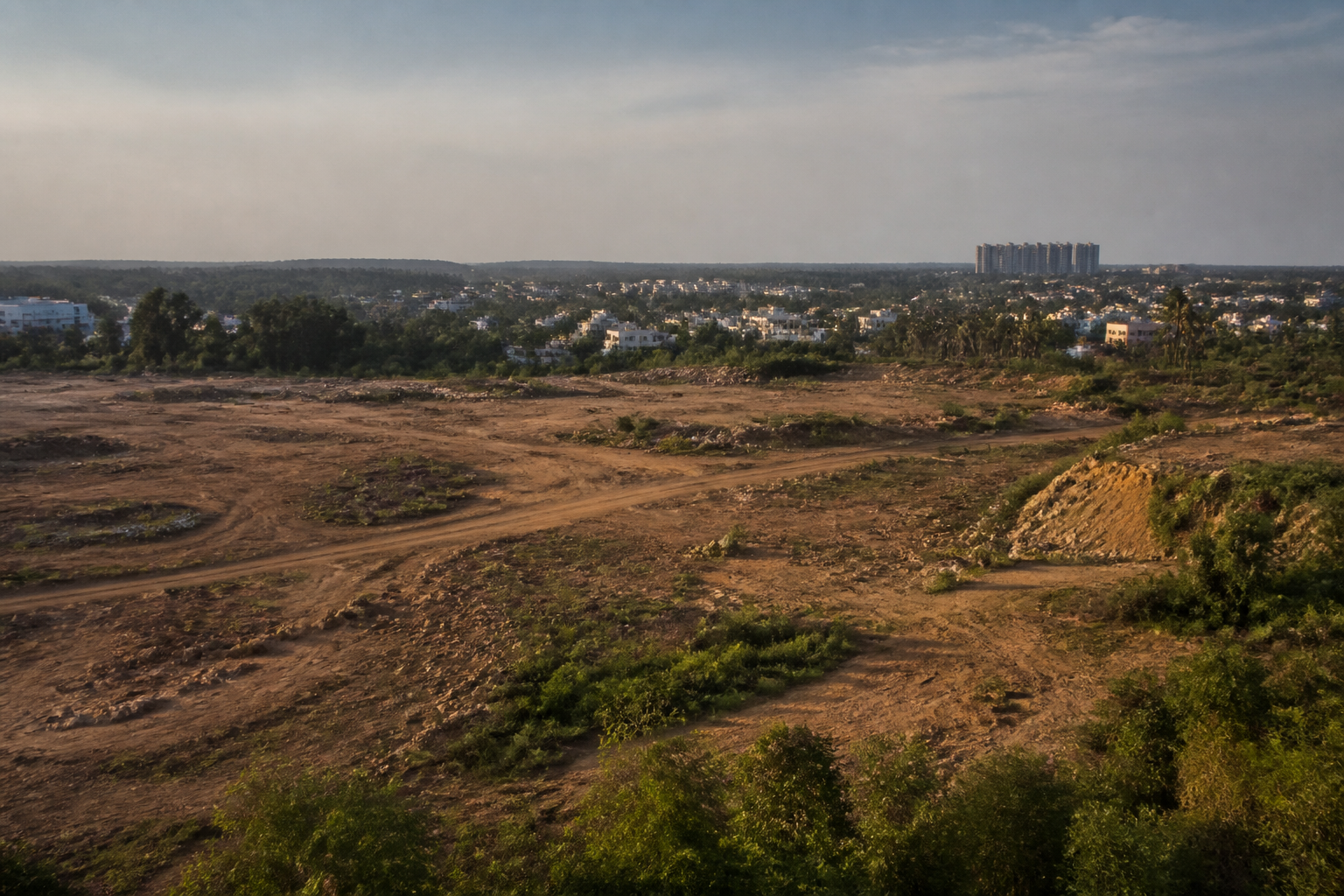
The tender for Bengaluru’s proposed international cricket stadium has been finalised, but the project now moves into a more consequential phase: converting a contested land parcel and an awarded contract into a legally and environmentally compliant public asset.
The Karnataka Housing Board has awarded the construction contract to Mumbai-based J Kumar Infraprojects Ltd for Rs 990.16 crore. The proposed stadium, planned across 75 acres in Suryanagar Phase 4 in Anekal taluk, is designed to accommodate about 80,000 spectators. Yet construction has not started, and the Housing Board has not issued the work order.
That sequence matters. The tender decision establishes a contractor, but it does not by itself establish that the full site is available, that all approvals are complete or that construction can begin immediately. According to the source report, the remaining steps include finalising an engineering, procurement and construction agreement, obtaining approvals from the Housing Board and the state government, and securing environmental clearance through the contractor’s responsibilities under the EPC arrangement.
The stadium therefore sits at the intersection of three processes: a large public-facing sports infrastructure project, a land-acquisition programme and an environmental approval framework. The tender has advanced, but the project’s readiness remains dependent on decisions outside the bid evaluation itself.
The tender figures show how the contract was awarded. Two major infrastructure companies participated. J Kumar Infraprojects submitted a bid of Rs 1,127.90 crore, while NCC Ltd quoted Rs 1,225.55 crore. The lower bidder was ultimately awarded the contract for Rs 990.16 crore, according to the report.
The total project cost is stated as Rs 1,241 crore. Of this, the infrastructure works were tendered at an estimated cost of Rs 943.46 crore on April 8. The difference between the infrastructure tender estimate, the awarded contract value and the total project cost reflects the fact that the overall project includes more than the core construction package. The supplied material does not provide a detailed cost breakdown for the balance amount.
The proposed stadium was formally launched with a foundation-stone ceremony on May 23, conducted by former chief minister Siddaramaiah. It is intended to become the country’s second-largest cricket stadium after Ahmedabad’s Narendra Modi Stadium if completed at the planned capacity.
The financing model is also unusual in the context of a project of this scale. The state government is reportedly not providing a separate grant for the stadium. Instead, the Karnataka Housing Board plans to mobilise the funds through the disposal of its own assets, including sites and houses. The project is thus linked to the Housing Board’s ability to generate and deploy its internal resources rather than to a separately identified state budget allocation.
That arrangement places the stadium within a wider urban-development balance sheet. The institution responsible for housing land and property development is also financing a major sports facility through asset sales. The supplied material does not establish whether the planned asset disposals have already generated the full amount required, nor does it specify the schedule on which those sales will fund construction payments.
The land position is similarly incomplete. The stadium requires 75 acres. Of that, 53 acres and 14 guntas have been set aside from 401 acres and 31 guntas already acquired by the Housing Board in Indlawadi village. The land has an assessed award value of Rs 95,52,328 per acre.
For landowners, the government is expected to provide developed sites under a 50:50 arrangement and an advance payment of Rs 20 lakh per acre under a 2020 order, according to the report. A further 21 acres and 26 guntas are being pursued in Indlawadi village. A preliminary notification has reportedly been issued under Section 11(1) of the land-acquisition law, while the process for a final notification under directions associated with Section 15(3) is under way.
This means that the land needed for the stadium is not presented as a single, fully consolidated parcel in the supplied material. A substantial portion has been identified from land already acquired by the Housing Board, while the balance is still moving through the acquisition process. The distinction is important because a contract award can progress independently of the final availability of every acre required for the project.
The land issue has acquired greater significance after the Karnataka High Court cancelled the acquisition of 1,938.13 acres obtained by the Housing Board for the Suryanagar Phase 4 housing project. The source report links that order to concerns over the project’s location within the 268.96-square-kilometre eco-sensitive zone of Bannerghatta National Park.
The report states that the Central Empowered Committee had identified shortcomings involving scientific study, environmental impact assessment and the consideration of social and ecological factors in the wider acquisition process. The supplied material does not reproduce the full court order or explain the precise legal distinction between the cancelled housing acquisition and the land being assembled for the stadium. That distinction will be important in determining how the court’s decision affects the stadium site and its approvals.
The Housing Board’s position, as quoted in the report, is that the court order will not affect the entire housing-project area in a way that prevents the stadium from proceeding. A senior official said construction would begin within two months and would be completed within three years. The official also said that the delay in issuing the work order resulted from the EPC contracting process and the need to complete approvals.
Under the proposed EPC model, the contractor will be responsible for the project’s planning, design, infrastructure engineering, procurement and construction. The contractor will also be responsible for obtaining environmental approval, according to the Housing Board official quoted in the report. The agreement must first be completed with the contractor and then approved by the Housing Board and the state government.
That structure transfers a substantial part of project coordination to the contractor, but it does not remove the public authority’s role. The Housing Board remains central to land availability, institutional approvals, financing through asset disposal and the formal issue of the work order. The state government also has an approval role under the process described by the official.
The project’s environmental question is therefore not limited to whether the stadium itself occupies 75 acres. It also concerns the legal and ecological setting in which the site is being assembled. The source material establishes that the wider Suryanagar acquisition was challenged on environmental grounds, but it does not establish the outcome of every approval specifically required for the stadium. It also does not provide the stadium’s traffic plan, water demand, waste-management arrangements, drainage design or public-transport strategy.
Those omissions are significant for a stadium of about 80,000 seats. A facility of that scale is not only a building; it is an urban system that requires access roads, crowd management, public transport, parking, emergency services, utilities and event-day operations. None of these supporting systems is detailed in the supplied report. Their absence from the available information does not prove that they have not been planned, but it means the project cannot yet be assessed comprehensively on the basis of the tender award alone.
The stadium also raises a question about how Bengaluru expands its major public facilities. The proposed site is in Anekal taluk, outside the city’s established central sporting districts. A peripheral location may provide the large land area required for an 80,000-seat venue, but it also makes connectivity and the relationship between the stadium and surrounding development central to the project’s eventual performance. The supplied material does not include a location-specific mobility assessment, so the consequences for travel times, congestion and neighbourhood access remain unestablished.
What is clear is that the project has moved beyond an announcement but has not yet reached construction. The contractor has been selected, the planned capacity and site area have been identified, and the Housing Board has stated a three-year construction period after work begins. At the same time, the work order is pending, a portion of the required land is still in the acquisition process and the environmental-approval pathway remains part of the EPC implementation sequence.
The next test is therefore procedural rather than ceremonial. The Housing Board and the state government must complete the contract and approval process, clarify the status of the remaining land and issue the work order. The project’s progress will also need to be read alongside the legal and environmental questions surrounding the larger Suryanagar development. Until those steps are documented, the tender award confirms an intended construction pathway, not a completed project or an unconditional start to work.
