


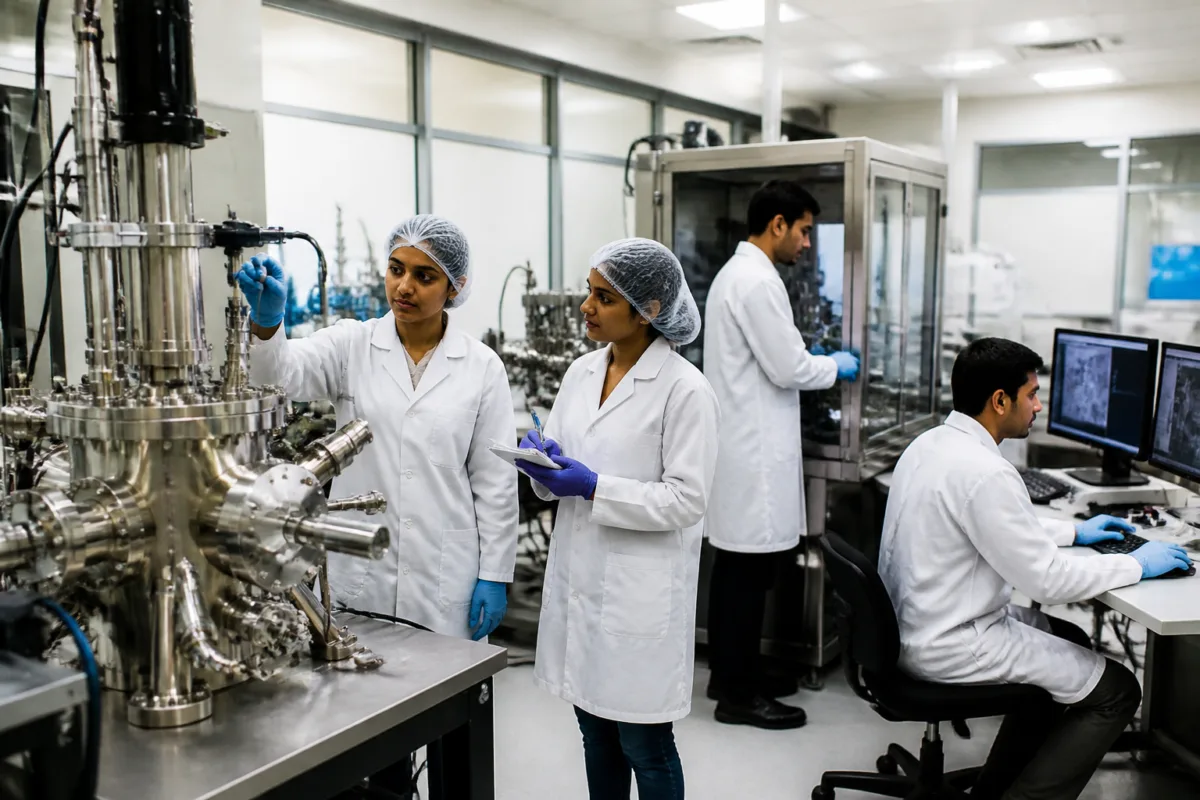
Mumbai University research equipment at the National Centre for Nanosciences and Nanotechnology (NCNNUM) will be repaired and upgraded with a Rs 9.75 crore grant sanctioned by the Maharashtra government, reviving a shared scientific facility on the university’s Kalina campus.
The funding will support the restoration of sophisticated instruments that have required critical component replacements, hardware repairs and software upgrades. The equipment is used for research in nanoscience, materials science, electronics, energy and related disciplines.
Mumbai University’s NCNNUM was established in 2007 with an investment of nearly Rs 100 crore as a national-level advanced research facility. It houses scientific equipment valued at approximately Rs 70 crore, along with cleanroom facilities commissioned in 2013. The university had approached the state government for financial assistance to restore the infrastructure and protect the public investment already made in the centre.
The grant will cover repairs and upgrades to instruments including an X-ray Photoelectron Spectrometer, Scanning Probe Microscope, X-ray Diffractometer and Micro Raman Spectrometer. Once operational, the facilities are expected to be available to students, research scholars and faculty members at Mumbai University, as well as scientists from other institutions.
Vice-chancellor Ravindra Kulkarni said the support would help revive critical scientific infrastructure and widen access to advanced research facilities. “The support will not only benefit our students, research scholars and faculty members but will also provide the wider scientific community across the country with access to advanced research facilities,” he said.
The centre functions as a shared research facility and is also working to strengthen industry collaborations and support start-ups developing affordable technological solutions. Its research areas include quantum devices, semiconductor materials, computational nanotechnology, nanomaterials for energy, food and agriculture, and nanobiotechnology.
Among the newer facilities at the centre is a lithium-ion battery recycling laboratory with a 20-litre pilot-scale plant. The laboratory is intended to develop economical and sustainable methods to recover valuable materials from used batteries for reuse. The university expects the upgraded instruments and newer laboratories to create additional opportunities for interdisciplinary research and for students and scientists working on emerging technologies.

