


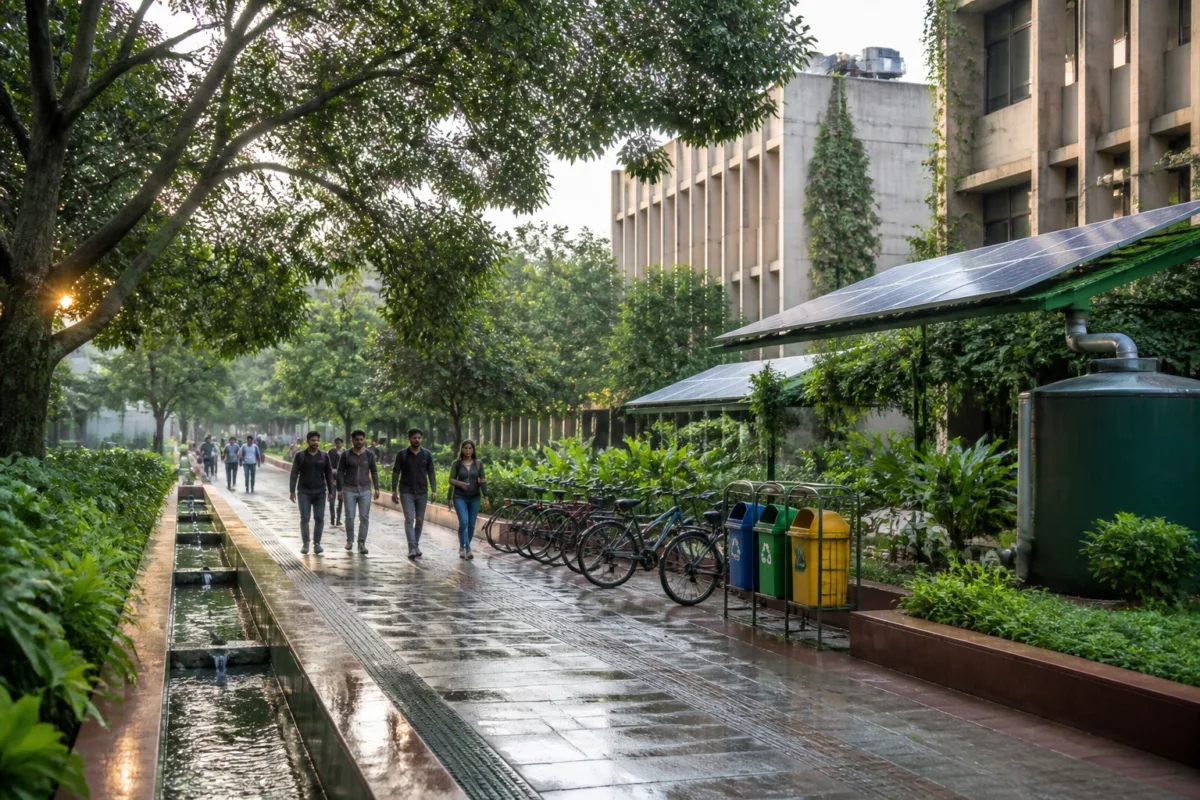
IIT Delhi’s rise to the top position among Indian institutions in the QS World University Rankings: Sustainability 2027 is significant not only because of its improved global standing, but also because the institute has tied its performance to changes in campus operations. Its stated targets—net-zero water use and eliminating waste sent to landfills—place everyday resource management at the centre of an institutional sustainability programme.
The institute ranked 194th globally, up from 205th in the previous ranking, and moved from 24th to 19th in Asia. Its overall sustainability score increased from 83.1 to 86.5 in a year. The ranking provides a visible measure of progress, but the more consequential question for the built environment is how such improvements are produced and whether they can be sustained through routine systems rather than isolated projects.
IIT Delhi has constituted a sustainability task force to coordinate changes in campus operations and monitor progress. According to the institute, its work covers renewable energy generation, energy efficiency, water conservation, waste management and green mobility. This institutional arrangement matters because sustainability on a large campus is not limited to installing equipment or conducting research. It requires coordination between facilities, academic departments, administrators, service providers and the people who use the campus every day.
Professor Somnath Baidya Roy, dean of planning and head of the ranking cell at IIT Delhi, said sustainability was a top priority and that the task force had been created to guide the institute’s transition towards a sustainable campus. His statement connects the ranking result to an internal governance mechanism rather than presenting the score as an isolated achievement.
The institute’s two long-term operational targets also reveal the practical pressures facing urban campuses. Net-zero water use requires attention to the full water cycle: collection, consumption, treatment, reuse and recharge. IIT Delhi said its measures include rainwater collection, groundwater replenishment and wastewater reuse. These interventions address both supply and discharge, although the supplied information does not establish the current volume of water used, the proportion being reused or the timeline for reaching the target.
The proposed shift towards net-zero water use is therefore best understood as an operational transition rather than a single infrastructure project. Rainwater collection can reduce dependence on external supplies during suitable weather conditions, while wastewater reuse can lower demand for fresh water if treatment and distribution systems function reliably. Groundwater replenishment addresses the relationship between the campus and the wider hydrological system. Together, these measures position the campus as a managed water landscape rather than merely a consumer of municipal or institutional supplies.
Waste management follows a similar logic. IIT Delhi said it segregates waste so that organic material can be composted and recyclable material can be sent for processing. Its stated ambition is to eliminate waste sent to landfills. That goal depends on more than segregation infrastructure. It also requires consistent collection practices, sufficient processing capacity and systems that prevent recyclable or organic material from being mixed with residual waste. The source does not provide a baseline for landfill-bound waste or a date by which the target is expected to be achieved, leaving implementation progress to be measured in future reporting.
The sustainability programme also includes renewable energy generation and energy efficiency. The institute is working with partners on clean energy initiatives, while a collaboration with the International Solar Alliance covers renewable energy deployment and skills development for the solar sector. The partnership is relevant to cities because the clean-energy transition requires both physical systems and trained people who can design, operate and maintain them. However, the available report does not specify the capacity of renewable energy installations at IIT Delhi or the amount of energy they currently supply.
The institute’s research partnerships extend the sustainability agenda beyond its own premises. IIT Delhi and Schmidt Sciences are working through a research frontier networks programme on the Net Zero India Project. Led by the institute’s School of Public Policy, the project aims to examine how different technologies could be used across regions to help India reach net-zero emissions by 2070. The emphasis on regional application is important because energy systems, climate risks and infrastructure conditions differ across India. The supplied material does not identify the technologies being assessed or the regions covered by the project.
A separate collaboration with TU Delft focuses on mitigating urban flooding and heat and developing climate-resilient infrastructure for energy transitions. These concerns are directly connected to the way Indian cities are being built and managed. Flooding and extreme heat affect roads, buildings, public spaces, utilities and mobility systems, while the energy transition introduces new demands on infrastructure. The collaboration indicates that IIT Delhi’s sustainability work is not confined to campus management; it also engages with urban risks that require planning and engineering responses.
The relationship between research and operations is central to the institute’s model. A campus can function as a place where technologies and management practices are tested under real conditions, while research can help evaluate how those practices might be adapted elsewhere. Yet the report does not establish that IIT Delhi’s campus initiatives have already been replicated at scale. That distinction is important: institutional leadership in sustainability can create demonstration value, but wider urban impact depends on implementation beyond the campus boundary.
The institute’s partnership with Jindal Steel to establish a Nodal Centre of Excellence adds a materials and construction dimension. The centre will focus on structural steel research, design innovation and skills development. Structural materials influence the safety, durability and resource use of buildings and infrastructure. The available information does not state what projects the centre will undertake or how its work will affect construction practices, but its creation places material research within the broader sustainability and energy-transition agenda.
IIT Delhi has also identified accessibility, gender equity and rural development among its community initiatives. These areas broaden the meaning of sustainability beyond energy, water and waste. Accessibility concerns how people move through and use institutional spaces. Gender equity concerns participation and access within the community. Rural development connects technical institutions with communities where infrastructure, livelihoods and resource access may be more constrained.
The institute’s role as the National Coordinating Institute for Unnat Bharat Abhiyan provides an institutional channel for this wider engagement. It works with higher education institutions and rural communities on solutions involving energy, water and livelihoods. This suggests a model in which sustainability knowledge is linked to local needs rather than being limited to high-technology campus interventions. The supplied report does not provide details on the number of participating institutions or communities, or on the outcomes of those interventions.
The ranking result therefore captures only one part of the story. IIT Delhi’s improved score and global position provide a benchmark, while the task force, operational targets and partnerships describe the machinery behind the result. The credibility of the programme will ultimately depend on whether targets are supported by transparent baselines, regular monitoring and evidence of reduced resource use and landfill disposal. Those details are not included in the current report.
For urban India, the larger question is whether campuses, industrial institutions and other large landholders can operate as resource-efficient systems while contributing knowledge to the cities and regions around them. IIT Delhi’s stated approach brings water, waste, energy, mobility, climate resilience, materials and social inclusion into one institutional framework. Its next test will be the transition from announced goals and partnerships to measurable operational outcomes. The institute’s future progress on net-zero water, landfill diversion and climate-resilient infrastructure will show how far its sustainability leadership extends beyond a ranking position.

